
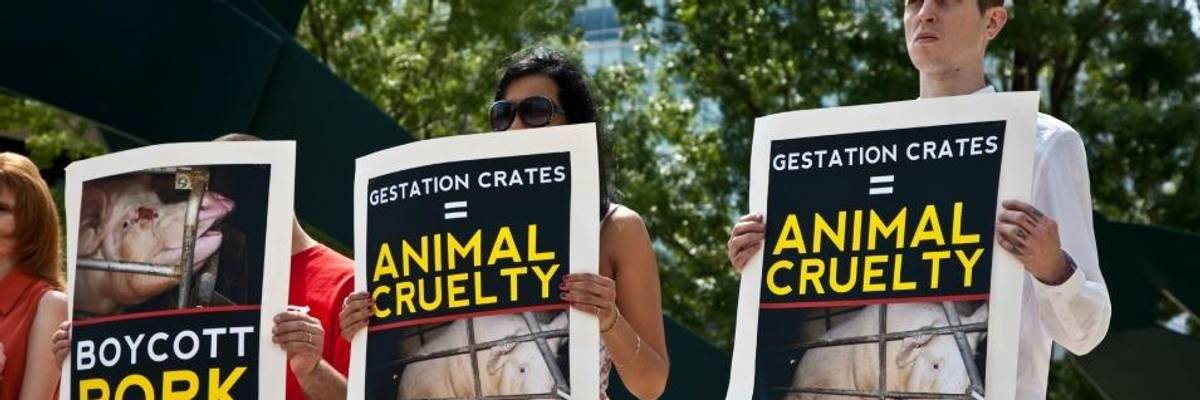
Animal rights supporters hold up signs at a pork expo protest in June 2012. (Photo: Justin Norman/flickr/cc)
New Report Exposes "Big Ag's Gag Agenda"
"Ag-Gag Across America" report from civil liberties groups documents rise of—and ALEC's hand behind—dissent-crushing laws
A new report puts a spotlight on so-called "ag-gag" laws, offering a clear look at how these efforts to criminalize whistleblowing "are part of a sweeping crackdown on dissent."
Released Wednesday by the Center for Constitutional Rights (CCR) and Defending Rights & Dissent, "Ag-Gag Across America Corporate-Backed Attacks on Activists and Whistleblowers" details the first part of the crackdown--"the Green Scare"--that emerged in 1990, and a second wave that erupted in 2011, as well as legal challenges they have faced and successful efforts to defeat them.
"States must not be allowed to shield the disturbing reality of animal agriculture from public scrutiny," said CCR senior staff attorney Rachel Meeropol. "Documenting what actually happens on factory farms is not a crime."
Though they've taken on different forms in different states, the report find that these laws all include at least one of these elements: prohibiting documentation of agricultural practices; prohibiting misrepresentations in job applications utilized to gain access to closed facilities; and requiring immediate reporting of illegal animal cruelty.
Kansas has dubious distinction of having passed the first ag-gag law in 1990. It bars destruction of property at an "animal facility" and "enter[ing] an animal facility to take pictures by photograph, video camera, or by any other means . . . without the effective consent of the owner and with the intent to damage the enterprise conducted at the animal facility."
That law, along with ones ones in Montana and North Dakota, served to "legitimiz[e] the idea that animal industries should receive special protection, that animal rights activists should be singled out for special punishment, and that documentation of animal agriculture should be criminalized," the report argues.
Another important development that guided the second wave was Congress's passage of the Animal Enterprise Protection Act (later amended as the Animal Enterprise Terrorism Act), which criminalizes animal and environment advocacy by equating it with terrorism, as well as the American Legislative Exchange Council- (ALEC-) drafted Animal and Ecological Terrorism Act model legislation. It "would not only criminalize undercover investigations and whistleblowing, it would require those convicted under the law to register with the state attorney general as terrorists," the report states.
In 2011, states witnessed a resurgence of ag-gag laws, the report says, and while most have failed, nearly half of the states in the country considered getting them on the books.
There was a clear pattern to their emergence, the report says:
animal welfare and animal rights organizations would conduct undercover investigations at animal agriculture facilities, documenting violence and sometimes uncovering actions that violate state animal cruelty laws. Lawmakers would respond not by aiming to prevent the abuse, but by criminalizing the types of investigations that brought the violence to light. Politicians and industry representatives working to enact ag-gag laws have employed the rhetoric of the Green Scare, complete with condemning undercover animal rights investigators as "terrorists."
Take Utah, which in 2012 passed the Agricultural Interference Act, which penalized recording of an agricultural operation or accessing such an operation "under false pretenses." It "also has the dubious honor of being the only state to ever attempt to prosecute someone under its ag-gag law--twice."
Another emergence in the second wave was the expanding scope of the laws, such as Wyoming's "data trespass," which barred the collection of data on open land with the intent to submit that data to a federal or state regulatory agency, even if that data would be helpful to that agency.
The law seemed to specifically target the efforts undertaken by citizen scientist Jonathan Ratner, who tested streams in the state for E.coli and sent that on to regulatory bodies. That bacteria, report notes, "is of particular concern in Wyoming, because the state is home to 1.3 million cows whose waste often makes its way into streams, creating a potential health hazard." The bill was notably backed by the Wyoming Farm Bureau Federation.
Most recently, in March 2017, Arkansas signed a sweeping ag-gag law, which imposes civil liability for making a recording "a nonpublic area of a commercial property" that has information that "damages the employer." As such it would seem to bar any whistleblower from making public abusive practices.
There's good news in the report as well: "Between 2012 and 2014, activists defeated ag-gag bills in 20 states, many repeatedly."
Among the victories was in Florida in 2011, which had "one of the most severe and far-reaching ag-gag bills in the country." In its first iteration, it would have made a first degree felony taking a photo video of an agricultural facility without the owner's consent, even if the image was taken from a public road. Despite its failure, Sen. Jim Norman, at the behest of egg farmer Wilton Simpson, put that same ag-gag language into agriculture omnibus bill. After pressure from animal activists, the ag-gag language was omitted from the bill.
All the ag-gag laws, the report says, don't pass muster with the Constitution. The First Amendment requires that prohibitions on speech be content and viewpoint neutral, and "ag-gag laws target the press's ability to report on the agricultural industry." They also violate the guarantee of Equal Protection, "as legislatures made no secret of their dislike of animal rights activists, whistleblowers, and undercover investigators. Many ag-gag laws are explicitly motivated by animus against animal rights activists."
"Ag-gag laws not only make it more difficult to expose animal cruelty or unsafe food; they are at their core an assault on free speech," added Defending Rights & Dissent policy and legislative counsel Chip Gibbons. "It is unacceptable for lawmakers to side with powerful corporate interests at the expense of peoples' constitutional rights."
The report concludes that "the public has a right to know how food is produced, what animal agriculture entails, and if the rivers and streams they depend on are polluted."
"The violence consistently documented by investigators and the trampling of the First Amendment by those working to enact these laws make clear why Big Ag's gag agenda must not be allowed to succeed."
We are at a crossroads
This country and this world are at a monumental crossroads. In a few short weeks, US voters will have an opportunity to beat back the forces of fascism and confront the billionaires who are rigging the economy, our media system, and our democracy, making it increasingly impossible for ordinary people to get by. We’re not just talking about the election. We’re talking about what must be done once these fascist elements are vanquished from power. We need a bolder set of solutions than what either major party has so far been willing to offer and a working-class movement ready to fight like hell for it. Trump didn't emerge from nowhere. The conditions that fueled MAGA authoritarianism were created by decades of radical neoliberal economic policies and a corrupt political system dominated by corporate interests. They slashed taxes on the super-rich, promising that the benefits would trickle down. They said giveaways to the corporate titans would make life more affordable for the rest of us. It was all bullshit. And when a bitter, betrayed populace searches for someone to blame, right-wing demagogues have little trouble finding scapegoats. People know when they're being lied to, but you won't hear any of this from the corporate media. Only independent journalism—powered and funded by people who believe in building a better world—can deliver truly trustworthy daily news. Our Fall Campaign is underway, and we need your help. To power our newsroom through the rest of the year, we need to raise $125,000 by midnight on October 31. So if you share our vision, please contribute whatever you can to sustain our work. |
A new report puts a spotlight on so-called "ag-gag" laws, offering a clear look at how these efforts to criminalize whistleblowing "are part of a sweeping crackdown on dissent."
Released Wednesday by the Center for Constitutional Rights (CCR) and Defending Rights & Dissent, "Ag-Gag Across America Corporate-Backed Attacks on Activists and Whistleblowers" details the first part of the crackdown--"the Green Scare"--that emerged in 1990, and a second wave that erupted in 2011, as well as legal challenges they have faced and successful efforts to defeat them.
"States must not be allowed to shield the disturbing reality of animal agriculture from public scrutiny," said CCR senior staff attorney Rachel Meeropol. "Documenting what actually happens on factory farms is not a crime."
Though they've taken on different forms in different states, the report find that these laws all include at least one of these elements: prohibiting documentation of agricultural practices; prohibiting misrepresentations in job applications utilized to gain access to closed facilities; and requiring immediate reporting of illegal animal cruelty.
Kansas has dubious distinction of having passed the first ag-gag law in 1990. It bars destruction of property at an "animal facility" and "enter[ing] an animal facility to take pictures by photograph, video camera, or by any other means . . . without the effective consent of the owner and with the intent to damage the enterprise conducted at the animal facility."
That law, along with ones ones in Montana and North Dakota, served to "legitimiz[e] the idea that animal industries should receive special protection, that animal rights activists should be singled out for special punishment, and that documentation of animal agriculture should be criminalized," the report argues.
Another important development that guided the second wave was Congress's passage of the Animal Enterprise Protection Act (later amended as the Animal Enterprise Terrorism Act), which criminalizes animal and environment advocacy by equating it with terrorism, as well as the American Legislative Exchange Council- (ALEC-) drafted Animal and Ecological Terrorism Act model legislation. It "would not only criminalize undercover investigations and whistleblowing, it would require those convicted under the law to register with the state attorney general as terrorists," the report states.
In 2011, states witnessed a resurgence of ag-gag laws, the report says, and while most have failed, nearly half of the states in the country considered getting them on the books.
There was a clear pattern to their emergence, the report says:
animal welfare and animal rights organizations would conduct undercover investigations at animal agriculture facilities, documenting violence and sometimes uncovering actions that violate state animal cruelty laws. Lawmakers would respond not by aiming to prevent the abuse, but by criminalizing the types of investigations that brought the violence to light. Politicians and industry representatives working to enact ag-gag laws have employed the rhetoric of the Green Scare, complete with condemning undercover animal rights investigators as "terrorists."
Take Utah, which in 2012 passed the Agricultural Interference Act, which penalized recording of an agricultural operation or accessing such an operation "under false pretenses." It "also has the dubious honor of being the only state to ever attempt to prosecute someone under its ag-gag law--twice."
Another emergence in the second wave was the expanding scope of the laws, such as Wyoming's "data trespass," which barred the collection of data on open land with the intent to submit that data to a federal or state regulatory agency, even if that data would be helpful to that agency.
The law seemed to specifically target the efforts undertaken by citizen scientist Jonathan Ratner, who tested streams in the state for E.coli and sent that on to regulatory bodies. That bacteria, report notes, "is of particular concern in Wyoming, because the state is home to 1.3 million cows whose waste often makes its way into streams, creating a potential health hazard." The bill was notably backed by the Wyoming Farm Bureau Federation.
Most recently, in March 2017, Arkansas signed a sweeping ag-gag law, which imposes civil liability for making a recording "a nonpublic area of a commercial property" that has information that "damages the employer." As such it would seem to bar any whistleblower from making public abusive practices.
There's good news in the report as well: "Between 2012 and 2014, activists defeated ag-gag bills in 20 states, many repeatedly."
Among the victories was in Florida in 2011, which had "one of the most severe and far-reaching ag-gag bills in the country." In its first iteration, it would have made a first degree felony taking a photo video of an agricultural facility without the owner's consent, even if the image was taken from a public road. Despite its failure, Sen. Jim Norman, at the behest of egg farmer Wilton Simpson, put that same ag-gag language into agriculture omnibus bill. After pressure from animal activists, the ag-gag language was omitted from the bill.
All the ag-gag laws, the report says, don't pass muster with the Constitution. The First Amendment requires that prohibitions on speech be content and viewpoint neutral, and "ag-gag laws target the press's ability to report on the agricultural industry." They also violate the guarantee of Equal Protection, "as legislatures made no secret of their dislike of animal rights activists, whistleblowers, and undercover investigators. Many ag-gag laws are explicitly motivated by animus against animal rights activists."
"Ag-gag laws not only make it more difficult to expose animal cruelty or unsafe food; they are at their core an assault on free speech," added Defending Rights & Dissent policy and legislative counsel Chip Gibbons. "It is unacceptable for lawmakers to side with powerful corporate interests at the expense of peoples' constitutional rights."
The report concludes that "the public has a right to know how food is produced, what animal agriculture entails, and if the rivers and streams they depend on are polluted."
"The violence consistently documented by investigators and the trampling of the First Amendment by those working to enact these laws make clear why Big Ag's gag agenda must not be allowed to succeed."
A new report puts a spotlight on so-called "ag-gag" laws, offering a clear look at how these efforts to criminalize whistleblowing "are part of a sweeping crackdown on dissent."
Released Wednesday by the Center for Constitutional Rights (CCR) and Defending Rights & Dissent, "Ag-Gag Across America Corporate-Backed Attacks on Activists and Whistleblowers" details the first part of the crackdown--"the Green Scare"--that emerged in 1990, and a second wave that erupted in 2011, as well as legal challenges they have faced and successful efforts to defeat them.
"States must not be allowed to shield the disturbing reality of animal agriculture from public scrutiny," said CCR senior staff attorney Rachel Meeropol. "Documenting what actually happens on factory farms is not a crime."
Though they've taken on different forms in different states, the report find that these laws all include at least one of these elements: prohibiting documentation of agricultural practices; prohibiting misrepresentations in job applications utilized to gain access to closed facilities; and requiring immediate reporting of illegal animal cruelty.
Kansas has dubious distinction of having passed the first ag-gag law in 1990. It bars destruction of property at an "animal facility" and "enter[ing] an animal facility to take pictures by photograph, video camera, or by any other means . . . without the effective consent of the owner and with the intent to damage the enterprise conducted at the animal facility."
That law, along with ones ones in Montana and North Dakota, served to "legitimiz[e] the idea that animal industries should receive special protection, that animal rights activists should be singled out for special punishment, and that documentation of animal agriculture should be criminalized," the report argues.
Another important development that guided the second wave was Congress's passage of the Animal Enterprise Protection Act (later amended as the Animal Enterprise Terrorism Act), which criminalizes animal and environment advocacy by equating it with terrorism, as well as the American Legislative Exchange Council- (ALEC-) drafted Animal and Ecological Terrorism Act model legislation. It "would not only criminalize undercover investigations and whistleblowing, it would require those convicted under the law to register with the state attorney general as terrorists," the report states.
In 2011, states witnessed a resurgence of ag-gag laws, the report says, and while most have failed, nearly half of the states in the country considered getting them on the books.
There was a clear pattern to their emergence, the report says:
animal welfare and animal rights organizations would conduct undercover investigations at animal agriculture facilities, documenting violence and sometimes uncovering actions that violate state animal cruelty laws. Lawmakers would respond not by aiming to prevent the abuse, but by criminalizing the types of investigations that brought the violence to light. Politicians and industry representatives working to enact ag-gag laws have employed the rhetoric of the Green Scare, complete with condemning undercover animal rights investigators as "terrorists."
Take Utah, which in 2012 passed the Agricultural Interference Act, which penalized recording of an agricultural operation or accessing such an operation "under false pretenses." It "also has the dubious honor of being the only state to ever attempt to prosecute someone under its ag-gag law--twice."
Another emergence in the second wave was the expanding scope of the laws, such as Wyoming's "data trespass," which barred the collection of data on open land with the intent to submit that data to a federal or state regulatory agency, even if that data would be helpful to that agency.
The law seemed to specifically target the efforts undertaken by citizen scientist Jonathan Ratner, who tested streams in the state for E.coli and sent that on to regulatory bodies. That bacteria, report notes, "is of particular concern in Wyoming, because the state is home to 1.3 million cows whose waste often makes its way into streams, creating a potential health hazard." The bill was notably backed by the Wyoming Farm Bureau Federation.
Most recently, in March 2017, Arkansas signed a sweeping ag-gag law, which imposes civil liability for making a recording "a nonpublic area of a commercial property" that has information that "damages the employer." As such it would seem to bar any whistleblower from making public abusive practices.
There's good news in the report as well: "Between 2012 and 2014, activists defeated ag-gag bills in 20 states, many repeatedly."
Among the victories was in Florida in 2011, which had "one of the most severe and far-reaching ag-gag bills in the country." In its first iteration, it would have made a first degree felony taking a photo video of an agricultural facility without the owner's consent, even if the image was taken from a public road. Despite its failure, Sen. Jim Norman, at the behest of egg farmer Wilton Simpson, put that same ag-gag language into agriculture omnibus bill. After pressure from animal activists, the ag-gag language was omitted from the bill.
All the ag-gag laws, the report says, don't pass muster with the Constitution. The First Amendment requires that prohibitions on speech be content and viewpoint neutral, and "ag-gag laws target the press's ability to report on the agricultural industry." They also violate the guarantee of Equal Protection, "as legislatures made no secret of their dislike of animal rights activists, whistleblowers, and undercover investigators. Many ag-gag laws are explicitly motivated by animus against animal rights activists."
"Ag-gag laws not only make it more difficult to expose animal cruelty or unsafe food; they are at their core an assault on free speech," added Defending Rights & Dissent policy and legislative counsel Chip Gibbons. "It is unacceptable for lawmakers to side with powerful corporate interests at the expense of peoples' constitutional rights."
The report concludes that "the public has a right to know how food is produced, what animal agriculture entails, and if the rivers and streams they depend on are polluted."
"The violence consistently documented by investigators and the trampling of the First Amendment by those working to enact these laws make clear why Big Ag's gag agenda must not be allowed to succeed."