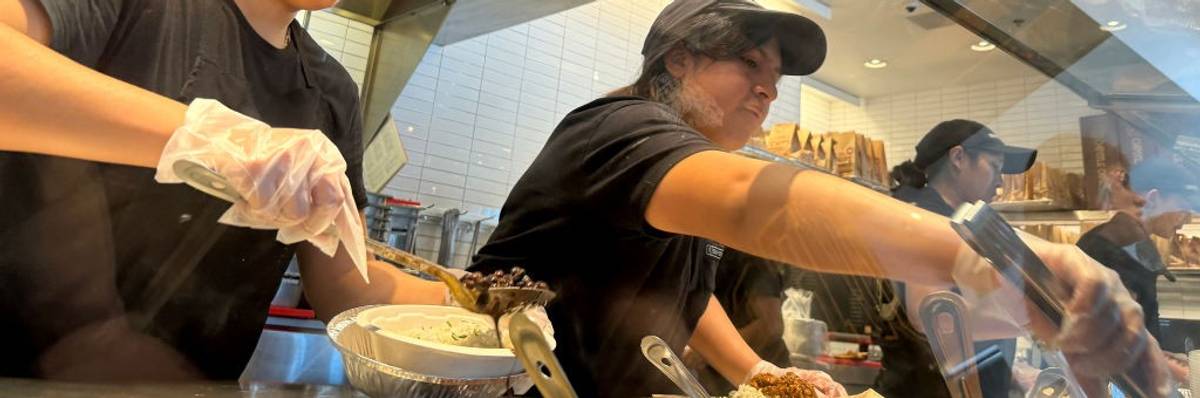
Workers fill food orders at a Chipotle restaurant in San Rafael, California on April 1, 2024.
California's $20 Fast Food Worker Minimum Wage Kicks In
"Fast food companies can afford to pay $20/hour without raising prices or cutting hours," said the California Fast Food Workers Union. "Doing either is a choice. Don't let them tell you otherwise."
A new California law raising the minimum wage for most fast food workers from $16 to $20 an hour took effect Monday, a move cheered by labor advocates who dismissed—and debunked—claims by an industry reaping record profits that the pay hike would force restaurant chains to raise prices and cut jobs.
The law applies to restaurants at national fast food chains with at least 60 locations and that have limited or no table service. Restaurants inside supermarkets and establishments that bake and sell bread are exempt. Twenty dollars is just a starting point, as a state law also established a Fast Food Council that can raise wages by up to 3.5% annually through 2029.
"The vast majority of fast food locations in California operate under the most profitable brands in the world," Joseph Bryant, executive vice president of the Service Employees International Union, said in a statement. "Those corporations need to pay their fair share and provide their operators with the resources they need to pay their workers a living wage without cutting jobs or passing the cost to consumers."
As the California Fast Food Workers Union noted:
- From 2015 to 2023, California raised the minimum wage by 72%, from $9 an hour to $15.50 an hour;
- While the minimum wage was rising, fast food restaurants in California added 142,000 jobs; and
- The minimum wage has increased every year in California since 2015, and so has the number of fast food jobs in California, except for 2020, when the Covid pandemic hit.
BREAKING: Today hundreds of fast food workers from across California are in LA to officially launch the California Fast Food Workers Union
We've won a Fast Food Council
We've won $20/hr
Now we're doing whatever it takes to win annual raises, just cause, and more#UnionsForAll pic.twitter.com/pykRKZF0PV
— California Fast Food Workers Union (@CAFastFoodUnion) February 9, 2024
The union highlighted various studies, including one in 2024 that found no fast food jobs were lost when California and New York increased their minimum wage to $15; another in 2018 that showed a slight increase in restaurant and food service employment in six cities that raised their minimum wage; and yet another in 2021 revealing hikes in state and local minimum wages had no effect on McDonald's opening or closing restaurants.
"According to the data, there's no reason why the new fast food minimum wage of $20 per hour in California should mean layoffs or increased prices," Alí Bustamante, deputy director for the Worker Power and Economic Security program at the Roosevelt Institute, said last week. "Profits in the fast food industry are sufficiently high to absorb the greater operating costs and ensure industry workers are paid fairly."
As More Perfect Union noted, McDonald's made $8.5 billion in profit last year, while Burger King's parent company raked in $1.2 billion, and Starbucks enjoyed $4.1 billion in profits.
Additionally, a new Roosevelt Institute analysis co-authored by Bustamante found that the 10 largest publicly traded fast food companies spent $6.1 billion on stock buybacks last year alone. This, while fast food prices soared by 46.8% over the past decade compared with 28.7% for the average of all prices. In 2023, fast food companies charged their customers 27% above their production costs. Critics have accused these and other corporations of "greedflation."
"In 2022, fast food industry employment in California had increased to approximately 553,000 workers—a 20.1% increase since 2014," the analysis notes. "Trends in the California fast food labor market have mirrored the national averages. Yet between 2014 and 2023, the federal minimum wage remained stagnant at $7.25 per hour, while California's minimum wage increased from $9 to $15.50 an hour—further evidence that California fast food firms can readily adjust to minimum wage increases."
The U.S. federal minimum wage of $7.25 an hour has not been raised since 2009, and that amount is worth far less now than it was then due to inflation.
"This is an insult to American workers and bad for our economy," former U.S. Labor Secretary Robert Reich said in a video published Monday by the Gravel Institute.
"It's simply a myth that raising the wage automatically means lost jobs," Reich asserted. "Here's the bottom line: If your business depends on paying your workers starvation wages, you should not be in business."
We are at a crossroads
This country and this world are at a monumental crossroads. In a few short weeks, US voters will have an opportunity to beat back the forces of fascism and confront the billionaires who are rigging the economy, our media system, and our democracy, making it increasingly impossible for ordinary people to get by. We’re not just talking about the election. We’re talking about what must be done once these fascist elements are vanquished from power. We need a bolder set of solutions than what either major party has so far been willing to offer and a working-class movement ready to fight like hell for it. Trump didn't emerge from nowhere. The conditions that fueled MAGA authoritarianism were created by decades of radical neoliberal economic policies and a corrupt political system dominated by corporate interests. They slashed taxes on the super-rich, promising that the benefits would trickle down. They said giveaways to the corporate titans would make life more affordable for the rest of us. It was all bullshit. And when a bitter, betrayed populace searches for someone to blame, right-wing demagogues have little trouble finding scapegoats. People know when they're being lied to, but you won't hear any of this from the corporate media. Only independent journalism—powered and funded by people who believe in building a better world—can deliver truly trustworthy daily news. Our Fall Campaign is underway, and we need your help. To power our newsroom through the rest of the year, we need to raise $125,000 by midnight on October 31. So if you share our vision, please contribute whatever you can to sustain our work. |
A new California law raising the minimum wage for most fast food workers from $16 to $20 an hour took effect Monday, a move cheered by labor advocates who dismissed—and debunked—claims by an industry reaping record profits that the pay hike would force restaurant chains to raise prices and cut jobs.
The law applies to restaurants at national fast food chains with at least 60 locations and that have limited or no table service. Restaurants inside supermarkets and establishments that bake and sell bread are exempt. Twenty dollars is just a starting point, as a state law also established a Fast Food Council that can raise wages by up to 3.5% annually through 2029.
"The vast majority of fast food locations in California operate under the most profitable brands in the world," Joseph Bryant, executive vice president of the Service Employees International Union, said in a statement. "Those corporations need to pay their fair share and provide their operators with the resources they need to pay their workers a living wage without cutting jobs or passing the cost to consumers."
As the California Fast Food Workers Union noted:
- From 2015 to 2023, California raised the minimum wage by 72%, from $9 an hour to $15.50 an hour;
- While the minimum wage was rising, fast food restaurants in California added 142,000 jobs; and
- The minimum wage has increased every year in California since 2015, and so has the number of fast food jobs in California, except for 2020, when the Covid pandemic hit.
BREAKING: Today hundreds of fast food workers from across California are in LA to officially launch the California Fast Food Workers Union
We've won a Fast Food Council
We've won $20/hr
Now we're doing whatever it takes to win annual raises, just cause, and more#UnionsForAll pic.twitter.com/pykRKZF0PV
— California Fast Food Workers Union (@CAFastFoodUnion) February 9, 2024
The union highlighted various studies, including one in 2024 that found no fast food jobs were lost when California and New York increased their minimum wage to $15; another in 2018 that showed a slight increase in restaurant and food service employment in six cities that raised their minimum wage; and yet another in 2021 revealing hikes in state and local minimum wages had no effect on McDonald's opening or closing restaurants.
"According to the data, there's no reason why the new fast food minimum wage of $20 per hour in California should mean layoffs or increased prices," Alí Bustamante, deputy director for the Worker Power and Economic Security program at the Roosevelt Institute, said last week. "Profits in the fast food industry are sufficiently high to absorb the greater operating costs and ensure industry workers are paid fairly."
As More Perfect Union noted, McDonald's made $8.5 billion in profit last year, while Burger King's parent company raked in $1.2 billion, and Starbucks enjoyed $4.1 billion in profits.
Additionally, a new Roosevelt Institute analysis co-authored by Bustamante found that the 10 largest publicly traded fast food companies spent $6.1 billion on stock buybacks last year alone. This, while fast food prices soared by 46.8% over the past decade compared with 28.7% for the average of all prices. In 2023, fast food companies charged their customers 27% above their production costs. Critics have accused these and other corporations of "greedflation."
"In 2022, fast food industry employment in California had increased to approximately 553,000 workers—a 20.1% increase since 2014," the analysis notes. "Trends in the California fast food labor market have mirrored the national averages. Yet between 2014 and 2023, the federal minimum wage remained stagnant at $7.25 per hour, while California's minimum wage increased from $9 to $15.50 an hour—further evidence that California fast food firms can readily adjust to minimum wage increases."
The U.S. federal minimum wage of $7.25 an hour has not been raised since 2009, and that amount is worth far less now than it was then due to inflation.
"This is an insult to American workers and bad for our economy," former U.S. Labor Secretary Robert Reich said in a video published Monday by the Gravel Institute.
"It's simply a myth that raising the wage automatically means lost jobs," Reich asserted. "Here's the bottom line: If your business depends on paying your workers starvation wages, you should not be in business."
A new California law raising the minimum wage for most fast food workers from $16 to $20 an hour took effect Monday, a move cheered by labor advocates who dismissed—and debunked—claims by an industry reaping record profits that the pay hike would force restaurant chains to raise prices and cut jobs.
The law applies to restaurants at national fast food chains with at least 60 locations and that have limited or no table service. Restaurants inside supermarkets and establishments that bake and sell bread are exempt. Twenty dollars is just a starting point, as a state law also established a Fast Food Council that can raise wages by up to 3.5% annually through 2029.
"The vast majority of fast food locations in California operate under the most profitable brands in the world," Joseph Bryant, executive vice president of the Service Employees International Union, said in a statement. "Those corporations need to pay their fair share and provide their operators with the resources they need to pay their workers a living wage without cutting jobs or passing the cost to consumers."
As the California Fast Food Workers Union noted:
- From 2015 to 2023, California raised the minimum wage by 72%, from $9 an hour to $15.50 an hour;
- While the minimum wage was rising, fast food restaurants in California added 142,000 jobs; and
- The minimum wage has increased every year in California since 2015, and so has the number of fast food jobs in California, except for 2020, when the Covid pandemic hit.
BREAKING: Today hundreds of fast food workers from across California are in LA to officially launch the California Fast Food Workers Union
We've won a Fast Food Council
We've won $20/hr
Now we're doing whatever it takes to win annual raises, just cause, and more#UnionsForAll pic.twitter.com/pykRKZF0PV
— California Fast Food Workers Union (@CAFastFoodUnion) February 9, 2024
The union highlighted various studies, including one in 2024 that found no fast food jobs were lost when California and New York increased their minimum wage to $15; another in 2018 that showed a slight increase in restaurant and food service employment in six cities that raised their minimum wage; and yet another in 2021 revealing hikes in state and local minimum wages had no effect on McDonald's opening or closing restaurants.
"According to the data, there's no reason why the new fast food minimum wage of $20 per hour in California should mean layoffs or increased prices," Alí Bustamante, deputy director for the Worker Power and Economic Security program at the Roosevelt Institute, said last week. "Profits in the fast food industry are sufficiently high to absorb the greater operating costs and ensure industry workers are paid fairly."
As More Perfect Union noted, McDonald's made $8.5 billion in profit last year, while Burger King's parent company raked in $1.2 billion, and Starbucks enjoyed $4.1 billion in profits.
Additionally, a new Roosevelt Institute analysis co-authored by Bustamante found that the 10 largest publicly traded fast food companies spent $6.1 billion on stock buybacks last year alone. This, while fast food prices soared by 46.8% over the past decade compared with 28.7% for the average of all prices. In 2023, fast food companies charged their customers 27% above their production costs. Critics have accused these and other corporations of "greedflation."
"In 2022, fast food industry employment in California had increased to approximately 553,000 workers—a 20.1% increase since 2014," the analysis notes. "Trends in the California fast food labor market have mirrored the national averages. Yet between 2014 and 2023, the federal minimum wage remained stagnant at $7.25 per hour, while California's minimum wage increased from $9 to $15.50 an hour—further evidence that California fast food firms can readily adjust to minimum wage increases."
The U.S. federal minimum wage of $7.25 an hour has not been raised since 2009, and that amount is worth far less now than it was then due to inflation.
"This is an insult to American workers and bad for our economy," former U.S. Labor Secretary Robert Reich said in a video published Monday by the Gravel Institute.
"It's simply a myth that raising the wage automatically means lost jobs," Reich asserted. "Here's the bottom line: If your business depends on paying your workers starvation wages, you should not be in business."