SUBSCRIBE TO OUR FREE NEWSLETTER
Daily news & progressive opinion—funded by the people, not the corporations—delivered straight to your inbox.
5
#000000
#FFFFFF
To donate by check, phone, or other method, see our More Ways to Give page.
Daily news & progressive opinion—funded by the people, not the corporations—delivered straight to your inbox.
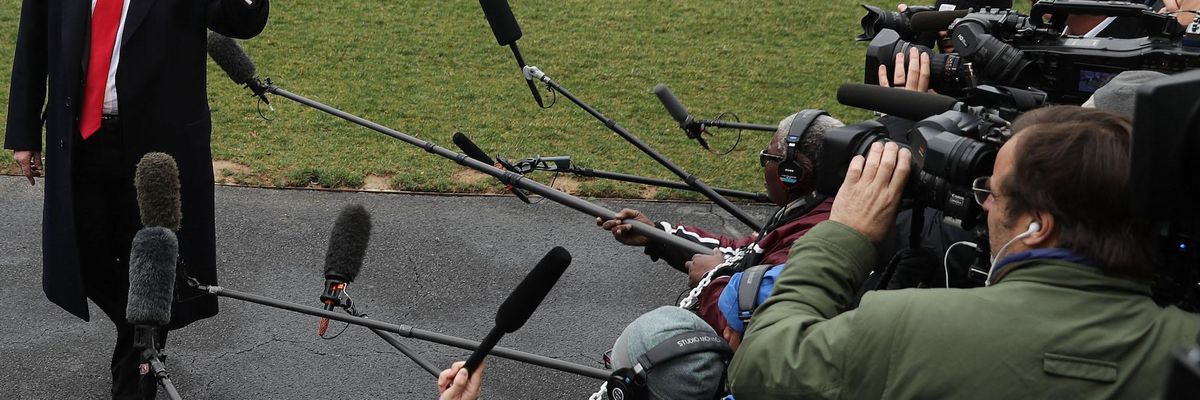
Then-President Donald Trump talks to reporters before departing the White House March 22, 2019 in Washington, D.C. (Photo: Chip Somodevilla/Getty Images)
A pair of Democratic lawmakers on Tuesday urged the Biden administration to revamp Justice Department guidelines to stop surveillance of journalists as a way to identify their sources.
The call came in a letter sent by Sen. Ron Wyden (D-Ore.) and Rep. Jamie Raskin (D-Md.) to Attorney General Merrick Garland in which they urged the administration to seize the "opportunity to voluntarily leave behind the thuggish and Orwellian abuses of power of the last administration, and stand up as a world leader for press freedoms."
The letter points to revelations by the Washington Post earlier this month that former President Donald Trump's Justice department, in early 2017, secretly seized phone records and tried to get email records of three Post reporters covering Russian interference in the 2016 election.
Biden's Justice Department defended the seizure and attempted seizure, the Post reported, with department spokesperson Marc Raimondi asserting the targets of the investigations were not the journalists "but rather those with access to the national defense information who provided it to the media and thus failed to protect it as lawfully required."
Wyden and Raskin noted that "in years past, the government would often attempt to force journalists to reveal their sources by dragging them into court."
"Now that most Americans carry always-on, always-recording smartphones, the government prefers to go to telecommunications companies, hoping that records of calls and texts might reveal the source," they wrote.
"While certainly more convenient for the government," they continued, "using subpoenas and surveillance orders to pry into a journalist's communications history is no less invasive and destructive than forcing a journalist to reveal their source."
"Simply put, the government should not collect journalists communications records unless it's investigating them for a crime or as part of an investigation into foreign espionage in which case it should get a warrant," wrote Wyden and Raskin.
The Democrats also wrote that they plan on introducing legislation in the coming months to shield journalists from being forced to reveal their sources.
A press statement from the lawmakers acknowledged that previous administrations have also sought to spy on reporters to identify sources and said, "It is past time that the United States end this invasive practice that threatens freedom of the press."
Dear Common Dreams reader, It’s been nearly 30 years since I co-founded Common Dreams with my late wife, Lina Newhouser. We had the radical notion that journalism should serve the public good, not corporate profits. It was clear to us from the outset what it would take to build such a project. No paid advertisements. No corporate sponsors. No millionaire publisher telling us what to think or do. Many people said we wouldn't last a year, but we proved those doubters wrong. Together with a tremendous team of journalists and dedicated staff, we built an independent media outlet free from the constraints of profits and corporate control. Our mission has always been simple: To inform. To inspire. To ignite change for the common good. Building Common Dreams was not easy. Our survival was never guaranteed. When you take on the most powerful forces—Wall Street greed, fossil fuel industry destruction, Big Tech lobbyists, and uber-rich oligarchs who have spent billions upon billions rigging the economy and democracy in their favor—the only bulwark you have is supporters who believe in your work. But here’s the urgent message from me today. It's never been this bad out there. And it's never been this hard to keep us going. At the very moment Common Dreams is most needed, the threats we face are intensifying. We need your support now more than ever. We don't accept corporate advertising and never will. We don't have a paywall because we don't think people should be blocked from critical news based on their ability to pay. Everything we do is funded by the donations of readers like you. When everyone does the little they can afford, we are strong. But if that support retreats or dries up, so do we. Will you donate now to make sure Common Dreams not only survives but thrives? —Craig Brown, Co-founder |
A pair of Democratic lawmakers on Tuesday urged the Biden administration to revamp Justice Department guidelines to stop surveillance of journalists as a way to identify their sources.
The call came in a letter sent by Sen. Ron Wyden (D-Ore.) and Rep. Jamie Raskin (D-Md.) to Attorney General Merrick Garland in which they urged the administration to seize the "opportunity to voluntarily leave behind the thuggish and Orwellian abuses of power of the last administration, and stand up as a world leader for press freedoms."
The letter points to revelations by the Washington Post earlier this month that former President Donald Trump's Justice department, in early 2017, secretly seized phone records and tried to get email records of three Post reporters covering Russian interference in the 2016 election.
Biden's Justice Department defended the seizure and attempted seizure, the Post reported, with department spokesperson Marc Raimondi asserting the targets of the investigations were not the journalists "but rather those with access to the national defense information who provided it to the media and thus failed to protect it as lawfully required."
Wyden and Raskin noted that "in years past, the government would often attempt to force journalists to reveal their sources by dragging them into court."
"Now that most Americans carry always-on, always-recording smartphones, the government prefers to go to telecommunications companies, hoping that records of calls and texts might reveal the source," they wrote.
"While certainly more convenient for the government," they continued, "using subpoenas and surveillance orders to pry into a journalist's communications history is no less invasive and destructive than forcing a journalist to reveal their source."
"Simply put, the government should not collect journalists communications records unless it's investigating them for a crime or as part of an investigation into foreign espionage in which case it should get a warrant," wrote Wyden and Raskin.
The Democrats also wrote that they plan on introducing legislation in the coming months to shield journalists from being forced to reveal their sources.
A press statement from the lawmakers acknowledged that previous administrations have also sought to spy on reporters to identify sources and said, "It is past time that the United States end this invasive practice that threatens freedom of the press."
A pair of Democratic lawmakers on Tuesday urged the Biden administration to revamp Justice Department guidelines to stop surveillance of journalists as a way to identify their sources.
The call came in a letter sent by Sen. Ron Wyden (D-Ore.) and Rep. Jamie Raskin (D-Md.) to Attorney General Merrick Garland in which they urged the administration to seize the "opportunity to voluntarily leave behind the thuggish and Orwellian abuses of power of the last administration, and stand up as a world leader for press freedoms."
The letter points to revelations by the Washington Post earlier this month that former President Donald Trump's Justice department, in early 2017, secretly seized phone records and tried to get email records of three Post reporters covering Russian interference in the 2016 election.
Biden's Justice Department defended the seizure and attempted seizure, the Post reported, with department spokesperson Marc Raimondi asserting the targets of the investigations were not the journalists "but rather those with access to the national defense information who provided it to the media and thus failed to protect it as lawfully required."
Wyden and Raskin noted that "in years past, the government would often attempt to force journalists to reveal their sources by dragging them into court."
"Now that most Americans carry always-on, always-recording smartphones, the government prefers to go to telecommunications companies, hoping that records of calls and texts might reveal the source," they wrote.
"While certainly more convenient for the government," they continued, "using subpoenas and surveillance orders to pry into a journalist's communications history is no less invasive and destructive than forcing a journalist to reveal their source."
"Simply put, the government should not collect journalists communications records unless it's investigating them for a crime or as part of an investigation into foreign espionage in which case it should get a warrant," wrote Wyden and Raskin.
The Democrats also wrote that they plan on introducing legislation in the coming months to shield journalists from being forced to reveal their sources.
A press statement from the lawmakers acknowledged that previous administrations have also sought to spy on reporters to identify sources and said, "It is past time that the United States end this invasive practice that threatens freedom of the press."