

SUBSCRIBE TO OUR FREE NEWSLETTER
Daily news & progressive opinion—funded by the people, not the corporations—delivered straight to your inbox.
5
#000000
#FFFFFF
To donate by check, phone, or other method, see our More Ways to Give page.
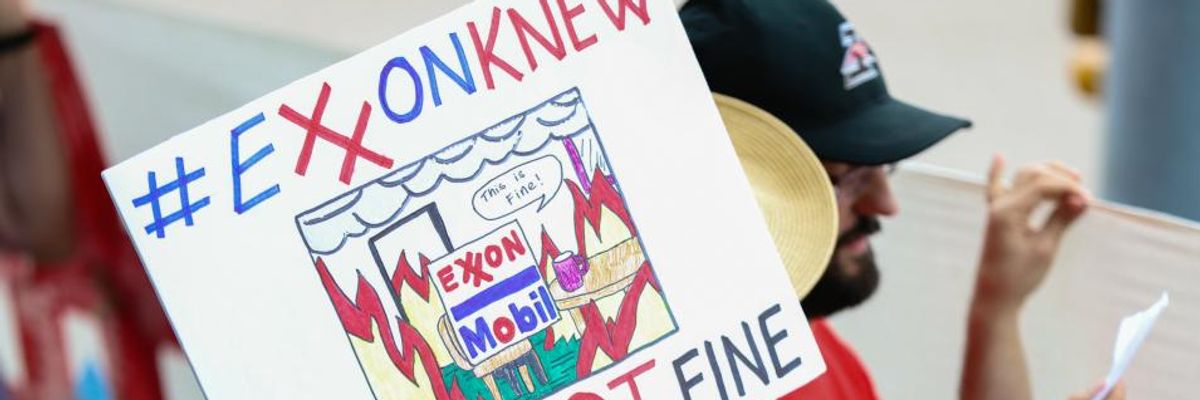
While an international debate rages over how social media companies manage political advertising and misinformation, a report published Tuesday in Emily Atkin's HEATED newsletter exposed that some of oil giant ExxonMobil's climate messaging is apparently exempt from Twitter's recently revised and restrictive ad policy.
"Under the new policy, [ExxonMobil's climate] ads will be permitted to run after November 22, while environmental groups' climate-related ads will be banned."
--Emily Atkin, HEATED
Twitter CEO Jack Dorsey won hesitant praise from some journalists and Democratic politicians last week when he announced a new ban on "all" political advertisements globally.
In an apparent swipe at Facebook CEO Mark Zuckerberg, who has stood firm in the face of intense criticism over his decision to let political candidates pay to spread lies on his platform, Dorsey said of Twitter's policy: "This isn't about free expression. This is about paying for reach."
However, amid celebrations over Twitter's effort combat online misinformation by banning ads about candidates as well as "issue ads" from companies and other groups, "it's become clear that there are some problems with Twitter's new policy," Atkin reported. "It's easy to determine which ads are about specific candidates. But what is Twitter's definition of a political 'issue ad,' exactly? How does Twitter plan to enforce what is one, and isn't one?"
According to Atkin:
These questions have serious implications for the climate fight. For example, a HEATED investigation identified more than a dozen tweets from ExxonMobil related to climate change that are not currently labelled by Twitter as political "issue" ads. Under the new policy, these ads will be permitted to run after November 22, while environmental groups' climate-related ads will be banned.
Asked to explain why Exxon's climate-related ads are not political, Twitter declined to comment. A Harvard researcher who studies Exxon for a living, however, did not hold back.
"Mobil and ExxonMobil have pioneered issue advertising for decades," said Geoffery Supran, who co-authored a peer-reviewed analysis of ExxonMobil's 40-year history of climate change communications. "I've studied this historical record in detail, and it couldn't be clearer to me that Twitter ads like these are its twenty-first century extension."
"These Twitter ads aren't just any political issue ads--they epitomize the art."
Atkin's report includes screenshots and embeds of ExxonMobil's climate-related ads that will still be permissible under Twitter's new rules:
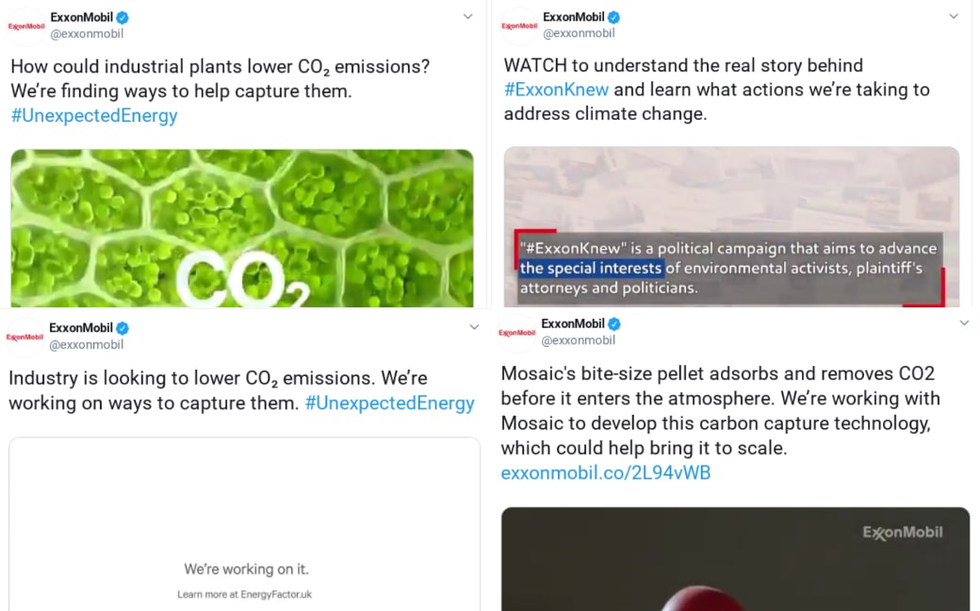
With ExxonMobil's ads on low-carbon investments, "they're promoting technologies that don't yet exist at any meaningful scale," Supran said. "There is not a product to sell. So what purpose do these ads conceivably serve other than to promote a political narrative on climate change and energy that protects Exxon's business interests?"
The fossil fuel giant's ads about lawsuits brought by the attorneys general of New York and Massachusetts are "literally alleging a political conspiracy," Supran added. "What else do you call a paid social media campaign designed to discredit peer-reviewed science? It's not product advertising, and it sure as heck isn't science."
Supran followed up on his comments to Atkin in a Twitter thread Tuesday, which was shared by author and climate activist Naomi Klein:
Enough grandstanding from Twitter. This kind of greed will cost us everything. https://t.co/3xfZGq4dCg
-- Naomi Klein (@NaomiAKlein) November 5, 2019
Two years ago, Supran and fellow Harvard researcher Naomi Oreskes published a study in the journal Environmental Research Letters that backed up media reports about how ExxonMobil spent decades suppressing science and promoting public doubt about the human-caused climate crisis.
On Twitter Tuesday, Supran wrote that "it's pretty ironic (read: bonkers) that our peer-reviewed analysis of how Exxon used ads to corrupt global warming politics is now being attacked by Exxon ads that corrupt global warming politics."
Tagging Twitter's CEO Dorsey, Supran asked, "How, exactly, are these ads not political enough to be banned?"
Following Dorsey's ad policy announcement last week, The Intercept's D.C. bureau chief Ryan Grim raised concerns about Twitter's new policy, warning that although "it might be a nice troll" of Facebook, the move "is a huge blow to progressives, and a boon to big-money candidates."
Grim argued in a lengthy Twitter thread that "if tech monopolies block candidates from using their platforms to grow their support, progressive candidates are screwed," because "that's how unknown candidates find supporters, persuade them to join their email list/contact info, then organize them."
Responding to Atkin Tuesday, Grim tweeted, "When you endorse censorship before you have power, the powerful continue to speak and you get censored."
While an international debate rages over how social media companies manage political advertising and misinformation, a report published Tuesday in Emily Atkin's HEATED newsletter exposed that some of oil giant ExxonMobil's climate messaging is apparently exempt from Twitter's recently revised and restrictive ad policy.
"Under the new policy, [ExxonMobil's climate] ads will be permitted to run after November 22, while environmental groups' climate-related ads will be banned."
--Emily Atkin, HEATED
Twitter CEO Jack Dorsey won hesitant praise from some journalists and Democratic politicians last week when he announced a new ban on "all" political advertisements globally.
In an apparent swipe at Facebook CEO Mark Zuckerberg, who has stood firm in the face of intense criticism over his decision to let political candidates pay to spread lies on his platform, Dorsey said of Twitter's policy: "This isn't about free expression. This is about paying for reach."
However, amid celebrations over Twitter's effort combat online misinformation by banning ads about candidates as well as "issue ads" from companies and other groups, "it's become clear that there are some problems with Twitter's new policy," Atkin reported. "It's easy to determine which ads are about specific candidates. But what is Twitter's definition of a political 'issue ad,' exactly? How does Twitter plan to enforce what is one, and isn't one?"
According to Atkin:
These questions have serious implications for the climate fight. For example, a HEATED investigation identified more than a dozen tweets from ExxonMobil related to climate change that are not currently labelled by Twitter as political "issue" ads. Under the new policy, these ads will be permitted to run after November 22, while environmental groups' climate-related ads will be banned.
Asked to explain why Exxon's climate-related ads are not political, Twitter declined to comment. A Harvard researcher who studies Exxon for a living, however, did not hold back.
"Mobil and ExxonMobil have pioneered issue advertising for decades," said Geoffery Supran, who co-authored a peer-reviewed analysis of ExxonMobil's 40-year history of climate change communications. "I've studied this historical record in detail, and it couldn't be clearer to me that Twitter ads like these are its twenty-first century extension."
"These Twitter ads aren't just any political issue ads--they epitomize the art."
Atkin's report includes screenshots and embeds of ExxonMobil's climate-related ads that will still be permissible under Twitter's new rules:
With ExxonMobil's ads on low-carbon investments, "they're promoting technologies that don't yet exist at any meaningful scale," Supran said. "There is not a product to sell. So what purpose do these ads conceivably serve other than to promote a political narrative on climate change and energy that protects Exxon's business interests?"
The fossil fuel giant's ads about lawsuits brought by the attorneys general of New York and Massachusetts are "literally alleging a political conspiracy," Supran added. "What else do you call a paid social media campaign designed to discredit peer-reviewed science? It's not product advertising, and it sure as heck isn't science."
Supran followed up on his comments to Atkin in a Twitter thread Tuesday, which was shared by author and climate activist Naomi Klein:
Enough grandstanding from Twitter. This kind of greed will cost us everything. https://t.co/3xfZGq4dCg
-- Naomi Klein (@NaomiAKlein) November 5, 2019
Two years ago, Supran and fellow Harvard researcher Naomi Oreskes published a study in the journal Environmental Research Letters that backed up media reports about how ExxonMobil spent decades suppressing science and promoting public doubt about the human-caused climate crisis.
On Twitter Tuesday, Supran wrote that "it's pretty ironic (read: bonkers) that our peer-reviewed analysis of how Exxon used ads to corrupt global warming politics is now being attacked by Exxon ads that corrupt global warming politics."
Tagging Twitter's CEO Dorsey, Supran asked, "How, exactly, are these ads not political enough to be banned?"
Following Dorsey's ad policy announcement last week, The Intercept's D.C. bureau chief Ryan Grim raised concerns about Twitter's new policy, warning that although "it might be a nice troll" of Facebook, the move "is a huge blow to progressives, and a boon to big-money candidates."
Grim argued in a lengthy Twitter thread that "if tech monopolies block candidates from using their platforms to grow their support, progressive candidates are screwed," because "that's how unknown candidates find supporters, persuade them to join their email list/contact info, then organize them."
Responding to Atkin Tuesday, Grim tweeted, "When you endorse censorship before you have power, the powerful continue to speak and you get censored."
While an international debate rages over how social media companies manage political advertising and misinformation, a report published Tuesday in Emily Atkin's HEATED newsletter exposed that some of oil giant ExxonMobil's climate messaging is apparently exempt from Twitter's recently revised and restrictive ad policy.
"Under the new policy, [ExxonMobil's climate] ads will be permitted to run after November 22, while environmental groups' climate-related ads will be banned."
--Emily Atkin, HEATED
Twitter CEO Jack Dorsey won hesitant praise from some journalists and Democratic politicians last week when he announced a new ban on "all" political advertisements globally.
In an apparent swipe at Facebook CEO Mark Zuckerberg, who has stood firm in the face of intense criticism over his decision to let political candidates pay to spread lies on his platform, Dorsey said of Twitter's policy: "This isn't about free expression. This is about paying for reach."
However, amid celebrations over Twitter's effort combat online misinformation by banning ads about candidates as well as "issue ads" from companies and other groups, "it's become clear that there are some problems with Twitter's new policy," Atkin reported. "It's easy to determine which ads are about specific candidates. But what is Twitter's definition of a political 'issue ad,' exactly? How does Twitter plan to enforce what is one, and isn't one?"
According to Atkin:
These questions have serious implications for the climate fight. For example, a HEATED investigation identified more than a dozen tweets from ExxonMobil related to climate change that are not currently labelled by Twitter as political "issue" ads. Under the new policy, these ads will be permitted to run after November 22, while environmental groups' climate-related ads will be banned.
Asked to explain why Exxon's climate-related ads are not political, Twitter declined to comment. A Harvard researcher who studies Exxon for a living, however, did not hold back.
"Mobil and ExxonMobil have pioneered issue advertising for decades," said Geoffery Supran, who co-authored a peer-reviewed analysis of ExxonMobil's 40-year history of climate change communications. "I've studied this historical record in detail, and it couldn't be clearer to me that Twitter ads like these are its twenty-first century extension."
"These Twitter ads aren't just any political issue ads--they epitomize the art."
Atkin's report includes screenshots and embeds of ExxonMobil's climate-related ads that will still be permissible under Twitter's new rules:
With ExxonMobil's ads on low-carbon investments, "they're promoting technologies that don't yet exist at any meaningful scale," Supran said. "There is not a product to sell. So what purpose do these ads conceivably serve other than to promote a political narrative on climate change and energy that protects Exxon's business interests?"
The fossil fuel giant's ads about lawsuits brought by the attorneys general of New York and Massachusetts are "literally alleging a political conspiracy," Supran added. "What else do you call a paid social media campaign designed to discredit peer-reviewed science? It's not product advertising, and it sure as heck isn't science."
Supran followed up on his comments to Atkin in a Twitter thread Tuesday, which was shared by author and climate activist Naomi Klein:
Enough grandstanding from Twitter. This kind of greed will cost us everything. https://t.co/3xfZGq4dCg
-- Naomi Klein (@NaomiAKlein) November 5, 2019
Two years ago, Supran and fellow Harvard researcher Naomi Oreskes published a study in the journal Environmental Research Letters that backed up media reports about how ExxonMobil spent decades suppressing science and promoting public doubt about the human-caused climate crisis.
On Twitter Tuesday, Supran wrote that "it's pretty ironic (read: bonkers) that our peer-reviewed analysis of how Exxon used ads to corrupt global warming politics is now being attacked by Exxon ads that corrupt global warming politics."
Tagging Twitter's CEO Dorsey, Supran asked, "How, exactly, are these ads not political enough to be banned?"
Following Dorsey's ad policy announcement last week, The Intercept's D.C. bureau chief Ryan Grim raised concerns about Twitter's new policy, warning that although "it might be a nice troll" of Facebook, the move "is a huge blow to progressives, and a boon to big-money candidates."
Grim argued in a lengthy Twitter thread that "if tech monopolies block candidates from using their platforms to grow their support, progressive candidates are screwed," because "that's how unknown candidates find supporters, persuade them to join their email list/contact info, then organize them."
Responding to Atkin Tuesday, Grim tweeted, "When you endorse censorship before you have power, the powerful continue to speak and you get censored."

