SUBSCRIBE TO OUR FREE NEWSLETTER
Daily news & progressive opinion—funded by the people, not the corporations—delivered straight to your inbox.
5
#000000
#FFFFFF
To donate by check, phone, or other method, see our More Ways to Give page.
Daily news & progressive opinion—funded by the people, not the corporations—delivered straight to your inbox.
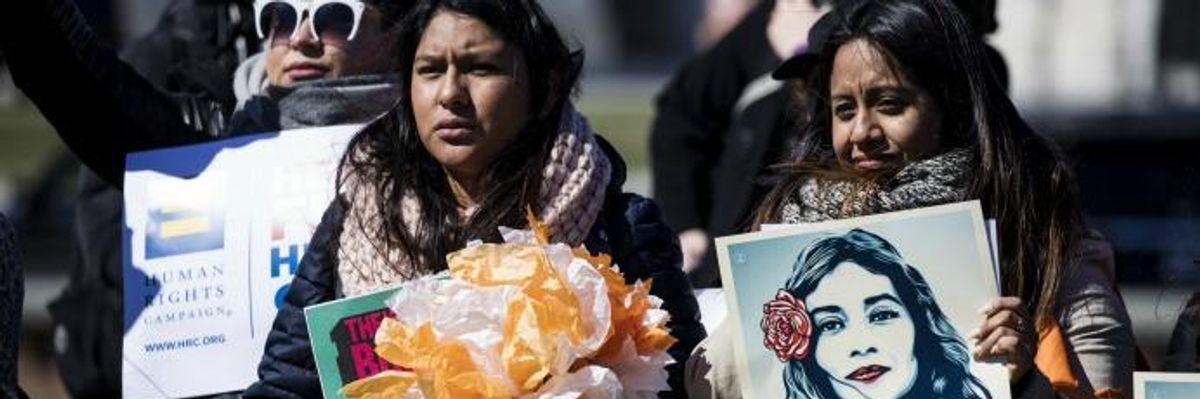
Demonstrators protest President Trump's attempts to end the Deferred Action for Childhood Arrivals (DACA), an executive action made by President Obama that protected minors known as Dreamers from deportation, outside of the U.S. Capitol in Washington on March 5, 2018. (Photo: Samuel Corum/Anadolu Agency/Getty Images)
The U.S. Supreme Court said Friday that it would take up challenges to President Donald Trump's bid to terminate DACA, the Obama-era program that protects roughly 800,000 youth from deportation.
Marielena Hincapie, executive director of the National Immigration Law Center (NILC), said on Twitter that the decision--issued just before the high court takes its three-month recess--"is a reminder of what's at stake with 2020 elections."
"In total," CBS News explained, "the court will hear three cases on the Deferred Action on Childhood Arrivals program known as DACA which will be consolidated into one ruling when the justices return in October."
"The legal question before the Supreme Court," Reuters reported, "is whether the administration properly followed a federal law called the Administrative Procedure Act in Trump's plan to rescind DACA."
Three federal judges have already said the administration did not follow that law.
NILC, Make the Road NY, and the Worker and Immigrant Rights Advocacy Clinic (WIRAC) at Yale Law School are representing DACA recipients groups in the challenge.
"President Trump has been overt about his unconscionable scheme to throw the future of DACA into uncertainty and use immigrant youth as a bargaining chip to advance an extremist, anti-immigrant agenda," said Hincapie in a statement. "His administration has gone so far as to refuse even to consider legislative action to provide relief and has repeatedly blocked bipartisan efforts to enact a permanent solution."
"This tactic," she continued, "which is rooted in white nationalism and includes jailing and deporting as many people as possible, militarizing the border, and severely cutting avenues for people to come to the U.S, has already caused immeasurable harm."
One of the plaintiffs, Eliana Fernandez, put the stakes in stark terms.
"If the Supreme Court reverses the current injunctions and allows Trump to end DACA," she said, "the consequences will be devastating for myself and my family, and I know my story is echoed by hundreds of thousands of people like me across the country."
"Trump's decision to end DACA doesn't just hurt immigrant youth," Fernandez said, "our children, our parents, our employers, our schools, and the country as a whole would be worse off if DACA were to disappear."
Those benefits are clear to tech giant giant Microsoft, which previously filed suit to stop Trump's move to end DACA.
"Dreamers make our country, community, and company stronger, and their protection is both a humanitarian obligation and an economic imperative," Microsoft president Brad Smith said in a statement Friday.
"Today's decision means the clock is now running," said Smith, "with even more reason for Congress to act."
Dear Common Dreams reader, It’s been nearly 30 years since I co-founded Common Dreams with my late wife, Lina Newhouser. We had the radical notion that journalism should serve the public good, not corporate profits. It was clear to us from the outset what it would take to build such a project. No paid advertisements. No corporate sponsors. No millionaire publisher telling us what to think or do. Many people said we wouldn't last a year, but we proved those doubters wrong. Together with a tremendous team of journalists and dedicated staff, we built an independent media outlet free from the constraints of profits and corporate control. Our mission has always been simple: To inform. To inspire. To ignite change for the common good. Building Common Dreams was not easy. Our survival was never guaranteed. When you take on the most powerful forces—Wall Street greed, fossil fuel industry destruction, Big Tech lobbyists, and uber-rich oligarchs who have spent billions upon billions rigging the economy and democracy in their favor—the only bulwark you have is supporters who believe in your work. But here’s the urgent message from me today. It's never been this bad out there. And it's never been this hard to keep us going. At the very moment Common Dreams is most needed, the threats we face are intensifying. We need your support now more than ever. We don't accept corporate advertising and never will. We don't have a paywall because we don't think people should be blocked from critical news based on their ability to pay. Everything we do is funded by the donations of readers like you. When everyone does the little they can afford, we are strong. But if that support retreats or dries up, so do we. Will you donate now to make sure Common Dreams not only survives but thrives? —Craig Brown, Co-founder |
The U.S. Supreme Court said Friday that it would take up challenges to President Donald Trump's bid to terminate DACA, the Obama-era program that protects roughly 800,000 youth from deportation.
Marielena Hincapie, executive director of the National Immigration Law Center (NILC), said on Twitter that the decision--issued just before the high court takes its three-month recess--"is a reminder of what's at stake with 2020 elections."
"In total," CBS News explained, "the court will hear three cases on the Deferred Action on Childhood Arrivals program known as DACA which will be consolidated into one ruling when the justices return in October."
"The legal question before the Supreme Court," Reuters reported, "is whether the administration properly followed a federal law called the Administrative Procedure Act in Trump's plan to rescind DACA."
Three federal judges have already said the administration did not follow that law.
NILC, Make the Road NY, and the Worker and Immigrant Rights Advocacy Clinic (WIRAC) at Yale Law School are representing DACA recipients groups in the challenge.
"President Trump has been overt about his unconscionable scheme to throw the future of DACA into uncertainty and use immigrant youth as a bargaining chip to advance an extremist, anti-immigrant agenda," said Hincapie in a statement. "His administration has gone so far as to refuse even to consider legislative action to provide relief and has repeatedly blocked bipartisan efforts to enact a permanent solution."
"This tactic," she continued, "which is rooted in white nationalism and includes jailing and deporting as many people as possible, militarizing the border, and severely cutting avenues for people to come to the U.S, has already caused immeasurable harm."
One of the plaintiffs, Eliana Fernandez, put the stakes in stark terms.
"If the Supreme Court reverses the current injunctions and allows Trump to end DACA," she said, "the consequences will be devastating for myself and my family, and I know my story is echoed by hundreds of thousands of people like me across the country."
"Trump's decision to end DACA doesn't just hurt immigrant youth," Fernandez said, "our children, our parents, our employers, our schools, and the country as a whole would be worse off if DACA were to disappear."
Those benefits are clear to tech giant giant Microsoft, which previously filed suit to stop Trump's move to end DACA.
"Dreamers make our country, community, and company stronger, and their protection is both a humanitarian obligation and an economic imperative," Microsoft president Brad Smith said in a statement Friday.
"Today's decision means the clock is now running," said Smith, "with even more reason for Congress to act."
The U.S. Supreme Court said Friday that it would take up challenges to President Donald Trump's bid to terminate DACA, the Obama-era program that protects roughly 800,000 youth from deportation.
Marielena Hincapie, executive director of the National Immigration Law Center (NILC), said on Twitter that the decision--issued just before the high court takes its three-month recess--"is a reminder of what's at stake with 2020 elections."
"In total," CBS News explained, "the court will hear three cases on the Deferred Action on Childhood Arrivals program known as DACA which will be consolidated into one ruling when the justices return in October."
"The legal question before the Supreme Court," Reuters reported, "is whether the administration properly followed a federal law called the Administrative Procedure Act in Trump's plan to rescind DACA."
Three federal judges have already said the administration did not follow that law.
NILC, Make the Road NY, and the Worker and Immigrant Rights Advocacy Clinic (WIRAC) at Yale Law School are representing DACA recipients groups in the challenge.
"President Trump has been overt about his unconscionable scheme to throw the future of DACA into uncertainty and use immigrant youth as a bargaining chip to advance an extremist, anti-immigrant agenda," said Hincapie in a statement. "His administration has gone so far as to refuse even to consider legislative action to provide relief and has repeatedly blocked bipartisan efforts to enact a permanent solution."
"This tactic," she continued, "which is rooted in white nationalism and includes jailing and deporting as many people as possible, militarizing the border, and severely cutting avenues for people to come to the U.S, has already caused immeasurable harm."
One of the plaintiffs, Eliana Fernandez, put the stakes in stark terms.
"If the Supreme Court reverses the current injunctions and allows Trump to end DACA," she said, "the consequences will be devastating for myself and my family, and I know my story is echoed by hundreds of thousands of people like me across the country."
"Trump's decision to end DACA doesn't just hurt immigrant youth," Fernandez said, "our children, our parents, our employers, our schools, and the country as a whole would be worse off if DACA were to disappear."
Those benefits are clear to tech giant giant Microsoft, which previously filed suit to stop Trump's move to end DACA.
"Dreamers make our country, community, and company stronger, and their protection is both a humanitarian obligation and an economic imperative," Microsoft president Brad Smith said in a statement Friday.
"Today's decision means the clock is now running," said Smith, "with even more reason for Congress to act."