SUBSCRIBE TO OUR FREE NEWSLETTER
Daily news & progressive opinion—funded by the people, not the corporations—delivered straight to your inbox.
5
#000000
#FFFFFF
To donate by check, phone, or other method, see our More Ways to Give page.
Daily news & progressive opinion—funded by the people, not the corporations—delivered straight to your inbox.
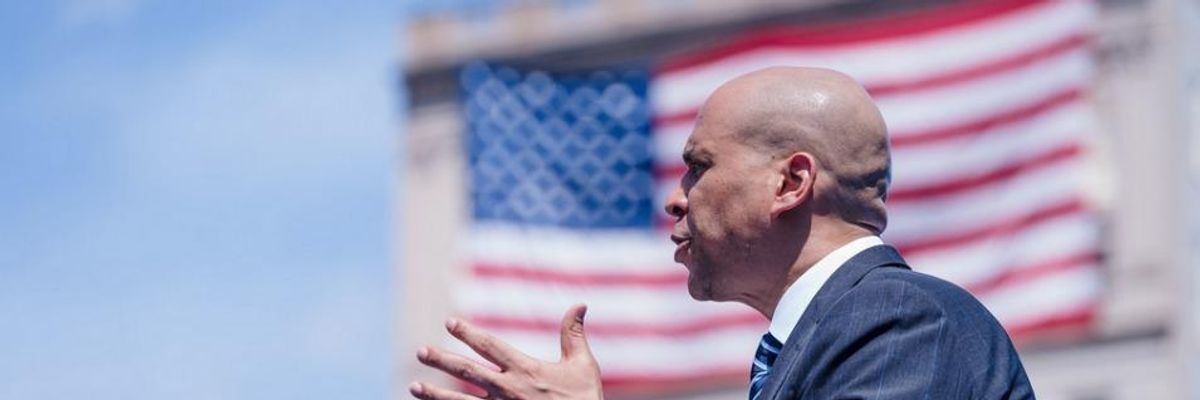
Sen. Cory Booker unveiled a sweeping gun control proposal on Monday. (Photo: @CoryBooker/Twitter)
National gun control groups and progressives offered praise on Monday for Sen. Cory Booker's proposal "to end the gun violence epidemic," with some advocates calling the plan the most ambitious of any gun control action plan offered by the 2020 Democratic presidential candidates.
The New Jersey Democrat detailed his plan in a Medium post, saying that meaningful gun control reform is a matter of making justice "a reality for all."
"My plan to address gun violence is simple--we will make it harder for people who should not have a gun to get one," Booker said in a statement. "I am sick and tired of hearing 'thoughts and prayers' for the communities that have been shattered by gun violence."
"Talking about gun laws was once a political third rail. Heading into 2020, it's a political must." --Peter Ambler, Giffords Law Center
Booker's plan includes a ban on military-style semi-automatic firearms like the AR-15--which have been used in a number of recent mass shootings--and high-capacity magazines, both of which have been called for by progressives who want sweeping reforms to dramatically curb what they view as a public health crisis, rather than incremental measures.
The proposal also includes a national gun licensing program, under which all gun purchasers would be requires to undergo a federal background check and fingerprinting, an interview, and a gun safety course.
"If you need a license to drive a car, you should need a license to own a gun," Booker said Monday.
A 2013 survey showed that more than 77 percent of Americans support a gun licensing program, while the Center for Gun Policy and Research at Johns Hopkins University in 2014 found that gun licensing requirements have been more effective at the state level in reducing gun deaths than background checks and bans on certain weapons.
Several gun control groups noted that Booker's sweeping plan is the latest sign that the country and the Democratic Party are quickly moving to the left on gun violence issues, in the years following several high-profile mass shootings which killed dozens of Americans.
"Talking about gun laws was once a political third rail," said Peter Ambler, executive director of Giffords Law Center. "Heading into 2020, it's a political must."
The non-profit organization Brady--formerly known as the Brady Center to Prevent Gun Violence--suggested that Booker's plan signifies a response to increased energy among gun control advocates including the survivors of last year's shooting in Parkland, Florida, who led other young people to hold school walkouts and organized the nationwide March for Our Lives weeks after the attack.
"America is ready to treat gun violence as the epidemic that it is," tweeted the organization.
Fred Guttenberg, whose daughter was shot and killed at Parkland, called the plan "impressive and aggressive."
"Thank you, [Sen. Booker], for helping to raise the issue of gun violence in this presidential campaign and for these steps to end the gun violence epidemic and to lower the gun violence death rate in America," Guttenberg wrote.
Booker's 14-point plan also calls for federal funding to support local evidence-based programs aimed at preventing violence in marginalized communities.
As Giffords Law Center reported last month, Oakland, California cut its gun homicide rate in half since 2012 through a multi-pronged strategy aimed at researching gun violence in the city; engaging with those found to be at risk for perpetrating violence; and reforming police-community relations.
The plan also includes a provision for closing the so-called "boyfriend loophole," which has kept gun control laws from applying to domestic abusers who are not married to their victims.
"While current law forbids an abusive spouse or ex-spouse convicted of abuse or under a restraining order from purchasing a firearm, the same commonsense rule does not extend to non-felony abuse at the hands of dating partners or former dating partners," Booker's campaign wrote at Medium.
"The risk of homicide in a domestic violence incident increases by 500 percent with the presence of a gun," the campaign added. "Cory will make closing the 'Boyfriend Loophole' a top priority."
Progressive blogger Melissa McEwan praised the senator for prioritizing the end of the loophole, which she called "a crucial public safety issue for women."
Dear Common Dreams reader, It’s been nearly 30 years since I co-founded Common Dreams with my late wife, Lina Newhouser. We had the radical notion that journalism should serve the public good, not corporate profits. It was clear to us from the outset what it would take to build such a project. No paid advertisements. No corporate sponsors. No millionaire publisher telling us what to think or do. Many people said we wouldn't last a year, but we proved those doubters wrong. Together with a tremendous team of journalists and dedicated staff, we built an independent media outlet free from the constraints of profits and corporate control. Our mission has always been simple: To inform. To inspire. To ignite change for the common good. Building Common Dreams was not easy. Our survival was never guaranteed. When you take on the most powerful forces—Wall Street greed, fossil fuel industry destruction, Big Tech lobbyists, and uber-rich oligarchs who have spent billions upon billions rigging the economy and democracy in their favor—the only bulwark you have is supporters who believe in your work. But here’s the urgent message from me today. It's never been this bad out there. And it's never been this hard to keep us going. At the very moment Common Dreams is most needed, the threats we face are intensifying. We need your support now more than ever. We don't accept corporate advertising and never will. We don't have a paywall because we don't think people should be blocked from critical news based on their ability to pay. Everything we do is funded by the donations of readers like you. When everyone does the little they can afford, we are strong. But if that support retreats or dries up, so do we. Will you donate now to make sure Common Dreams not only survives but thrives? —Craig Brown, Co-founder |
National gun control groups and progressives offered praise on Monday for Sen. Cory Booker's proposal "to end the gun violence epidemic," with some advocates calling the plan the most ambitious of any gun control action plan offered by the 2020 Democratic presidential candidates.
The New Jersey Democrat detailed his plan in a Medium post, saying that meaningful gun control reform is a matter of making justice "a reality for all."
"My plan to address gun violence is simple--we will make it harder for people who should not have a gun to get one," Booker said in a statement. "I am sick and tired of hearing 'thoughts and prayers' for the communities that have been shattered by gun violence."
"Talking about gun laws was once a political third rail. Heading into 2020, it's a political must." --Peter Ambler, Giffords Law Center
Booker's plan includes a ban on military-style semi-automatic firearms like the AR-15--which have been used in a number of recent mass shootings--and high-capacity magazines, both of which have been called for by progressives who want sweeping reforms to dramatically curb what they view as a public health crisis, rather than incremental measures.
The proposal also includes a national gun licensing program, under which all gun purchasers would be requires to undergo a federal background check and fingerprinting, an interview, and a gun safety course.
"If you need a license to drive a car, you should need a license to own a gun," Booker said Monday.
A 2013 survey showed that more than 77 percent of Americans support a gun licensing program, while the Center for Gun Policy and Research at Johns Hopkins University in 2014 found that gun licensing requirements have been more effective at the state level in reducing gun deaths than background checks and bans on certain weapons.
Several gun control groups noted that Booker's sweeping plan is the latest sign that the country and the Democratic Party are quickly moving to the left on gun violence issues, in the years following several high-profile mass shootings which killed dozens of Americans.
"Talking about gun laws was once a political third rail," said Peter Ambler, executive director of Giffords Law Center. "Heading into 2020, it's a political must."
The non-profit organization Brady--formerly known as the Brady Center to Prevent Gun Violence--suggested that Booker's plan signifies a response to increased energy among gun control advocates including the survivors of last year's shooting in Parkland, Florida, who led other young people to hold school walkouts and organized the nationwide March for Our Lives weeks after the attack.
"America is ready to treat gun violence as the epidemic that it is," tweeted the organization.
Fred Guttenberg, whose daughter was shot and killed at Parkland, called the plan "impressive and aggressive."
"Thank you, [Sen. Booker], for helping to raise the issue of gun violence in this presidential campaign and for these steps to end the gun violence epidemic and to lower the gun violence death rate in America," Guttenberg wrote.
Booker's 14-point plan also calls for federal funding to support local evidence-based programs aimed at preventing violence in marginalized communities.
As Giffords Law Center reported last month, Oakland, California cut its gun homicide rate in half since 2012 through a multi-pronged strategy aimed at researching gun violence in the city; engaging with those found to be at risk for perpetrating violence; and reforming police-community relations.
The plan also includes a provision for closing the so-called "boyfriend loophole," which has kept gun control laws from applying to domestic abusers who are not married to their victims.
"While current law forbids an abusive spouse or ex-spouse convicted of abuse or under a restraining order from purchasing a firearm, the same commonsense rule does not extend to non-felony abuse at the hands of dating partners or former dating partners," Booker's campaign wrote at Medium.
"The risk of homicide in a domestic violence incident increases by 500 percent with the presence of a gun," the campaign added. "Cory will make closing the 'Boyfriend Loophole' a top priority."
Progressive blogger Melissa McEwan praised the senator for prioritizing the end of the loophole, which she called "a crucial public safety issue for women."
National gun control groups and progressives offered praise on Monday for Sen. Cory Booker's proposal "to end the gun violence epidemic," with some advocates calling the plan the most ambitious of any gun control action plan offered by the 2020 Democratic presidential candidates.
The New Jersey Democrat detailed his plan in a Medium post, saying that meaningful gun control reform is a matter of making justice "a reality for all."
"My plan to address gun violence is simple--we will make it harder for people who should not have a gun to get one," Booker said in a statement. "I am sick and tired of hearing 'thoughts and prayers' for the communities that have been shattered by gun violence."
"Talking about gun laws was once a political third rail. Heading into 2020, it's a political must." --Peter Ambler, Giffords Law Center
Booker's plan includes a ban on military-style semi-automatic firearms like the AR-15--which have been used in a number of recent mass shootings--and high-capacity magazines, both of which have been called for by progressives who want sweeping reforms to dramatically curb what they view as a public health crisis, rather than incremental measures.
The proposal also includes a national gun licensing program, under which all gun purchasers would be requires to undergo a federal background check and fingerprinting, an interview, and a gun safety course.
"If you need a license to drive a car, you should need a license to own a gun," Booker said Monday.
A 2013 survey showed that more than 77 percent of Americans support a gun licensing program, while the Center for Gun Policy and Research at Johns Hopkins University in 2014 found that gun licensing requirements have been more effective at the state level in reducing gun deaths than background checks and bans on certain weapons.
Several gun control groups noted that Booker's sweeping plan is the latest sign that the country and the Democratic Party are quickly moving to the left on gun violence issues, in the years following several high-profile mass shootings which killed dozens of Americans.
"Talking about gun laws was once a political third rail," said Peter Ambler, executive director of Giffords Law Center. "Heading into 2020, it's a political must."
The non-profit organization Brady--formerly known as the Brady Center to Prevent Gun Violence--suggested that Booker's plan signifies a response to increased energy among gun control advocates including the survivors of last year's shooting in Parkland, Florida, who led other young people to hold school walkouts and organized the nationwide March for Our Lives weeks after the attack.
"America is ready to treat gun violence as the epidemic that it is," tweeted the organization.
Fred Guttenberg, whose daughter was shot and killed at Parkland, called the plan "impressive and aggressive."
"Thank you, [Sen. Booker], for helping to raise the issue of gun violence in this presidential campaign and for these steps to end the gun violence epidemic and to lower the gun violence death rate in America," Guttenberg wrote.
Booker's 14-point plan also calls for federal funding to support local evidence-based programs aimed at preventing violence in marginalized communities.
As Giffords Law Center reported last month, Oakland, California cut its gun homicide rate in half since 2012 through a multi-pronged strategy aimed at researching gun violence in the city; engaging with those found to be at risk for perpetrating violence; and reforming police-community relations.
The plan also includes a provision for closing the so-called "boyfriend loophole," which has kept gun control laws from applying to domestic abusers who are not married to their victims.
"While current law forbids an abusive spouse or ex-spouse convicted of abuse or under a restraining order from purchasing a firearm, the same commonsense rule does not extend to non-felony abuse at the hands of dating partners or former dating partners," Booker's campaign wrote at Medium.
"The risk of homicide in a domestic violence incident increases by 500 percent with the presence of a gun," the campaign added. "Cory will make closing the 'Boyfriend Loophole' a top priority."
Progressive blogger Melissa McEwan praised the senator for prioritizing the end of the loophole, which she called "a crucial public safety issue for women."