

SUBSCRIBE TO OUR FREE NEWSLETTER
Daily news & progressive opinion—funded by the people, not the corporations—delivered straight to your inbox.
5
#000000
#FFFFFF
To donate by check, phone, or other method, see our More Ways to Give page.
Daily news & progressive opinion—funded by the people, not the corporations—delivered straight to your inbox.
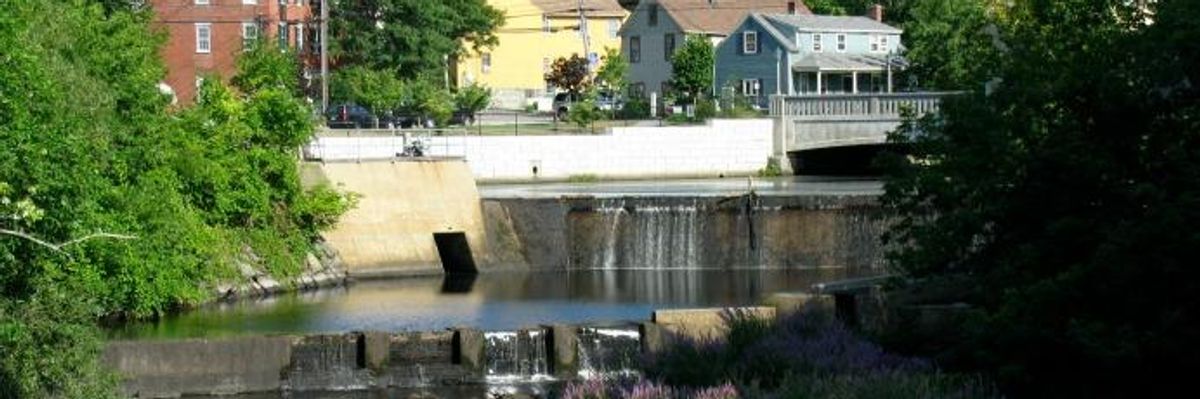
This shot from the New England town shows where the Exeter River ends and the Squamscott River begins. (Photo: Josh Graciano/flickr/cc)
Voters in Exeter, New Hampshire, fearing the impact on their community from a planned pipeline project, declared Tuesday that their town's right to a safe and healthy climate trumps corporate profits.
"Our right to a healthy climate is an unalienable right," said Maura Fay, co-founder of the community group Citizen Action for Exeter's Environment (CAEE), in a statement. "Any new energy infrastructure in our town must align with that right. We live here, and what we envision for our community comes before what any project developer and state government envision if it threatens our rights."
Voters passed Article 30, the Right to a Healthy Climate Ordinance, by a vote of 1,176 to 1,007
The ordinance states, in part:
It is our legislative determination that certain corporate activities are detrimental to our rights, health, safety, and welfare. These activities include but are not limited to: the runoff from commercial use of fertilizers, the intentional or unintentional dumping of toxic waste, and the physical deposition, emission, leakage, disposal, or placement of toxins into the land, air or waterways from extraction, transportation, processing, storage, conveyance, and depositing of waste from fossil fuel exploration and development.
As we are purportedly constrained by state and federal law, which courts interpret to require us to accept such harmful corporate activity, we the people of Exeter are unable under our current system of local government to secure human rights and ecosystem rights by banning said activity.
Therefore, we deem it necessary to alter our system of local government, and we do so by adopting this Right to a Healthy Climate Ordinance.
Exeter resident Stephanie Marshall recently laid out what's at stake for the town--and the planet. In a letter to the editor published this month at Seacoastonline, she wrote:
Climate change is not too big to tackle and the solutions come from local to global action. Exeter is a likely meter station site for Liberty Utility's proposed Granite Bridge fracked gas pipeline. What's the impact of more natural gas on climate change? Significant and negative; more methane and carbon dioxide emissions, accelerated warming of the earth, faster sea level rise, more floods and wildfires, more threats to agriculture. [...]
In August 2018, the Exeter Select Board unanimously approved an option agreement with Liberty Utilities to serve as a meter site for Granite Bridge pipeline. While some members of the board noted that this did not necessarily signal support for the project, it certainly helps Liberty continue forward on the project. Even if the Select Board and, more importantly Exeter's citizens, oppose this pipeline, it's up to the state to decide if it will be built.
Warrant Article 30 accomplishes two objectives. It assures that Exeter citizens' right to a safe and healthy climate must be considered in any plans for new energy infrastructure and other corporate projects. Secondly, it safeguards that the opinions of citizens have as much standing as those of Liberty Utility or the state government.
The ordinance was drafted with the help of the Community Environmental Legal Defense Fund, which describes itself as "spearheading a movement at the local, state, national, and international level to establish rights for humans and nature over the systems that control them."
The group says that the proposed pipeline project would cross eight towns in the state and "threatens to contaminate the Piscataqua River Watershed, an ecosystem that hundreds of thousands of people and countless species depend upon for clean air and water."
Welcoming the vote, CELDF community organizer Michelle Sanborn said, "The residents of Exeter are well-organized, informed, and engaged." She also cheered the community for "joining a growing Community Rights movement in New Hampshire."
That's reflected in the proposed New Hampshire Community Rights Amendment, which says that "the people of the state may enact local laws that protect health, safety, and welfare."
With a hearing before lawmakers on Wednesday, the New Hampshire Community Rights Network (NHCRN), which drafted the proposed constitutional amendment along with CELDF, is urging constituents to call their representatives and demand they support the measure.
According to NHCRN, it "will be reintroduced as many times as it takes to pass it. We know from prior people's movements that fundamental change takes persistent, unrelenting pressure."
Dear Common Dreams reader, It’s been nearly 30 years since I co-founded Common Dreams with my late wife, Lina Newhouser. We had the radical notion that journalism should serve the public good, not corporate profits. It was clear to us from the outset what it would take to build such a project. No paid advertisements. No corporate sponsors. No millionaire publisher telling us what to think or do. Many people said we wouldn't last a year, but we proved those doubters wrong. Together with a tremendous team of journalists and dedicated staff, we built an independent media outlet free from the constraints of profits and corporate control. Our mission has always been simple: To inform. To inspire. To ignite change for the common good. Building Common Dreams was not easy. Our survival was never guaranteed. When you take on the most powerful forces—Wall Street greed, fossil fuel industry destruction, Big Tech lobbyists, and uber-rich oligarchs who have spent billions upon billions rigging the economy and democracy in their favor—the only bulwark you have is supporters who believe in your work. But here’s the urgent message from me today. It's never been this bad out there. And it's never been this hard to keep us going. At the very moment Common Dreams is most needed, the threats we face are intensifying. We need your support now more than ever. We don't accept corporate advertising and never will. We don't have a paywall because we don't think people should be blocked from critical news based on their ability to pay. Everything we do is funded by the donations of readers like you. When everyone does the little they can afford, we are strong. But if that support retreats or dries up, so do we. Will you donate now to make sure Common Dreams not only survives but thrives? —Craig Brown, Co-founder |
Voters in Exeter, New Hampshire, fearing the impact on their community from a planned pipeline project, declared Tuesday that their town's right to a safe and healthy climate trumps corporate profits.
"Our right to a healthy climate is an unalienable right," said Maura Fay, co-founder of the community group Citizen Action for Exeter's Environment (CAEE), in a statement. "Any new energy infrastructure in our town must align with that right. We live here, and what we envision for our community comes before what any project developer and state government envision if it threatens our rights."
Voters passed Article 30, the Right to a Healthy Climate Ordinance, by a vote of 1,176 to 1,007
The ordinance states, in part:
It is our legislative determination that certain corporate activities are detrimental to our rights, health, safety, and welfare. These activities include but are not limited to: the runoff from commercial use of fertilizers, the intentional or unintentional dumping of toxic waste, and the physical deposition, emission, leakage, disposal, or placement of toxins into the land, air or waterways from extraction, transportation, processing, storage, conveyance, and depositing of waste from fossil fuel exploration and development.
As we are purportedly constrained by state and federal law, which courts interpret to require us to accept such harmful corporate activity, we the people of Exeter are unable under our current system of local government to secure human rights and ecosystem rights by banning said activity.
Therefore, we deem it necessary to alter our system of local government, and we do so by adopting this Right to a Healthy Climate Ordinance.
Exeter resident Stephanie Marshall recently laid out what's at stake for the town--and the planet. In a letter to the editor published this month at Seacoastonline, she wrote:
Climate change is not too big to tackle and the solutions come from local to global action. Exeter is a likely meter station site for Liberty Utility's proposed Granite Bridge fracked gas pipeline. What's the impact of more natural gas on climate change? Significant and negative; more methane and carbon dioxide emissions, accelerated warming of the earth, faster sea level rise, more floods and wildfires, more threats to agriculture. [...]
In August 2018, the Exeter Select Board unanimously approved an option agreement with Liberty Utilities to serve as a meter site for Granite Bridge pipeline. While some members of the board noted that this did not necessarily signal support for the project, it certainly helps Liberty continue forward on the project. Even if the Select Board and, more importantly Exeter's citizens, oppose this pipeline, it's up to the state to decide if it will be built.
Warrant Article 30 accomplishes two objectives. It assures that Exeter citizens' right to a safe and healthy climate must be considered in any plans for new energy infrastructure and other corporate projects. Secondly, it safeguards that the opinions of citizens have as much standing as those of Liberty Utility or the state government.
The ordinance was drafted with the help of the Community Environmental Legal Defense Fund, which describes itself as "spearheading a movement at the local, state, national, and international level to establish rights for humans and nature over the systems that control them."
The group says that the proposed pipeline project would cross eight towns in the state and "threatens to contaminate the Piscataqua River Watershed, an ecosystem that hundreds of thousands of people and countless species depend upon for clean air and water."
Welcoming the vote, CELDF community organizer Michelle Sanborn said, "The residents of Exeter are well-organized, informed, and engaged." She also cheered the community for "joining a growing Community Rights movement in New Hampshire."
That's reflected in the proposed New Hampshire Community Rights Amendment, which says that "the people of the state may enact local laws that protect health, safety, and welfare."
With a hearing before lawmakers on Wednesday, the New Hampshire Community Rights Network (NHCRN), which drafted the proposed constitutional amendment along with CELDF, is urging constituents to call their representatives and demand they support the measure.
According to NHCRN, it "will be reintroduced as many times as it takes to pass it. We know from prior people's movements that fundamental change takes persistent, unrelenting pressure."
Voters in Exeter, New Hampshire, fearing the impact on their community from a planned pipeline project, declared Tuesday that their town's right to a safe and healthy climate trumps corporate profits.
"Our right to a healthy climate is an unalienable right," said Maura Fay, co-founder of the community group Citizen Action for Exeter's Environment (CAEE), in a statement. "Any new energy infrastructure in our town must align with that right. We live here, and what we envision for our community comes before what any project developer and state government envision if it threatens our rights."
Voters passed Article 30, the Right to a Healthy Climate Ordinance, by a vote of 1,176 to 1,007
The ordinance states, in part:
It is our legislative determination that certain corporate activities are detrimental to our rights, health, safety, and welfare. These activities include but are not limited to: the runoff from commercial use of fertilizers, the intentional or unintentional dumping of toxic waste, and the physical deposition, emission, leakage, disposal, or placement of toxins into the land, air or waterways from extraction, transportation, processing, storage, conveyance, and depositing of waste from fossil fuel exploration and development.
As we are purportedly constrained by state and federal law, which courts interpret to require us to accept such harmful corporate activity, we the people of Exeter are unable under our current system of local government to secure human rights and ecosystem rights by banning said activity.
Therefore, we deem it necessary to alter our system of local government, and we do so by adopting this Right to a Healthy Climate Ordinance.
Exeter resident Stephanie Marshall recently laid out what's at stake for the town--and the planet. In a letter to the editor published this month at Seacoastonline, she wrote:
Climate change is not too big to tackle and the solutions come from local to global action. Exeter is a likely meter station site for Liberty Utility's proposed Granite Bridge fracked gas pipeline. What's the impact of more natural gas on climate change? Significant and negative; more methane and carbon dioxide emissions, accelerated warming of the earth, faster sea level rise, more floods and wildfires, more threats to agriculture. [...]
In August 2018, the Exeter Select Board unanimously approved an option agreement with Liberty Utilities to serve as a meter site for Granite Bridge pipeline. While some members of the board noted that this did not necessarily signal support for the project, it certainly helps Liberty continue forward on the project. Even if the Select Board and, more importantly Exeter's citizens, oppose this pipeline, it's up to the state to decide if it will be built.
Warrant Article 30 accomplishes two objectives. It assures that Exeter citizens' right to a safe and healthy climate must be considered in any plans for new energy infrastructure and other corporate projects. Secondly, it safeguards that the opinions of citizens have as much standing as those of Liberty Utility or the state government.
The ordinance was drafted with the help of the Community Environmental Legal Defense Fund, which describes itself as "spearheading a movement at the local, state, national, and international level to establish rights for humans and nature over the systems that control them."
The group says that the proposed pipeline project would cross eight towns in the state and "threatens to contaminate the Piscataqua River Watershed, an ecosystem that hundreds of thousands of people and countless species depend upon for clean air and water."
Welcoming the vote, CELDF community organizer Michelle Sanborn said, "The residents of Exeter are well-organized, informed, and engaged." She also cheered the community for "joining a growing Community Rights movement in New Hampshire."
That's reflected in the proposed New Hampshire Community Rights Amendment, which says that "the people of the state may enact local laws that protect health, safety, and welfare."
With a hearing before lawmakers on Wednesday, the New Hampshire Community Rights Network (NHCRN), which drafted the proposed constitutional amendment along with CELDF, is urging constituents to call their representatives and demand they support the measure.
According to NHCRN, it "will be reintroduced as many times as it takes to pass it. We know from prior people's movements that fundamental change takes persistent, unrelenting pressure."

