SUBSCRIBE TO OUR FREE NEWSLETTER
Daily news & progressive opinion—funded by the people, not the corporations—delivered straight to your inbox.
5
#000000
#FFFFFF
To donate by check, phone, or other method, see our More Ways to Give page.
Daily news & progressive opinion—funded by the people, not the corporations—delivered straight to your inbox.
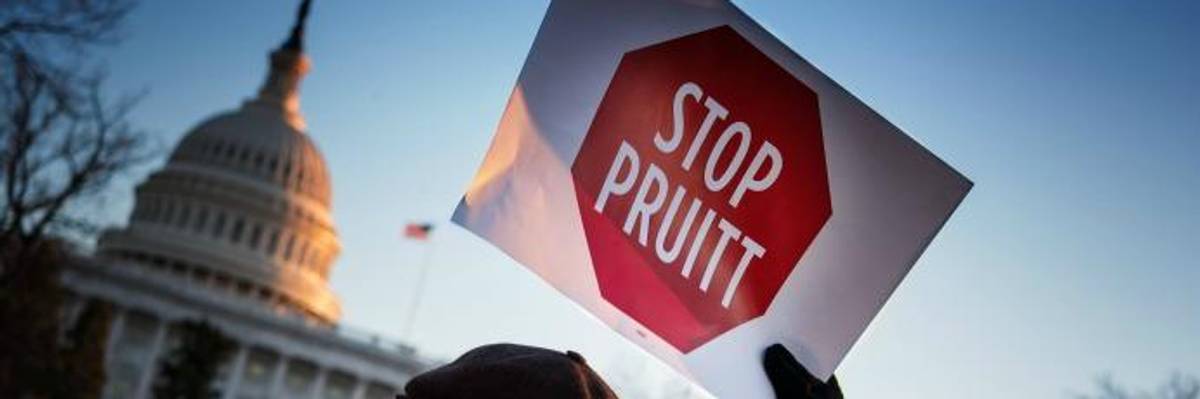
Trump's Environmental Protection Agency on Monday issued a directive that one environmental organization says targets nonexistent collusion and will make it easier for corporations to pollute.
The order from EPA Administrator [and former serial EPA suer] Scott Pruitt curbs "the type of legal agreements the EPA can reach with groups pressuring it to regulate," as the Washington Post sums up. Echoing language used by rightwing think tanks, Pruitt called them "sue and settle" practices and said, "The days of regulation through litigation are over."
Indeed, they've been in cross hairs of conservative groups, thus the Heritage Foundation praised Pruitt's directive as "hugely positive news."
"We will no longer go behind closed doors and use consent decrees and settlement agreements to resolve lawsuits filed against the Agency by special interest groups where doing so would circumvent the regulatory process set forth by Congress. Additionally, gone are the days of routinely paying tens of thousands of dollars in attorney's fees to these groups with which we swiftly settle," Pruitt said.
"The rule change," Talking Points Memo explains,
could force environmental groups to spend much more time and effort on lawsuits aimed at making the EPA enforce its own rules and abide by agreed-upon timelines--spreading them thinner and making it harder for them to expend effort on other, more complicated cases. The EPA's decision to refuse to reimburse lawyers' fees also could be costly to environmental groups, as well as make it harder and less likely for average citizens and localities to undertake lawsuits to get the EPA to do what it's legally required to do.
The EPA's press statement says the "sue and settle" practices "effectively force the Agency to reach certain regulatory outcomes." A 2015 GAO report, however, stated "the impact of deadline suits on EPA's rulemaking is limited."
According to John Walke, director of Natural Resources Defense Council's Clean Air Project and Climate and Clean Air program, "Pruitt's doing nothing more than posturing about a non-existent problem and political fiction. His targeting of legal settlements, especially where EPA has no defense to breaking the law, will just allow violations to persist, along with harms to Americans."
"The irony," he continued, "is that polluters don't even have to sue Pruitt to get what they want. They just pick up the phone and ask. Make no mistake, the unspoken Trump EPA agenda is to allow more corporations to ignore the law and prolong EPA breaking the law; both will lead to dirtier air, dirtier water, and sicker people."
Walke also took to social media to denounce what he characterized as Pruitt's "serial falsehoods and political posturing on the topic of EPA legal settlements."
Among the charges in his "tweet storm" include saying that Pruitt can't name an example of when a settlement subverted rulemaking, and that his agency's beef is not with all suits but with those by "Americans that want EPA to enforce clean air, clean water, and health protections."
"Nothing you do, Mr. Pruitt, can curtail Americans' right to hold EPA accountable for breaking law, whether you agree to follow law or not," he concluded.
Dear Common Dreams reader, It’s been nearly 30 years since I co-founded Common Dreams with my late wife, Lina Newhouser. We had the radical notion that journalism should serve the public good, not corporate profits. It was clear to us from the outset what it would take to build such a project. No paid advertisements. No corporate sponsors. No millionaire publisher telling us what to think or do. Many people said we wouldn't last a year, but we proved those doubters wrong. Together with a tremendous team of journalists and dedicated staff, we built an independent media outlet free from the constraints of profits and corporate control. Our mission has always been simple: To inform. To inspire. To ignite change for the common good. Building Common Dreams was not easy. Our survival was never guaranteed. When you take on the most powerful forces—Wall Street greed, fossil fuel industry destruction, Big Tech lobbyists, and uber-rich oligarchs who have spent billions upon billions rigging the economy and democracy in their favor—the only bulwark you have is supporters who believe in your work. But here’s the urgent message from me today. It's never been this bad out there. And it's never been this hard to keep us going. At the very moment Common Dreams is most needed, the threats we face are intensifying. We need your support now more than ever. We don't accept corporate advertising and never will. We don't have a paywall because we don't think people should be blocked from critical news based on their ability to pay. Everything we do is funded by the donations of readers like you. When everyone does the little they can afford, we are strong. But if that support retreats or dries up, so do we. Will you donate now to make sure Common Dreams not only survives but thrives? —Craig Brown, Co-founder |
Trump's Environmental Protection Agency on Monday issued a directive that one environmental organization says targets nonexistent collusion and will make it easier for corporations to pollute.
The order from EPA Administrator [and former serial EPA suer] Scott Pruitt curbs "the type of legal agreements the EPA can reach with groups pressuring it to regulate," as the Washington Post sums up. Echoing language used by rightwing think tanks, Pruitt called them "sue and settle" practices and said, "The days of regulation through litigation are over."
Indeed, they've been in cross hairs of conservative groups, thus the Heritage Foundation praised Pruitt's directive as "hugely positive news."
"We will no longer go behind closed doors and use consent decrees and settlement agreements to resolve lawsuits filed against the Agency by special interest groups where doing so would circumvent the regulatory process set forth by Congress. Additionally, gone are the days of routinely paying tens of thousands of dollars in attorney's fees to these groups with which we swiftly settle," Pruitt said.
"The rule change," Talking Points Memo explains,
could force environmental groups to spend much more time and effort on lawsuits aimed at making the EPA enforce its own rules and abide by agreed-upon timelines--spreading them thinner and making it harder for them to expend effort on other, more complicated cases. The EPA's decision to refuse to reimburse lawyers' fees also could be costly to environmental groups, as well as make it harder and less likely for average citizens and localities to undertake lawsuits to get the EPA to do what it's legally required to do.
The EPA's press statement says the "sue and settle" practices "effectively force the Agency to reach certain regulatory outcomes." A 2015 GAO report, however, stated "the impact of deadline suits on EPA's rulemaking is limited."
According to John Walke, director of Natural Resources Defense Council's Clean Air Project and Climate and Clean Air program, "Pruitt's doing nothing more than posturing about a non-existent problem and political fiction. His targeting of legal settlements, especially where EPA has no defense to breaking the law, will just allow violations to persist, along with harms to Americans."
"The irony," he continued, "is that polluters don't even have to sue Pruitt to get what they want. They just pick up the phone and ask. Make no mistake, the unspoken Trump EPA agenda is to allow more corporations to ignore the law and prolong EPA breaking the law; both will lead to dirtier air, dirtier water, and sicker people."
Walke also took to social media to denounce what he characterized as Pruitt's "serial falsehoods and political posturing on the topic of EPA legal settlements."
Among the charges in his "tweet storm" include saying that Pruitt can't name an example of when a settlement subverted rulemaking, and that his agency's beef is not with all suits but with those by "Americans that want EPA to enforce clean air, clean water, and health protections."
"Nothing you do, Mr. Pruitt, can curtail Americans' right to hold EPA accountable for breaking law, whether you agree to follow law or not," he concluded.
Trump's Environmental Protection Agency on Monday issued a directive that one environmental organization says targets nonexistent collusion and will make it easier for corporations to pollute.
The order from EPA Administrator [and former serial EPA suer] Scott Pruitt curbs "the type of legal agreements the EPA can reach with groups pressuring it to regulate," as the Washington Post sums up. Echoing language used by rightwing think tanks, Pruitt called them "sue and settle" practices and said, "The days of regulation through litigation are over."
Indeed, they've been in cross hairs of conservative groups, thus the Heritage Foundation praised Pruitt's directive as "hugely positive news."
"We will no longer go behind closed doors and use consent decrees and settlement agreements to resolve lawsuits filed against the Agency by special interest groups where doing so would circumvent the regulatory process set forth by Congress. Additionally, gone are the days of routinely paying tens of thousands of dollars in attorney's fees to these groups with which we swiftly settle," Pruitt said.
"The rule change," Talking Points Memo explains,
could force environmental groups to spend much more time and effort on lawsuits aimed at making the EPA enforce its own rules and abide by agreed-upon timelines--spreading them thinner and making it harder for them to expend effort on other, more complicated cases. The EPA's decision to refuse to reimburse lawyers' fees also could be costly to environmental groups, as well as make it harder and less likely for average citizens and localities to undertake lawsuits to get the EPA to do what it's legally required to do.
The EPA's press statement says the "sue and settle" practices "effectively force the Agency to reach certain regulatory outcomes." A 2015 GAO report, however, stated "the impact of deadline suits on EPA's rulemaking is limited."
According to John Walke, director of Natural Resources Defense Council's Clean Air Project and Climate and Clean Air program, "Pruitt's doing nothing more than posturing about a non-existent problem and political fiction. His targeting of legal settlements, especially where EPA has no defense to breaking the law, will just allow violations to persist, along with harms to Americans."
"The irony," he continued, "is that polluters don't even have to sue Pruitt to get what they want. They just pick up the phone and ask. Make no mistake, the unspoken Trump EPA agenda is to allow more corporations to ignore the law and prolong EPA breaking the law; both will lead to dirtier air, dirtier water, and sicker people."
Walke also took to social media to denounce what he characterized as Pruitt's "serial falsehoods and political posturing on the topic of EPA legal settlements."
Among the charges in his "tweet storm" include saying that Pruitt can't name an example of when a settlement subverted rulemaking, and that his agency's beef is not with all suits but with those by "Americans that want EPA to enforce clean air, clean water, and health protections."
"Nothing you do, Mr. Pruitt, can curtail Americans' right to hold EPA accountable for breaking law, whether you agree to follow law or not," he concluded.