




SUBSCRIBE TO OUR FREE NEWSLETTER
Daily news & progressive opinion—funded by the people, not the corporations—delivered straight to your inbox.
5
#000000
#FFFFFF
To donate by check, phone, or other method, see our More Ways to Give page.
Daily news & progressive opinion—funded by the people, not the corporations—delivered straight to your inbox.
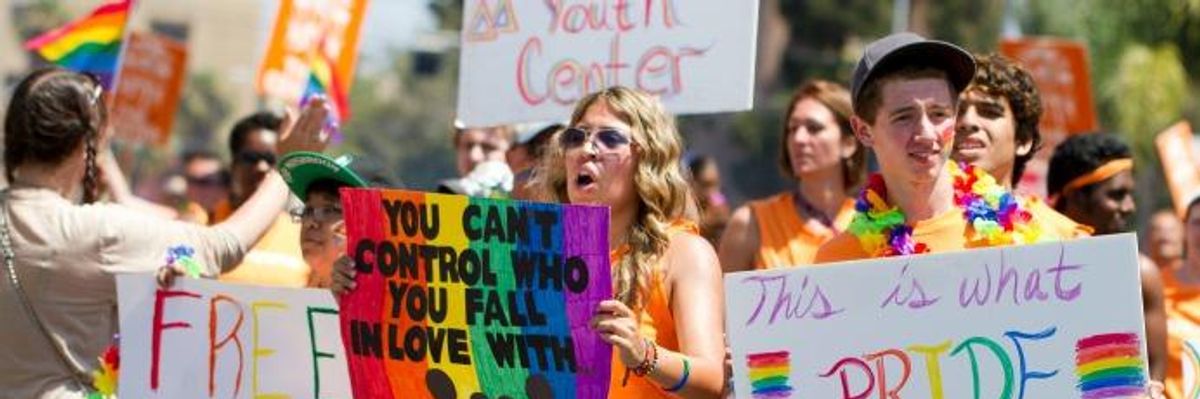
Youth march in a pride parade in San Diego, California in 2012. (Photo: Nathan Rupert/flickr/cc)
The U.S. Centers for Disease Control and Prevention (CDC) on Thursday released a "heartbreaking" new study which found that LGBTQ youths face significantly higher levels of violence than their heterosexual peers.
Lesbian, gay, bisexual, transgender, queer, and questioning teenagers are far more likely to experience violence and bullying, as well as depression and suicide, the CDC found in the first national study to address the health risks of sexual-minority youths.
Roughly 30 percent had been raped, and about 41 percent had been physically abused by a partner. At least a third said they had been bullied on school grounds, and respondents were twice as likely to have been threatened or injured with a weapon on school property--which in turn increased the number of times they skipped class because of safety concerns.
More than 40 percent said they had seriously considered suicide, and 29 percent said they had tried. Six percent said they had used heroin, compared to 1.3 percent of their straight peers.
"Anti-LGBTQ bullying and harassment have serious and heartbreaking consequences for young people and these numbers make that more clear than ever," said Mary Beth Maxwell, senior vice president for research, training, and programs at the Human Rights Campaign (HRC).
"This is a call to action to support and protect our young people. From the messages youth receive at their kitchen table, in their classroom, and on prime-time T.V., we all must do more to put an end to anti-LGBTQ stigma. Policymakers, for one, can start with the passage and implementation of local, state, and federal anti-bullying policies and nondiscrimination protections," Maxwell said.
The study also marks the first time that the federal government's Youth Risk Behavior Survey looked at sexual identity. About 8 percent, or 1.3 million high school students, identify as LGBTQ, the study found.
The CDC surveyed about 15,600 students aged 14-17 across the country.
"I found the numbers heartbreaking," CDC senior official Dr. Jonathan Mermin told the New York Times.
Dr. Elizabeth Miller, chief of adolescent and young adult medicine at the Children's Hospital of Pittsburgh, added, "The intensity of homophobic attitudes and acceptance of gay-related victimization, as well as the ongoing silence around adolescent sexuality, marginalizes a whole group of young people."
The Times also noted:
Dr. Miller also pointed out that the report implicitly underscores the fluidity of adolescent sexual identity. When asked to identify themselves sexually, 3.2 percent of students chose "not sure." Among students who said they had "sexual contact" with only people of the same sex or with both sexes, 25 percent identified as heterosexual and 13.6 percent said they were not sure of their sexual identity. Among students who had sexual contact only with someone of the opposite sex, 2.8 percent nonetheless described themselves as gay, lesbian or bisexual.
"We have to start conversations early with young people about healthy sexuality, attraction, relationships, intimacy and how to explore those feelings in as safe and respectful a way as possible," Dr. Miller said.
Dr. Mermin added, "Nations are judged by the health and well-being of their children. Many would find these levels of physical and sexual violence unacceptable and something we should act on quickly."
Trump and Musk are on an unconstitutional rampage, aiming for virtually every corner of the federal government. These two right-wing billionaires are targeting nurses, scientists, teachers, daycare providers, judges, veterans, air traffic controllers, and nuclear safety inspectors. No one is safe. The food stamps program, Social Security, Medicare, and Medicaid are next. It’s an unprecedented disaster and a five-alarm fire, but there will be a reckoning. The people did not vote for this. The American people do not want this dystopian hellscape that hides behind claims of “efficiency.” Still, in reality, it is all a giveaway to corporate interests and the libertarian dreams of far-right oligarchs like Musk. Common Dreams is playing a vital role by reporting day and night on this orgy of corruption and greed, as well as what everyday people can do to organize and fight back. As a people-powered nonprofit news outlet, we cover issues the corporate media never will, but we can only continue with our readers’ support. |
The U.S. Centers for Disease Control and Prevention (CDC) on Thursday released a "heartbreaking" new study which found that LGBTQ youths face significantly higher levels of violence than their heterosexual peers.
Lesbian, gay, bisexual, transgender, queer, and questioning teenagers are far more likely to experience violence and bullying, as well as depression and suicide, the CDC found in the first national study to address the health risks of sexual-minority youths.
Roughly 30 percent had been raped, and about 41 percent had been physically abused by a partner. At least a third said they had been bullied on school grounds, and respondents were twice as likely to have been threatened or injured with a weapon on school property--which in turn increased the number of times they skipped class because of safety concerns.
More than 40 percent said they had seriously considered suicide, and 29 percent said they had tried. Six percent said they had used heroin, compared to 1.3 percent of their straight peers.
"Anti-LGBTQ bullying and harassment have serious and heartbreaking consequences for young people and these numbers make that more clear than ever," said Mary Beth Maxwell, senior vice president for research, training, and programs at the Human Rights Campaign (HRC).
"This is a call to action to support and protect our young people. From the messages youth receive at their kitchen table, in their classroom, and on prime-time T.V., we all must do more to put an end to anti-LGBTQ stigma. Policymakers, for one, can start with the passage and implementation of local, state, and federal anti-bullying policies and nondiscrimination protections," Maxwell said.
The study also marks the first time that the federal government's Youth Risk Behavior Survey looked at sexual identity. About 8 percent, or 1.3 million high school students, identify as LGBTQ, the study found.
The CDC surveyed about 15,600 students aged 14-17 across the country.
"I found the numbers heartbreaking," CDC senior official Dr. Jonathan Mermin told the New York Times.
Dr. Elizabeth Miller, chief of adolescent and young adult medicine at the Children's Hospital of Pittsburgh, added, "The intensity of homophobic attitudes and acceptance of gay-related victimization, as well as the ongoing silence around adolescent sexuality, marginalizes a whole group of young people."
The Times also noted:
Dr. Miller also pointed out that the report implicitly underscores the fluidity of adolescent sexual identity. When asked to identify themselves sexually, 3.2 percent of students chose "not sure." Among students who said they had "sexual contact" with only people of the same sex or with both sexes, 25 percent identified as heterosexual and 13.6 percent said they were not sure of their sexual identity. Among students who had sexual contact only with someone of the opposite sex, 2.8 percent nonetheless described themselves as gay, lesbian or bisexual.
"We have to start conversations early with young people about healthy sexuality, attraction, relationships, intimacy and how to explore those feelings in as safe and respectful a way as possible," Dr. Miller said.
Dr. Mermin added, "Nations are judged by the health and well-being of their children. Many would find these levels of physical and sexual violence unacceptable and something we should act on quickly."
The U.S. Centers for Disease Control and Prevention (CDC) on Thursday released a "heartbreaking" new study which found that LGBTQ youths face significantly higher levels of violence than their heterosexual peers.
Lesbian, gay, bisexual, transgender, queer, and questioning teenagers are far more likely to experience violence and bullying, as well as depression and suicide, the CDC found in the first national study to address the health risks of sexual-minority youths.
Roughly 30 percent had been raped, and about 41 percent had been physically abused by a partner. At least a third said they had been bullied on school grounds, and respondents were twice as likely to have been threatened or injured with a weapon on school property--which in turn increased the number of times they skipped class because of safety concerns.
More than 40 percent said they had seriously considered suicide, and 29 percent said they had tried. Six percent said they had used heroin, compared to 1.3 percent of their straight peers.
"Anti-LGBTQ bullying and harassment have serious and heartbreaking consequences for young people and these numbers make that more clear than ever," said Mary Beth Maxwell, senior vice president for research, training, and programs at the Human Rights Campaign (HRC).
"This is a call to action to support and protect our young people. From the messages youth receive at their kitchen table, in their classroom, and on prime-time T.V., we all must do more to put an end to anti-LGBTQ stigma. Policymakers, for one, can start with the passage and implementation of local, state, and federal anti-bullying policies and nondiscrimination protections," Maxwell said.
The study also marks the first time that the federal government's Youth Risk Behavior Survey looked at sexual identity. About 8 percent, or 1.3 million high school students, identify as LGBTQ, the study found.
The CDC surveyed about 15,600 students aged 14-17 across the country.
"I found the numbers heartbreaking," CDC senior official Dr. Jonathan Mermin told the New York Times.
Dr. Elizabeth Miller, chief of adolescent and young adult medicine at the Children's Hospital of Pittsburgh, added, "The intensity of homophobic attitudes and acceptance of gay-related victimization, as well as the ongoing silence around adolescent sexuality, marginalizes a whole group of young people."
The Times also noted:
Dr. Miller also pointed out that the report implicitly underscores the fluidity of adolescent sexual identity. When asked to identify themselves sexually, 3.2 percent of students chose "not sure." Among students who said they had "sexual contact" with only people of the same sex or with both sexes, 25 percent identified as heterosexual and 13.6 percent said they were not sure of their sexual identity. Among students who had sexual contact only with someone of the opposite sex, 2.8 percent nonetheless described themselves as gay, lesbian or bisexual.
"We have to start conversations early with young people about healthy sexuality, attraction, relationships, intimacy and how to explore those feelings in as safe and respectful a way as possible," Dr. Miller said.
Dr. Mermin added, "Nations are judged by the health and well-being of their children. Many would find these levels of physical and sexual violence unacceptable and something we should act on quickly."