SUBSCRIBE TO OUR FREE NEWSLETTER
Daily news & progressive opinion—funded by the people, not the corporations—delivered straight to your inbox.
5
#000000
#FFFFFF
To donate by check, phone, or other method, see our More Ways to Give page.
Daily news & progressive opinion—funded by the people, not the corporations—delivered straight to your inbox.
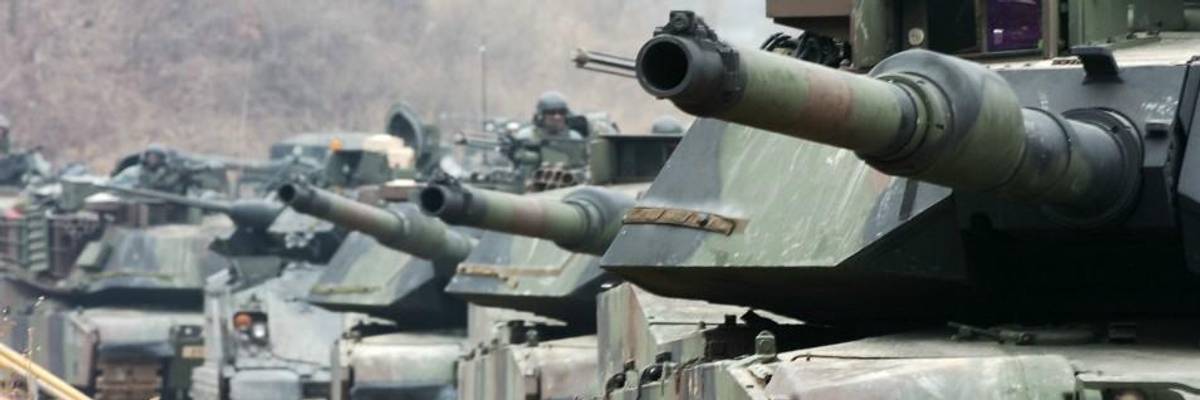
U.S. soldiers in South Korea train in their Abrams tanks. (Photo: Spc. Christen Best/U.S. Army)
NBC reports that a US convoy of light armored vehicles carrying special operations forces has been sighted heading from Iraq into northeast Syria and then south to the oil-rich Deir al-Zor province, with attack helicopters hovering above. You have to wonder if the Kurds pelted them with rotten vegetables again as they passed through Hasaka.
The U.S. military and political establishment was extremely upset by Trump's withdrawal of 1,000 US troops from northeast Syria, where they had been embedded with Kurdish People's Protection Units (YPG), much to the distress of Turkey, which views the YPG as a terrorist organization.
Madeleine Carlisle at Time magazine explains that the US destroyed most Syrian oil facilities to deny them to ISIL, and while the Kurdish forces have restored a few, most are inoperative until extensive repairs can be carried out. She quotes experts as highly skeptical that ISIL could retake the oil fields and get anything out of them any time soon.
But her best insight is that Trump has a weird fixation on Middle Eastern oil, having said that the U.S. should have "taken" Iraqi oil before departing in 2011 and insisting that Middle Eastern states should pay the U.S. from oil proceeds for the security umbrella it gives them.
She quotes Dana Stroul as saying that the administration officials who want to keep troops in Syria found a way to manipulate Trump into allowing that by telling him that they would be securing Syria's oil.
That sounds about right to me.
Meanwhile, Jim Heintz at AP reports that Russia is extremely upset about this return of the American military, branding the seizure of the oil fields in Deir al-Zor an act of "banditry." He pointed out that Syria oil resources do not belong to the United States.
Russian propaganda websites in Arabic are charging that the U.S. military is actually pumping Syrian oil and exporting it to "other countries." I presume that they are attempting to stir anti-Americanism by this false accusation, including an implication that the U.S. is giving Syrian oil to Israel.
Meanwhile, Syrian officials are reaching out to Arab states such as Egypt, charging that Trump is using Turkish president Tayyip Erdogan to rip apart the Arab world. The Egyptian government hates Erdogan anyway because of his support of the Muslim Brotherhood, which Cairo brands a terrorist organization. But Syria is attempting to wedge that hatred of Erdogan into a turn toward anti-Americanism in the Arab world.
Russian media is also helping along this perception with its false reports of the U.S. military pumping and exporting Syrian oil to "other states."
While these ploys are unlikely to wean the Egyptian government away from the U.S., you can only imagine that U.S. allies in the Middle East are running for the exits after Trump threw the Kurds under the bus, and reevaluating their American alliance.
Dear Common Dreams reader, It’s been nearly 30 years since I co-founded Common Dreams with my late wife, Lina Newhouser. We had the radical notion that journalism should serve the public good, not corporate profits. It was clear to us from the outset what it would take to build such a project. No paid advertisements. No corporate sponsors. No millionaire publisher telling us what to think or do. Many people said we wouldn't last a year, but we proved those doubters wrong. Together with a tremendous team of journalists and dedicated staff, we built an independent media outlet free from the constraints of profits and corporate control. Our mission has always been simple: To inform. To inspire. To ignite change for the common good. Building Common Dreams was not easy. Our survival was never guaranteed. When you take on the most powerful forces—Wall Street greed, fossil fuel industry destruction, Big Tech lobbyists, and uber-rich oligarchs who have spent billions upon billions rigging the economy and democracy in their favor—the only bulwark you have is supporters who believe in your work. But here’s the urgent message from me today. It's never been this bad out there. And it's never been this hard to keep us going. At the very moment Common Dreams is most needed, the threats we face are intensifying. We need your support now more than ever. We don't accept corporate advertising and never will. We don't have a paywall because we don't think people should be blocked from critical news based on their ability to pay. Everything we do is funded by the donations of readers like you. When everyone does the little they can afford, we are strong. But if that support retreats or dries up, so do we. Will you donate now to make sure Common Dreams not only survives but thrives? —Craig Brown, Co-founder |
NBC reports that a US convoy of light armored vehicles carrying special operations forces has been sighted heading from Iraq into northeast Syria and then south to the oil-rich Deir al-Zor province, with attack helicopters hovering above. You have to wonder if the Kurds pelted them with rotten vegetables again as they passed through Hasaka.
The U.S. military and political establishment was extremely upset by Trump's withdrawal of 1,000 US troops from northeast Syria, where they had been embedded with Kurdish People's Protection Units (YPG), much to the distress of Turkey, which views the YPG as a terrorist organization.
Madeleine Carlisle at Time magazine explains that the US destroyed most Syrian oil facilities to deny them to ISIL, and while the Kurdish forces have restored a few, most are inoperative until extensive repairs can be carried out. She quotes experts as highly skeptical that ISIL could retake the oil fields and get anything out of them any time soon.
But her best insight is that Trump has a weird fixation on Middle Eastern oil, having said that the U.S. should have "taken" Iraqi oil before departing in 2011 and insisting that Middle Eastern states should pay the U.S. from oil proceeds for the security umbrella it gives them.
She quotes Dana Stroul as saying that the administration officials who want to keep troops in Syria found a way to manipulate Trump into allowing that by telling him that they would be securing Syria's oil.
That sounds about right to me.
Meanwhile, Jim Heintz at AP reports that Russia is extremely upset about this return of the American military, branding the seizure of the oil fields in Deir al-Zor an act of "banditry." He pointed out that Syria oil resources do not belong to the United States.
Russian propaganda websites in Arabic are charging that the U.S. military is actually pumping Syrian oil and exporting it to "other countries." I presume that they are attempting to stir anti-Americanism by this false accusation, including an implication that the U.S. is giving Syrian oil to Israel.
Meanwhile, Syrian officials are reaching out to Arab states such as Egypt, charging that Trump is using Turkish president Tayyip Erdogan to rip apart the Arab world. The Egyptian government hates Erdogan anyway because of his support of the Muslim Brotherhood, which Cairo brands a terrorist organization. But Syria is attempting to wedge that hatred of Erdogan into a turn toward anti-Americanism in the Arab world.
Russian media is also helping along this perception with its false reports of the U.S. military pumping and exporting Syrian oil to "other states."
While these ploys are unlikely to wean the Egyptian government away from the U.S., you can only imagine that U.S. allies in the Middle East are running for the exits after Trump threw the Kurds under the bus, and reevaluating their American alliance.
NBC reports that a US convoy of light armored vehicles carrying special operations forces has been sighted heading from Iraq into northeast Syria and then south to the oil-rich Deir al-Zor province, with attack helicopters hovering above. You have to wonder if the Kurds pelted them with rotten vegetables again as they passed through Hasaka.
The U.S. military and political establishment was extremely upset by Trump's withdrawal of 1,000 US troops from northeast Syria, where they had been embedded with Kurdish People's Protection Units (YPG), much to the distress of Turkey, which views the YPG as a terrorist organization.
Madeleine Carlisle at Time magazine explains that the US destroyed most Syrian oil facilities to deny them to ISIL, and while the Kurdish forces have restored a few, most are inoperative until extensive repairs can be carried out. She quotes experts as highly skeptical that ISIL could retake the oil fields and get anything out of them any time soon.
But her best insight is that Trump has a weird fixation on Middle Eastern oil, having said that the U.S. should have "taken" Iraqi oil before departing in 2011 and insisting that Middle Eastern states should pay the U.S. from oil proceeds for the security umbrella it gives them.
She quotes Dana Stroul as saying that the administration officials who want to keep troops in Syria found a way to manipulate Trump into allowing that by telling him that they would be securing Syria's oil.
That sounds about right to me.
Meanwhile, Jim Heintz at AP reports that Russia is extremely upset about this return of the American military, branding the seizure of the oil fields in Deir al-Zor an act of "banditry." He pointed out that Syria oil resources do not belong to the United States.
Russian propaganda websites in Arabic are charging that the U.S. military is actually pumping Syrian oil and exporting it to "other countries." I presume that they are attempting to stir anti-Americanism by this false accusation, including an implication that the U.S. is giving Syrian oil to Israel.
Meanwhile, Syrian officials are reaching out to Arab states such as Egypt, charging that Trump is using Turkish president Tayyip Erdogan to rip apart the Arab world. The Egyptian government hates Erdogan anyway because of his support of the Muslim Brotherhood, which Cairo brands a terrorist organization. But Syria is attempting to wedge that hatred of Erdogan into a turn toward anti-Americanism in the Arab world.
Russian media is also helping along this perception with its false reports of the U.S. military pumping and exporting Syrian oil to "other states."
While these ploys are unlikely to wean the Egyptian government away from the U.S., you can only imagine that U.S. allies in the Middle East are running for the exits after Trump threw the Kurds under the bus, and reevaluating their American alliance.