

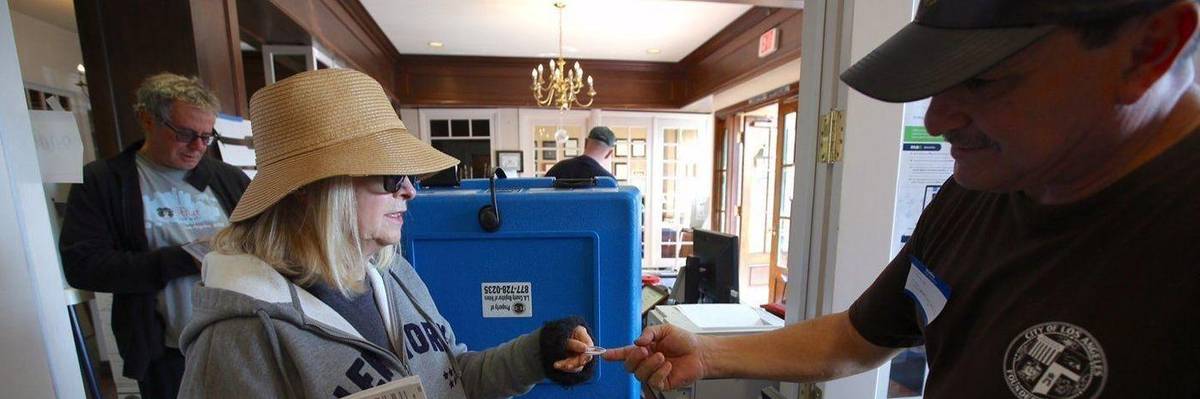
A woman gets "I Voted" sticker from poll worker Tony Dominguez at polling station set-up in a real estate office in Los Angeles on May 19, 2015. (Irfan Khan / Los Angeles Times)
Why Baby Boomers Should Vote Like Their Kids This November
The middle of this century will be theirs to navigate. We can give them a boost.
But if our generation is wary, what are our kids thinking? Many of us have healthcare plans, pensions, savings, Social Security and Medicare. Our kids are likely to have none of that.
When we were growing up, there were new highways being built, bridges erected, mass transit created and water treatment systems invented. Our kids have seen little in the way of public works improvement.
Instead, their future is overshadowed with serious problems: low wage growth, climate change, the collapse of basic healthcare and a rollback of reproductive health services.
Our kids are wise enough to see their crumbling future and inspired enough not to despair in the face of it.
The federal government's ability to address these problems is increasingly hogtied by national debt: $21 trillion at present, or about $1 million for every high school student in the country.
Our kids live in a different society than our generation does, and it's a crueler and more precarious one. This makes us mad and sad in equal measure. And it means voters our age need to change how we do things at the voting booth.
Younger generations were adamant in 2016 that Bernie Sanders was the beginning of an answer. They saw in him, if not a savior, the only national politician willing to acknowledge their predicament.
We worked our way up through companies for decades. Not them. Jobs today are increasingly specialized, and career advancement is attained by quitting and moving to a new company.
We got health insurance through our long-term employers. Now that employers have little loyalty to employees, our kids need healthcare that doesn't hinge on a job.
How many of us got a college education and launched into life nearly debt-free? Not them. They will be saddled with student debt the magnitude of which was unheard of in our day.
How many of us bought starter homes in new neighborhoods with good public schools? Not them. In the few cities with good tech jobs, even starter apartments are virtually out of reach.
There are solutions to these problems. Nearly every advanced society in the world is doing a better job of finding them than we are. In America, clearly, fixes are not going to come from our senior political leaders, big companies or the clergy.
Rather, solutions are bubbling up from a new crop of politicians who are willing to face the world our kids live in, because they themselves live in the same world. This diverse set talks of investing in healthcare for all, education for all, infrastructure for the future and jobs that value workers.
The main reason we recognize the potential in these candidates is because our kids know about them, and tell us. Their solutions may not seem perfect, or perfectly practical, to our generation. But at least these hopefuls are grappling directly with the intractable problems our kids will need to solve.
Some of these candidates are on the national radar. Alexandria Ocasio-Cortez, in New York, who defeated Rep. Joseph Crowley in the Democratic race for the House. Beto O'Rourke, the 45-year-old congressman from El Paso who is closing in on Ted Cruz's Senate seat.
But the few who have attracted headlines are not alone. A whole wave of younger, bolder, more diverse candidates is emerging. They are running for school board seats, county administrators, state representatives. With our help, this new wave could crest.
In the next few weeks, we ought to listen to our kids. Ask them whom to vote for and why. Perhaps we won't agree with their choices, but we ought to believe in them enough to vote their way anyway. The middle of this century will be theirs to navigate. They need and deserve the power to begin forging a path through it. We can give them a boost.
For the first time in our country's history, the next generation will be worse off than our own. Our kids are wise enough to see their crumbling future and inspired enough not to despair in the face of it. Why not prioritize their needs in the midterm elections?
Signs in our neighborhood read, "Drive like your kids live here." In that spirit, this November, vote like your kids live here. Because they do.
An Urgent Message From Our Co-Founder
Dear Common Dreams reader, It’s been nearly 30 years since I co-founded Common Dreams with my late wife, Lina Newhouser. We had the radical notion that journalism should serve the public good, not corporate profits. It was clear to us from the outset what it would take to build such a project. No paid advertisements. No corporate sponsors. No millionaire publisher telling us what to think or do. Many people said we wouldn't last a year, but we proved those doubters wrong. Together with a tremendous team of journalists and dedicated staff, we built an independent media outlet free from the constraints of profits and corporate control. Our mission has always been simple: To inform. To inspire. To ignite change for the common good. Building Common Dreams was not easy. Our survival was never guaranteed. When you take on the most powerful forces—Wall Street greed, fossil fuel industry destruction, Big Tech lobbyists, and uber-rich oligarchs who have spent billions upon billions rigging the economy and democracy in their favor—the only bulwark you have is supporters who believe in your work. But here’s the urgent message from me today. It's never been this bad out there. And it's never been this hard to keep us going. At the very moment Common Dreams is most needed, the threats we face are intensifying. We need your support now more than ever. We don't accept corporate advertising and never will. We don't have a paywall because we don't think people should be blocked from critical news based on their ability to pay. Everything we do is funded by the donations of readers like you. When everyone does the little they can afford, we are strong. But if that support retreats or dries up, so do we. Will you donate now to make sure Common Dreams not only survives but thrives? —Craig Brown, Co-founder |
But if our generation is wary, what are our kids thinking? Many of us have healthcare plans, pensions, savings, Social Security and Medicare. Our kids are likely to have none of that.
When we were growing up, there were new highways being built, bridges erected, mass transit created and water treatment systems invented. Our kids have seen little in the way of public works improvement.
Instead, their future is overshadowed with serious problems: low wage growth, climate change, the collapse of basic healthcare and a rollback of reproductive health services.
Our kids are wise enough to see their crumbling future and inspired enough not to despair in the face of it.
The federal government's ability to address these problems is increasingly hogtied by national debt: $21 trillion at present, or about $1 million for every high school student in the country.
Our kids live in a different society than our generation does, and it's a crueler and more precarious one. This makes us mad and sad in equal measure. And it means voters our age need to change how we do things at the voting booth.
Younger generations were adamant in 2016 that Bernie Sanders was the beginning of an answer. They saw in him, if not a savior, the only national politician willing to acknowledge their predicament.
We worked our way up through companies for decades. Not them. Jobs today are increasingly specialized, and career advancement is attained by quitting and moving to a new company.
We got health insurance through our long-term employers. Now that employers have little loyalty to employees, our kids need healthcare that doesn't hinge on a job.
How many of us got a college education and launched into life nearly debt-free? Not them. They will be saddled with student debt the magnitude of which was unheard of in our day.
How many of us bought starter homes in new neighborhoods with good public schools? Not them. In the few cities with good tech jobs, even starter apartments are virtually out of reach.
There are solutions to these problems. Nearly every advanced society in the world is doing a better job of finding them than we are. In America, clearly, fixes are not going to come from our senior political leaders, big companies or the clergy.
Rather, solutions are bubbling up from a new crop of politicians who are willing to face the world our kids live in, because they themselves live in the same world. This diverse set talks of investing in healthcare for all, education for all, infrastructure for the future and jobs that value workers.
The main reason we recognize the potential in these candidates is because our kids know about them, and tell us. Their solutions may not seem perfect, or perfectly practical, to our generation. But at least these hopefuls are grappling directly with the intractable problems our kids will need to solve.
Some of these candidates are on the national radar. Alexandria Ocasio-Cortez, in New York, who defeated Rep. Joseph Crowley in the Democratic race for the House. Beto O'Rourke, the 45-year-old congressman from El Paso who is closing in on Ted Cruz's Senate seat.
But the few who have attracted headlines are not alone. A whole wave of younger, bolder, more diverse candidates is emerging. They are running for school board seats, county administrators, state representatives. With our help, this new wave could crest.
In the next few weeks, we ought to listen to our kids. Ask them whom to vote for and why. Perhaps we won't agree with their choices, but we ought to believe in them enough to vote their way anyway. The middle of this century will be theirs to navigate. They need and deserve the power to begin forging a path through it. We can give them a boost.
For the first time in our country's history, the next generation will be worse off than our own. Our kids are wise enough to see their crumbling future and inspired enough not to despair in the face of it. Why not prioritize their needs in the midterm elections?
Signs in our neighborhood read, "Drive like your kids live here." In that spirit, this November, vote like your kids live here. Because they do.
But if our generation is wary, what are our kids thinking? Many of us have healthcare plans, pensions, savings, Social Security and Medicare. Our kids are likely to have none of that.
When we were growing up, there were new highways being built, bridges erected, mass transit created and water treatment systems invented. Our kids have seen little in the way of public works improvement.
Instead, their future is overshadowed with serious problems: low wage growth, climate change, the collapse of basic healthcare and a rollback of reproductive health services.
Our kids are wise enough to see their crumbling future and inspired enough not to despair in the face of it.
The federal government's ability to address these problems is increasingly hogtied by national debt: $21 trillion at present, or about $1 million for every high school student in the country.
Our kids live in a different society than our generation does, and it's a crueler and more precarious one. This makes us mad and sad in equal measure. And it means voters our age need to change how we do things at the voting booth.
Younger generations were adamant in 2016 that Bernie Sanders was the beginning of an answer. They saw in him, if not a savior, the only national politician willing to acknowledge their predicament.
We worked our way up through companies for decades. Not them. Jobs today are increasingly specialized, and career advancement is attained by quitting and moving to a new company.
We got health insurance through our long-term employers. Now that employers have little loyalty to employees, our kids need healthcare that doesn't hinge on a job.
How many of us got a college education and launched into life nearly debt-free? Not them. They will be saddled with student debt the magnitude of which was unheard of in our day.
How many of us bought starter homes in new neighborhoods with good public schools? Not them. In the few cities with good tech jobs, even starter apartments are virtually out of reach.
There are solutions to these problems. Nearly every advanced society in the world is doing a better job of finding them than we are. In America, clearly, fixes are not going to come from our senior political leaders, big companies or the clergy.
Rather, solutions are bubbling up from a new crop of politicians who are willing to face the world our kids live in, because they themselves live in the same world. This diverse set talks of investing in healthcare for all, education for all, infrastructure for the future and jobs that value workers.
The main reason we recognize the potential in these candidates is because our kids know about them, and tell us. Their solutions may not seem perfect, or perfectly practical, to our generation. But at least these hopefuls are grappling directly with the intractable problems our kids will need to solve.
Some of these candidates are on the national radar. Alexandria Ocasio-Cortez, in New York, who defeated Rep. Joseph Crowley in the Democratic race for the House. Beto O'Rourke, the 45-year-old congressman from El Paso who is closing in on Ted Cruz's Senate seat.
But the few who have attracted headlines are not alone. A whole wave of younger, bolder, more diverse candidates is emerging. They are running for school board seats, county administrators, state representatives. With our help, this new wave could crest.
In the next few weeks, we ought to listen to our kids. Ask them whom to vote for and why. Perhaps we won't agree with their choices, but we ought to believe in them enough to vote their way anyway. The middle of this century will be theirs to navigate. They need and deserve the power to begin forging a path through it. We can give them a boost.
For the first time in our country's history, the next generation will be worse off than our own. Our kids are wise enough to see their crumbling future and inspired enough not to despair in the face of it. Why not prioritize their needs in the midterm elections?
Signs in our neighborhood read, "Drive like your kids live here." In that spirit, this November, vote like your kids live here. Because they do.