SUBSCRIBE TO OUR FREE NEWSLETTER
Daily news & progressive opinion—funded by the people, not the corporations—delivered straight to your inbox.
5
#000000
#FFFFFF
To donate by check, phone, or other method, see our More Ways to Give page.
NAFTA, the free trade agreement between Canada, the USA, and Mexico that went into effect in 1994, was the first trade agreement among developed countries to include an investor-state provision (ISDS). This provision grants investors on the continent the right to sue one another's governments without first pursuing legal action through the country's legal system. Before NAFTA, ISDS provisions were only negotiated between developed and undeveloped countries.
As a result of NAFTA's ISDS challenges, Canada is now the most sued developed country in the world. Canada has been sued more times than either the U.S. or Mexico. Of the 77 known NAFTA investor-state claims, 35 have been against Canada, 22 have targeted Mexico and 20 have targeted the US. The US government has won 11 of its cases and never lost a NAFTA investor-state case or paid any compensation to Canadian or Mexican companies.
This is evidence that even though trade agreements appear to treat all parties equally, the more powerful countries are usually more immune to trade challenges.
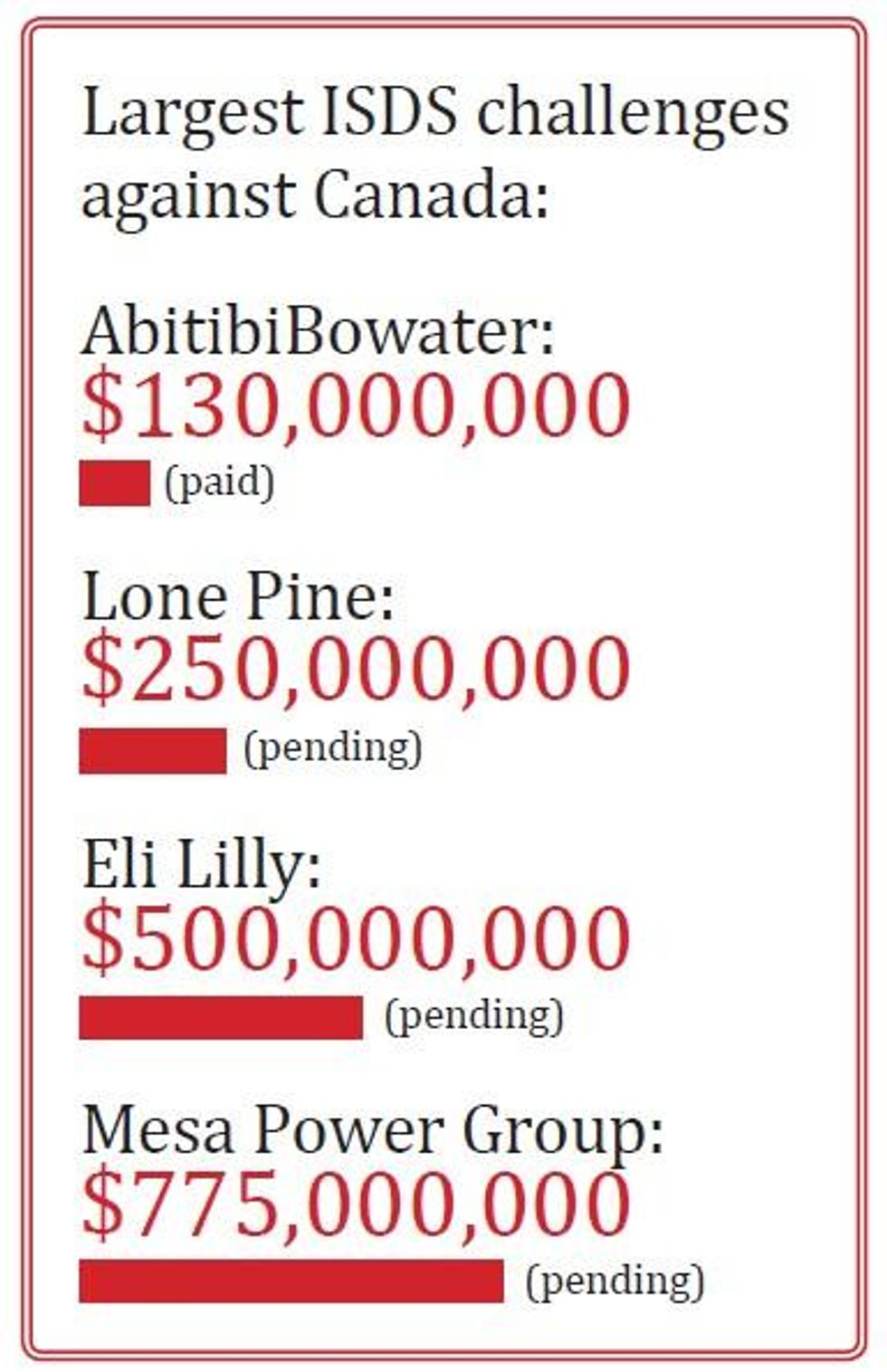
Canada has paid American corporations more than $200 million (approximately EUR135 million) in the seven cases it has lost and foreign investors are now seeking over $6 billion (approximately EUR4 billion) from the Canadian government in new cases. Even defending cases that may not be successful is expensive. Canada has spent over $65 million (approximately EUR45 million) defending itself from NAFTA challenges.
The Canadian Centre for Policy Alternatives reports that almost two-thirds of claims against Canada involved environmental protection or resources management challenges that allegedly interfered with American corporations' profit.
Cases include:
These, and other examples show that trade and investment agreements such as NAFTA give transnational corporations incredible new rights to impose their will on governments. But they are probably just the tip of the iceberg because many new laws or changes to laws never come to light because of the "chill effect" of prior restraint. The Canadian government adopted a new policy soon after NAFTA was adopted whereby all new laws and any changes to existing laws have to be vetted by trade experts to ensure they are not challengeable under ISDS rules.
NAFTA, the free trade agreement between Canada, the USA, and Mexico that went into effect in 1994, was the first trade agreement among developed countries to include an investor-state provision (ISDS). This provision grants investors on the continent the right to sue one another's governments without first pursuing legal action through the country's legal system. Before NAFTA, ISDS provisions were only negotiated between developed and undeveloped countries.
As a result of NAFTA's ISDS challenges, Canada is now the most sued developed country in the world. Canada has been sued more times than either the U.S. or Mexico. Of the 77 known NAFTA investor-state claims, 35 have been against Canada, 22 have targeted Mexico and 20 have targeted the US. The US government has won 11 of its cases and never lost a NAFTA investor-state case or paid any compensation to Canadian or Mexican companies.
This is evidence that even though trade agreements appear to treat all parties equally, the more powerful countries are usually more immune to trade challenges.
Canada has paid American corporations more than $200 million (approximately EUR135 million) in the seven cases it has lost and foreign investors are now seeking over $6 billion (approximately EUR4 billion) from the Canadian government in new cases. Even defending cases that may not be successful is expensive. Canada has spent over $65 million (approximately EUR45 million) defending itself from NAFTA challenges.
The Canadian Centre for Policy Alternatives reports that almost two-thirds of claims against Canada involved environmental protection or resources management challenges that allegedly interfered with American corporations' profit.
Cases include:
These, and other examples show that trade and investment agreements such as NAFTA give transnational corporations incredible new rights to impose their will on governments. But they are probably just the tip of the iceberg because many new laws or changes to laws never come to light because of the "chill effect" of prior restraint. The Canadian government adopted a new policy soon after NAFTA was adopted whereby all new laws and any changes to existing laws have to be vetted by trade experts to ensure they are not challengeable under ISDS rules.
NAFTA, the free trade agreement between Canada, the USA, and Mexico that went into effect in 1994, was the first trade agreement among developed countries to include an investor-state provision (ISDS). This provision grants investors on the continent the right to sue one another's governments without first pursuing legal action through the country's legal system. Before NAFTA, ISDS provisions were only negotiated between developed and undeveloped countries.
As a result of NAFTA's ISDS challenges, Canada is now the most sued developed country in the world. Canada has been sued more times than either the U.S. or Mexico. Of the 77 known NAFTA investor-state claims, 35 have been against Canada, 22 have targeted Mexico and 20 have targeted the US. The US government has won 11 of its cases and never lost a NAFTA investor-state case or paid any compensation to Canadian or Mexican companies.
This is evidence that even though trade agreements appear to treat all parties equally, the more powerful countries are usually more immune to trade challenges.
Canada has paid American corporations more than $200 million (approximately EUR135 million) in the seven cases it has lost and foreign investors are now seeking over $6 billion (approximately EUR4 billion) from the Canadian government in new cases. Even defending cases that may not be successful is expensive. Canada has spent over $65 million (approximately EUR45 million) defending itself from NAFTA challenges.
The Canadian Centre for Policy Alternatives reports that almost two-thirds of claims against Canada involved environmental protection or resources management challenges that allegedly interfered with American corporations' profit.
Cases include:
These, and other examples show that trade and investment agreements such as NAFTA give transnational corporations incredible new rights to impose their will on governments. But they are probably just the tip of the iceberg because many new laws or changes to laws never come to light because of the "chill effect" of prior restraint. The Canadian government adopted a new policy soon after NAFTA was adopted whereby all new laws and any changes to existing laws have to be vetted by trade experts to ensure they are not challengeable under ISDS rules.