SUBSCRIBE TO OUR FREE NEWSLETTER
Daily news & progressive opinion—funded by the people, not the corporations—delivered straight to your inbox.
5
#000000
#FFFFFF
To donate by check, phone, or other method, see our More Ways to Give page.
Sociologists tell us that the reason an otherwise happily married man will seek the services of a prostitute is because he knows she will do things his wife would never consent to do. Whether or not that explanation is accurate, the same perception appears to be Sweden's reason for embracing the American worker. Judging from their recent actions, Swedish companies are convinced they can get American workers to do things their own citizens would never do.
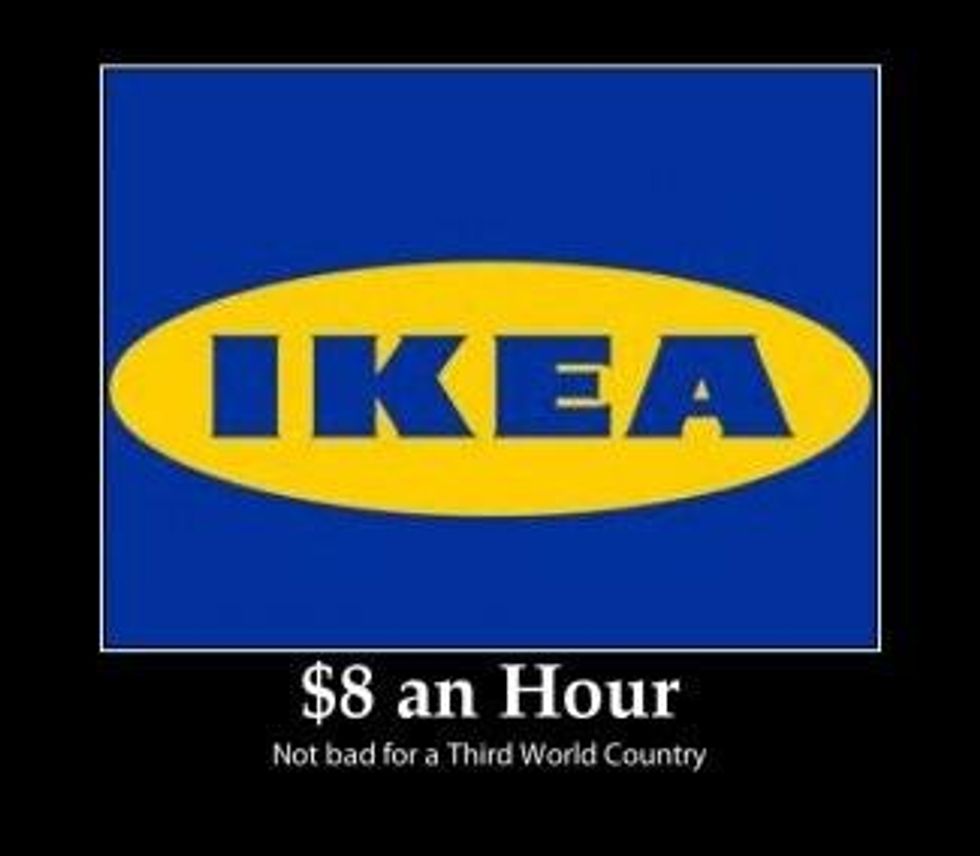
Early evidence of this perception was seen in the draconian measures instituted at Sweden's IKEA manufacturing plant in Danville, Virginia. After getting the local community to pony up more than $12 million in tax breaks and other subsidies (as an inducement for IKEA to locate its factory in this job-starved region of Virginia), it didn't take long for the company to show its true colors.
They not only hired a union-busting outfit to keep the IAM (International Association of Machinists) from making a run at the employees, they proceeded to drastically slash employee wages, and unilaterally modify long-standing work and overtime rules. Needless to say, these measures not only would have been frowned upon by Swedish society, but most of them would've been illegal. They would have been in violation of Sweden's labor laws.
As brutal as the Danville crackdown was, a similar move is occurring at the AAK (AahusKarishamn) oils and fats processing plant, in Louisville, Kentucky. The Louisville plant was formerly owned and operated by Golden Brands, but was sold to the Swedish multinational corporation last July. Despite having had a fairly cooperative relationship with Golden Brands for more than 25 years, once the company changed hands, things turned ugly in a hurry.
Within months, AAK launched an unprecedented anti-union campaign, one that culminated in--and this is going to sound preposterous--the company circulating a decertification petition, urging the fifty members of Chapter 320 of the National Conference of Firemen and Oilers (NCFO/Local 32BJ SEIU) to voluntarily leave their union.
The arrogance and audacity of such a move was mind-boggling. Had management dared circulate a union decertification petition in Sweden, the company's executives would've been strung up by their Buster Browns and pelted with lingenberries.
But when the decert effort failed, AAK became even more determined. The company not only threatened to fire members of the union bargaining committee if they didn't recommend to their fellow workers ratification of a grossly inferior contract, but their negotiators came to the bargaining table armed with a set of ultimatums that would have effectively stripped the union of its legitimacy (including abolishing the union security clause and eliminating seniority rights).
Say what you will about the Swedes, but they're shrewd and resourceful. Accordingly, they were perceptive enough to realize that the United States no longer qualifies, technically, as a "country"--at least not in the way that Sweden qualifies as one.
The U.S. seems to have lost its sense of identity; it no longer feels like a national community. Rather, it has mutated into a gladiatorial arena, a battleground where corporations compete for profits in a merciless zero-sum game, where everything is reduced to winners and losers, and where, unfortunately, the federal labor laws are so weak they practically guarantee that the workers will always be the losers.
Sociologists tell us that the reason an otherwise happily married man will seek the services of a prostitute is because he knows she will do things his wife would never consent to do. Whether or not that explanation is accurate, the same perception appears to be Sweden's reason for embracing the American worker. Judging from their recent actions, Swedish companies are convinced they can get American workers to do things their own citizens would never do.
Early evidence of this perception was seen in the draconian measures instituted at Sweden's IKEA manufacturing plant in Danville, Virginia. After getting the local community to pony up more than $12 million in tax breaks and other subsidies (as an inducement for IKEA to locate its factory in this job-starved region of Virginia), it didn't take long for the company to show its true colors.
They not only hired a union-busting outfit to keep the IAM (International Association of Machinists) from making a run at the employees, they proceeded to drastically slash employee wages, and unilaterally modify long-standing work and overtime rules. Needless to say, these measures not only would have been frowned upon by Swedish society, but most of them would've been illegal. They would have been in violation of Sweden's labor laws.
As brutal as the Danville crackdown was, a similar move is occurring at the AAK (AahusKarishamn) oils and fats processing plant, in Louisville, Kentucky. The Louisville plant was formerly owned and operated by Golden Brands, but was sold to the Swedish multinational corporation last July. Despite having had a fairly cooperative relationship with Golden Brands for more than 25 years, once the company changed hands, things turned ugly in a hurry.
Within months, AAK launched an unprecedented anti-union campaign, one that culminated in--and this is going to sound preposterous--the company circulating a decertification petition, urging the fifty members of Chapter 320 of the National Conference of Firemen and Oilers (NCFO/Local 32BJ SEIU) to voluntarily leave their union.
The arrogance and audacity of such a move was mind-boggling. Had management dared circulate a union decertification petition in Sweden, the company's executives would've been strung up by their Buster Browns and pelted with lingenberries.
But when the decert effort failed, AAK became even more determined. The company not only threatened to fire members of the union bargaining committee if they didn't recommend to their fellow workers ratification of a grossly inferior contract, but their negotiators came to the bargaining table armed with a set of ultimatums that would have effectively stripped the union of its legitimacy (including abolishing the union security clause and eliminating seniority rights).
Say what you will about the Swedes, but they're shrewd and resourceful. Accordingly, they were perceptive enough to realize that the United States no longer qualifies, technically, as a "country"--at least not in the way that Sweden qualifies as one.
The U.S. seems to have lost its sense of identity; it no longer feels like a national community. Rather, it has mutated into a gladiatorial arena, a battleground where corporations compete for profits in a merciless zero-sum game, where everything is reduced to winners and losers, and where, unfortunately, the federal labor laws are so weak they practically guarantee that the workers will always be the losers.
Sociologists tell us that the reason an otherwise happily married man will seek the services of a prostitute is because he knows she will do things his wife would never consent to do. Whether or not that explanation is accurate, the same perception appears to be Sweden's reason for embracing the American worker. Judging from their recent actions, Swedish companies are convinced they can get American workers to do things their own citizens would never do.
Early evidence of this perception was seen in the draconian measures instituted at Sweden's IKEA manufacturing plant in Danville, Virginia. After getting the local community to pony up more than $12 million in tax breaks and other subsidies (as an inducement for IKEA to locate its factory in this job-starved region of Virginia), it didn't take long for the company to show its true colors.
They not only hired a union-busting outfit to keep the IAM (International Association of Machinists) from making a run at the employees, they proceeded to drastically slash employee wages, and unilaterally modify long-standing work and overtime rules. Needless to say, these measures not only would have been frowned upon by Swedish society, but most of them would've been illegal. They would have been in violation of Sweden's labor laws.
As brutal as the Danville crackdown was, a similar move is occurring at the AAK (AahusKarishamn) oils and fats processing plant, in Louisville, Kentucky. The Louisville plant was formerly owned and operated by Golden Brands, but was sold to the Swedish multinational corporation last July. Despite having had a fairly cooperative relationship with Golden Brands for more than 25 years, once the company changed hands, things turned ugly in a hurry.
Within months, AAK launched an unprecedented anti-union campaign, one that culminated in--and this is going to sound preposterous--the company circulating a decertification petition, urging the fifty members of Chapter 320 of the National Conference of Firemen and Oilers (NCFO/Local 32BJ SEIU) to voluntarily leave their union.
The arrogance and audacity of such a move was mind-boggling. Had management dared circulate a union decertification petition in Sweden, the company's executives would've been strung up by their Buster Browns and pelted with lingenberries.
But when the decert effort failed, AAK became even more determined. The company not only threatened to fire members of the union bargaining committee if they didn't recommend to their fellow workers ratification of a grossly inferior contract, but their negotiators came to the bargaining table armed with a set of ultimatums that would have effectively stripped the union of its legitimacy (including abolishing the union security clause and eliminating seniority rights).
Say what you will about the Swedes, but they're shrewd and resourceful. Accordingly, they were perceptive enough to realize that the United States no longer qualifies, technically, as a "country"--at least not in the way that Sweden qualifies as one.
The U.S. seems to have lost its sense of identity; it no longer feels like a national community. Rather, it has mutated into a gladiatorial arena, a battleground where corporations compete for profits in a merciless zero-sum game, where everything is reduced to winners and losers, and where, unfortunately, the federal labor laws are so weak they practically guarantee that the workers will always be the losers.