SUBSCRIBE TO OUR FREE NEWSLETTER
Daily news & progressive opinion—funded by the people, not the corporations—delivered straight to your inbox.
5
#000000
#FFFFFF
To donate by check, phone, or other method, see our More Ways to Give page.
Daily news & progressive opinion—funded by the people, not the corporations—delivered straight to your inbox.
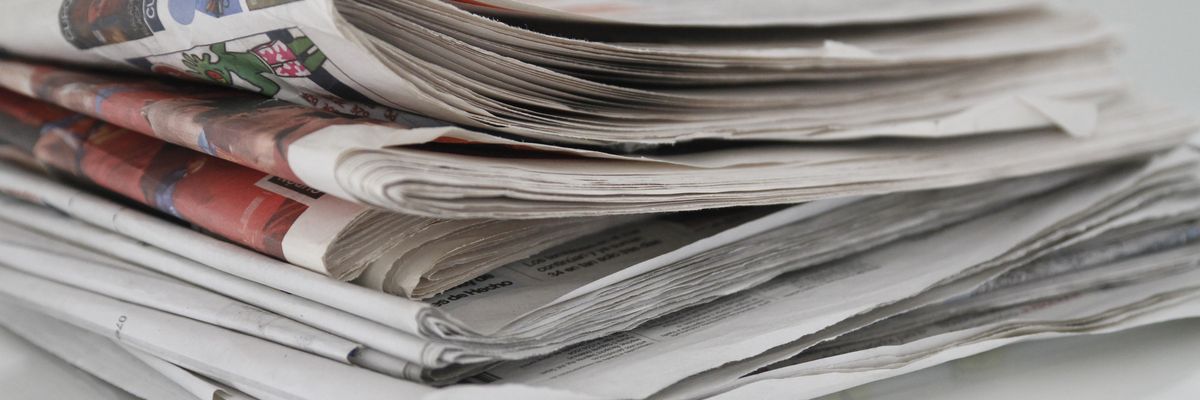
A pile of newspapers is pictured on a table.
"This may feel like a difficult time to call for bold policy change," wrote the advocacy group Free Press. "Yet, this is also a moment of immense opportunity."
Journalism is a public good.
That's the basic premise of a 12-page policy roadmap released Tuesday by Free Press Action, the 501(c)(4) arm of the advocacy group Free Press, and created by members of Media Power Collaborative, an organizing space for media workers and others, which aims to resist journalism's trend towards clickbait, misinformation, and "a shortage of local news that actually meet people's needs."
Instead, the document envisions a transformed media system that enjoys robust public funding and guardrails that safeguard editorial independence. What's needed is a "media system in which the needs of the working and middle classes are valued over corporate profits and the interests of billionaires," according to the authors of the blueprint, which has been endorsed by organizations like the worker-led nonprofit outlet 51st, the National Writers Union, the progressive group Common Cause, and other entities.
So how do we get there? The Media Power Collective outlines a number of actions leaders and policymakers can take that are grouped into categories such as prioritizing "community information needs" and investing in "community-first models to democratize media power."
Under the "community-first models to democratize media power" goal, for example, the blueprint calls for actions like dedicating public subsidies—grants, tax credits, and vouchers—to nonprofit media, public media, community media, BIPOC media, and worker-owned media. If public funding is going to go to commercial outlets, it should be tied to "community-positive factors," like commitments to union neutrality, per the blueprint.
Other actions span a wide range of issues, like halting anti-competitive mergers that impact the media industry, promoting media literacy at the high school level, supporting community colleges as hubs for community information and journalism, and more.
Mike Rispoli, Free Press Action's senior director of journalism and civic information, in a statement Tuesday that "now more than ever, we need to build public support for an independent press that holds power to account and helps people make sense of an increasingly chaotic world around them."
"We're seeing the real consequences of the decades-long collapse of local commercial media: Misinformation is filling the public's news feeds, important government meetings are happening without coverage, and people can't find basic information about what's happening in their neighborhoods," he added.
Neither Free Press Action's statement or the blueprint mentions U.S. President Donald Trump or the conservative policy document Project 2025 by name, but on social media Free Press Action connected the document to the current White House's attacks on press freedom.
"This may feel like a difficult time to call for bold policy change. The new administration is applying pressure to independent journalism, and public media funding will come under attack in the coming months," wrote the group on Bluesky on Tuesday. "Yet, this is also a moment of immense opportunity."
Since his second administration began, Trump has signaled his commitment to continuing his long-running feud with the news media.
In January, the Republican Federal Communications Commission Chair Brendan Carr announced an investigation into the outlets NPR and PBS that could lead to stripping them of government funding. And in a break with precedent, White House Press Secretary Karoline Leavitt announced Tuesday that the administration will now decide which outlets get to participate in the presidential press pool.
Dear Common Dreams reader, It’s been nearly 30 years since I co-founded Common Dreams with my late wife, Lina Newhouser. We had the radical notion that journalism should serve the public good, not corporate profits. It was clear to us from the outset what it would take to build such a project. No paid advertisements. No corporate sponsors. No millionaire publisher telling us what to think or do. Many people said we wouldn't last a year, but we proved those doubters wrong. Together with a tremendous team of journalists and dedicated staff, we built an independent media outlet free from the constraints of profits and corporate control. Our mission has always been simple: To inform. To inspire. To ignite change for the common good. Building Common Dreams was not easy. Our survival was never guaranteed. When you take on the most powerful forces—Wall Street greed, fossil fuel industry destruction, Big Tech lobbyists, and uber-rich oligarchs who have spent billions upon billions rigging the economy and democracy in their favor—the only bulwark you have is supporters who believe in your work. But here’s the urgent message from me today. It's never been this bad out there. And it's never been this hard to keep us going. At the very moment Common Dreams is most needed, the threats we face are intensifying. We need your support now more than ever. We don't accept corporate advertising and never will. We don't have a paywall because we don't think people should be blocked from critical news based on their ability to pay. Everything we do is funded by the donations of readers like you. When everyone does the little they can afford, we are strong. But if that support retreats or dries up, so do we. Will you donate now to make sure Common Dreams not only survives but thrives? —Craig Brown, Co-founder |
Journalism is a public good.
That's the basic premise of a 12-page policy roadmap released Tuesday by Free Press Action, the 501(c)(4) arm of the advocacy group Free Press, and created by members of Media Power Collaborative, an organizing space for media workers and others, which aims to resist journalism's trend towards clickbait, misinformation, and "a shortage of local news that actually meet people's needs."
Instead, the document envisions a transformed media system that enjoys robust public funding and guardrails that safeguard editorial independence. What's needed is a "media system in which the needs of the working and middle classes are valued over corporate profits and the interests of billionaires," according to the authors of the blueprint, which has been endorsed by organizations like the worker-led nonprofit outlet 51st, the National Writers Union, the progressive group Common Cause, and other entities.
So how do we get there? The Media Power Collective outlines a number of actions leaders and policymakers can take that are grouped into categories such as prioritizing "community information needs" and investing in "community-first models to democratize media power."
Under the "community-first models to democratize media power" goal, for example, the blueprint calls for actions like dedicating public subsidies—grants, tax credits, and vouchers—to nonprofit media, public media, community media, BIPOC media, and worker-owned media. If public funding is going to go to commercial outlets, it should be tied to "community-positive factors," like commitments to union neutrality, per the blueprint.
Other actions span a wide range of issues, like halting anti-competitive mergers that impact the media industry, promoting media literacy at the high school level, supporting community colleges as hubs for community information and journalism, and more.
Mike Rispoli, Free Press Action's senior director of journalism and civic information, in a statement Tuesday that "now more than ever, we need to build public support for an independent press that holds power to account and helps people make sense of an increasingly chaotic world around them."
"We're seeing the real consequences of the decades-long collapse of local commercial media: Misinformation is filling the public's news feeds, important government meetings are happening without coverage, and people can't find basic information about what's happening in their neighborhoods," he added.
Neither Free Press Action's statement or the blueprint mentions U.S. President Donald Trump or the conservative policy document Project 2025 by name, but on social media Free Press Action connected the document to the current White House's attacks on press freedom.
"This may feel like a difficult time to call for bold policy change. The new administration is applying pressure to independent journalism, and public media funding will come under attack in the coming months," wrote the group on Bluesky on Tuesday. "Yet, this is also a moment of immense opportunity."
Since his second administration began, Trump has signaled his commitment to continuing his long-running feud with the news media.
In January, the Republican Federal Communications Commission Chair Brendan Carr announced an investigation into the outlets NPR and PBS that could lead to stripping them of government funding. And in a break with precedent, White House Press Secretary Karoline Leavitt announced Tuesday that the administration will now decide which outlets get to participate in the presidential press pool.
Journalism is a public good.
That's the basic premise of a 12-page policy roadmap released Tuesday by Free Press Action, the 501(c)(4) arm of the advocacy group Free Press, and created by members of Media Power Collaborative, an organizing space for media workers and others, which aims to resist journalism's trend towards clickbait, misinformation, and "a shortage of local news that actually meet people's needs."
Instead, the document envisions a transformed media system that enjoys robust public funding and guardrails that safeguard editorial independence. What's needed is a "media system in which the needs of the working and middle classes are valued over corporate profits and the interests of billionaires," according to the authors of the blueprint, which has been endorsed by organizations like the worker-led nonprofit outlet 51st, the National Writers Union, the progressive group Common Cause, and other entities.
So how do we get there? The Media Power Collective outlines a number of actions leaders and policymakers can take that are grouped into categories such as prioritizing "community information needs" and investing in "community-first models to democratize media power."
Under the "community-first models to democratize media power" goal, for example, the blueprint calls for actions like dedicating public subsidies—grants, tax credits, and vouchers—to nonprofit media, public media, community media, BIPOC media, and worker-owned media. If public funding is going to go to commercial outlets, it should be tied to "community-positive factors," like commitments to union neutrality, per the blueprint.
Other actions span a wide range of issues, like halting anti-competitive mergers that impact the media industry, promoting media literacy at the high school level, supporting community colleges as hubs for community information and journalism, and more.
Mike Rispoli, Free Press Action's senior director of journalism and civic information, in a statement Tuesday that "now more than ever, we need to build public support for an independent press that holds power to account and helps people make sense of an increasingly chaotic world around them."
"We're seeing the real consequences of the decades-long collapse of local commercial media: Misinformation is filling the public's news feeds, important government meetings are happening without coverage, and people can't find basic information about what's happening in their neighborhoods," he added.
Neither Free Press Action's statement or the blueprint mentions U.S. President Donald Trump or the conservative policy document Project 2025 by name, but on social media Free Press Action connected the document to the current White House's attacks on press freedom.
"This may feel like a difficult time to call for bold policy change. The new administration is applying pressure to independent journalism, and public media funding will come under attack in the coming months," wrote the group on Bluesky on Tuesday. "Yet, this is also a moment of immense opportunity."
Since his second administration began, Trump has signaled his commitment to continuing his long-running feud with the news media.
In January, the Republican Federal Communications Commission Chair Brendan Carr announced an investigation into the outlets NPR and PBS that could lead to stripping them of government funding. And in a break with precedent, White House Press Secretary Karoline Leavitt announced Tuesday that the administration will now decide which outlets get to participate in the presidential press pool.