SUBSCRIBE TO OUR FREE NEWSLETTER
Daily news & progressive opinion—funded by the people, not the corporations—delivered straight to your inbox.
5
#000000
#FFFFFF
To donate by check, phone, or other method, see our More Ways to Give page.
Daily news & progressive opinion—funded by the people, not the corporations—delivered straight to your inbox.
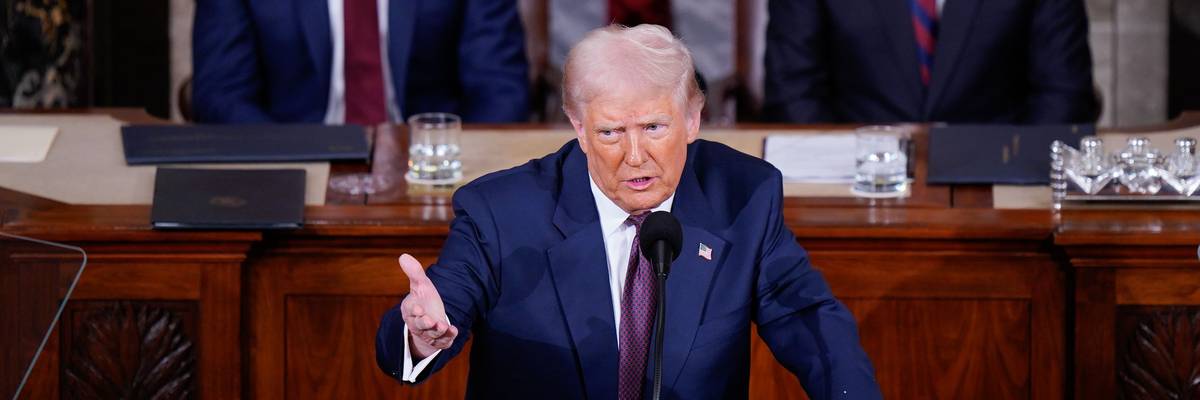
President Donald Trump addresses a joint session of Congress on Tuesday, March 04, 2025 in Washington, D.C.
"The Trump administration seems hellbent on dismantling the system of checks and balances which are the pillars of a democratic society," said one senior leader with the group CIVICUS.
An organization that tracks threats to civic freedoms announced Monday that it has added the United States to its watchlist, citing the Trump administration's "unprecedented" executive orders that the group says undermine democratic institutions, rule of law, and global cooperation.
"The Trump administration seems hellbent on dismantling the system of checks and balances which are the pillars of a democratic society," said Mandeep Tiwana, interim co-secretary general of CIVICUS, a global alliance of civil society activists and organizations, in a statement Monday.
"This is an unparalleled attack on the rule of law in the United States, not seen since the days of McCarthyism in the twentieth century. Restrictive executive orders, unjustifiable institutional cutbacks, and intimidation tactics through threatening pronouncements by senior officials in the administration are creating an atmosphere to chill democratic dissent, a cherished American ideal," Tiwana continued.
The CIVICUS Monitor Watchlist, which highlights countries where there is a serious decline in "respect for civic space," also noted declines in the status of four other countries on Monday: Democratic Republic of the Congo, Italy, Pakistan, and Serbia. Democratic Republic of the Congo and Pakistan earned a rating of "repressed," while the watchlist considers the civic space rating of Italy and the United States to be "narrowed." Serbia earned the civic space rating of "obstructed."
"Open" is the highest ranking a country can receive, and denotes when "citizens and civil society organizations are able to organize, participate, and communicate without hindrance."
"Narrowed" is the second-highest tier rating, and countries earn this designation when people can exercise civic freedoms, including the freedoms of association, peaceful assembly, and expression, though occasionally violations of these rights occur.
Following his return to the White House, "Trump has issued at least 125 executive orders, dismantling federal policies with profound implications for human rights and the rule of law," according to the group.
Other actions that CIVICUS Monitor Watchlist highlights include: rolling back federal diversity, equity, and inclusion programs, implementing a widespread pause on foreign aid, taking steps to dismantle the U.S. Agency for International Development and laying off employees there, and withdrawing from the World Health Organization, the U.N. Human Rights Council, and the Paris Climate Agreement.
"These measures come amid a broader potential curb on the freedom of association," according to the group, which points to the passage of the so-called "nonprofit killer" bill in the U.S. House of Representatives in November, 2024. If it became law, the bill would allow the Treasury Department to revoke the tax-exempt status of non-profits it deems to be supporting terrorism.
The group points to Trump's January 30 executive order which is purportedly aimed at combating antisemitism. In an accompanying fact sheet with the order, Trump is quoted saying: "To all the resident aliens who joined in the pro-jihadist protests, we put you on notice: come 2025, we will find you, and we will deport you. I will also quickly cancel the student visas of all Hamas sympathizers on college campuses, which have been infested with radicalism like never before."
Critics had warned that the executive order could chill political speech on campuses, according to The Guardian, and it is freshly in the news after Immigration and Customs Enforcement arrested Palestinian activist Mahmoud Khalil, who helped lead the Gaza solidarity encampment on Columbia University's campus.
A spokesperson for the Department of Homeland Security said described Khalil's arrest as being "in support of President Trump's executive orders prohibiting antisemitism," according to The Associated Press.
The group also highlighted recent actions that touch on press freedom concerns. For example, White House Press Secretary Karoline Leavitt announced in February that the administration will now decide which outlets get to participate in the presidential press pool, in a break with precedent.
Dear Common Dreams reader, It’s been nearly 30 years since I co-founded Common Dreams with my late wife, Lina Newhouser. We had the radical notion that journalism should serve the public good, not corporate profits. It was clear to us from the outset what it would take to build such a project. No paid advertisements. No corporate sponsors. No millionaire publisher telling us what to think or do. Many people said we wouldn't last a year, but we proved those doubters wrong. Together with a tremendous team of journalists and dedicated staff, we built an independent media outlet free from the constraints of profits and corporate control. Our mission has always been simple: To inform. To inspire. To ignite change for the common good. Building Common Dreams was not easy. Our survival was never guaranteed. When you take on the most powerful forces—Wall Street greed, fossil fuel industry destruction, Big Tech lobbyists, and uber-rich oligarchs who have spent billions upon billions rigging the economy and democracy in their favor—the only bulwark you have is supporters who believe in your work. But here’s the urgent message from me today. It's never been this bad out there. And it's never been this hard to keep us going. At the very moment Common Dreams is most needed, the threats we face are intensifying. We need your support now more than ever. We don't accept corporate advertising and never will. We don't have a paywall because we don't think people should be blocked from critical news based on their ability to pay. Everything we do is funded by the donations of readers like you. When everyone does the little they can afford, we are strong. But if that support retreats or dries up, so do we. Will you donate now to make sure Common Dreams not only survives but thrives? —Craig Brown, Co-founder |
An organization that tracks threats to civic freedoms announced Monday that it has added the United States to its watchlist, citing the Trump administration's "unprecedented" executive orders that the group says undermine democratic institutions, rule of law, and global cooperation.
"The Trump administration seems hellbent on dismantling the system of checks and balances which are the pillars of a democratic society," said Mandeep Tiwana, interim co-secretary general of CIVICUS, a global alliance of civil society activists and organizations, in a statement Monday.
"This is an unparalleled attack on the rule of law in the United States, not seen since the days of McCarthyism in the twentieth century. Restrictive executive orders, unjustifiable institutional cutbacks, and intimidation tactics through threatening pronouncements by senior officials in the administration are creating an atmosphere to chill democratic dissent, a cherished American ideal," Tiwana continued.
The CIVICUS Monitor Watchlist, which highlights countries where there is a serious decline in "respect for civic space," also noted declines in the status of four other countries on Monday: Democratic Republic of the Congo, Italy, Pakistan, and Serbia. Democratic Republic of the Congo and Pakistan earned a rating of "repressed," while the watchlist considers the civic space rating of Italy and the United States to be "narrowed." Serbia earned the civic space rating of "obstructed."
"Open" is the highest ranking a country can receive, and denotes when "citizens and civil society organizations are able to organize, participate, and communicate without hindrance."
"Narrowed" is the second-highest tier rating, and countries earn this designation when people can exercise civic freedoms, including the freedoms of association, peaceful assembly, and expression, though occasionally violations of these rights occur.
Following his return to the White House, "Trump has issued at least 125 executive orders, dismantling federal policies with profound implications for human rights and the rule of law," according to the group.
Other actions that CIVICUS Monitor Watchlist highlights include: rolling back federal diversity, equity, and inclusion programs, implementing a widespread pause on foreign aid, taking steps to dismantle the U.S. Agency for International Development and laying off employees there, and withdrawing from the World Health Organization, the U.N. Human Rights Council, and the Paris Climate Agreement.
"These measures come amid a broader potential curb on the freedom of association," according to the group, which points to the passage of the so-called "nonprofit killer" bill in the U.S. House of Representatives in November, 2024. If it became law, the bill would allow the Treasury Department to revoke the tax-exempt status of non-profits it deems to be supporting terrorism.
The group points to Trump's January 30 executive order which is purportedly aimed at combating antisemitism. In an accompanying fact sheet with the order, Trump is quoted saying: "To all the resident aliens who joined in the pro-jihadist protests, we put you on notice: come 2025, we will find you, and we will deport you. I will also quickly cancel the student visas of all Hamas sympathizers on college campuses, which have been infested with radicalism like never before."
Critics had warned that the executive order could chill political speech on campuses, according to The Guardian, and it is freshly in the news after Immigration and Customs Enforcement arrested Palestinian activist Mahmoud Khalil, who helped lead the Gaza solidarity encampment on Columbia University's campus.
A spokesperson for the Department of Homeland Security said described Khalil's arrest as being "in support of President Trump's executive orders prohibiting antisemitism," according to The Associated Press.
The group also highlighted recent actions that touch on press freedom concerns. For example, White House Press Secretary Karoline Leavitt announced in February that the administration will now decide which outlets get to participate in the presidential press pool, in a break with precedent.
An organization that tracks threats to civic freedoms announced Monday that it has added the United States to its watchlist, citing the Trump administration's "unprecedented" executive orders that the group says undermine democratic institutions, rule of law, and global cooperation.
"The Trump administration seems hellbent on dismantling the system of checks and balances which are the pillars of a democratic society," said Mandeep Tiwana, interim co-secretary general of CIVICUS, a global alliance of civil society activists and organizations, in a statement Monday.
"This is an unparalleled attack on the rule of law in the United States, not seen since the days of McCarthyism in the twentieth century. Restrictive executive orders, unjustifiable institutional cutbacks, and intimidation tactics through threatening pronouncements by senior officials in the administration are creating an atmosphere to chill democratic dissent, a cherished American ideal," Tiwana continued.
The CIVICUS Monitor Watchlist, which highlights countries where there is a serious decline in "respect for civic space," also noted declines in the status of four other countries on Monday: Democratic Republic of the Congo, Italy, Pakistan, and Serbia. Democratic Republic of the Congo and Pakistan earned a rating of "repressed," while the watchlist considers the civic space rating of Italy and the United States to be "narrowed." Serbia earned the civic space rating of "obstructed."
"Open" is the highest ranking a country can receive, and denotes when "citizens and civil society organizations are able to organize, participate, and communicate without hindrance."
"Narrowed" is the second-highest tier rating, and countries earn this designation when people can exercise civic freedoms, including the freedoms of association, peaceful assembly, and expression, though occasionally violations of these rights occur.
Following his return to the White House, "Trump has issued at least 125 executive orders, dismantling federal policies with profound implications for human rights and the rule of law," according to the group.
Other actions that CIVICUS Monitor Watchlist highlights include: rolling back federal diversity, equity, and inclusion programs, implementing a widespread pause on foreign aid, taking steps to dismantle the U.S. Agency for International Development and laying off employees there, and withdrawing from the World Health Organization, the U.N. Human Rights Council, and the Paris Climate Agreement.
"These measures come amid a broader potential curb on the freedom of association," according to the group, which points to the passage of the so-called "nonprofit killer" bill in the U.S. House of Representatives in November, 2024. If it became law, the bill would allow the Treasury Department to revoke the tax-exempt status of non-profits it deems to be supporting terrorism.
The group points to Trump's January 30 executive order which is purportedly aimed at combating antisemitism. In an accompanying fact sheet with the order, Trump is quoted saying: "To all the resident aliens who joined in the pro-jihadist protests, we put you on notice: come 2025, we will find you, and we will deport you. I will also quickly cancel the student visas of all Hamas sympathizers on college campuses, which have been infested with radicalism like never before."
Critics had warned that the executive order could chill political speech on campuses, according to The Guardian, and it is freshly in the news after Immigration and Customs Enforcement arrested Palestinian activist Mahmoud Khalil, who helped lead the Gaza solidarity encampment on Columbia University's campus.
A spokesperson for the Department of Homeland Security said described Khalil's arrest as being "in support of President Trump's executive orders prohibiting antisemitism," according to The Associated Press.
The group also highlighted recent actions that touch on press freedom concerns. For example, White House Press Secretary Karoline Leavitt announced in February that the administration will now decide which outlets get to participate in the presidential press pool, in a break with precedent.