SUBSCRIBE TO OUR FREE NEWSLETTER
Daily news & progressive opinion—funded by the people, not the corporations—delivered straight to your inbox.
5
#000000
#FFFFFF
To donate by check, phone, or other method, see our More Ways to Give page.
Daily news & progressive opinion—funded by the people, not the corporations—delivered straight to your inbox.
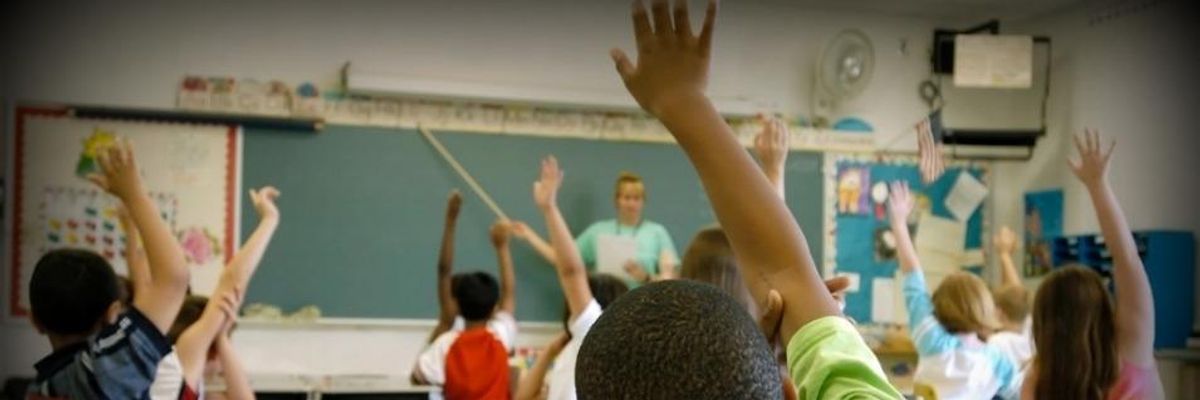
New York City schools will only close as a last resort, city officials said Saturday. (Photo: carl_hfser/flickr)
In an example of how the coronavirus outbreak is exposing longstanding cracks in U.S. society, New York City schools chancellor Richard A. Carranza said that closing the city's public schools for a prolonged period of time would be a "last resort" because 750,000 low-income students in the city, 114,000 of whom are homeless, rely on schools for food, bathing, and even laundry.
"Well this is a tragic embarrassment," tweeted Bard College professor Emma Briant.
As the New York Times reported:
Large-scale school closings might mean, for example, that subway conductors and bus drivers must stay home with their children, or that nurses at public hospitals would not be able to come to work, potentially slowing essential city services.
New York Gov. Andrew Cuomo, who declared a state of emergency over the disease on Saturday, told reporters Monday that the state would shut down any school across New York with a positive case for 24 hours as a precautionary measure.
Any school closures in the country could have dire effects on poorer populations, as observers like Times reporter Dana Goldstein pointed out on Twitter.
"I think the main concern I heard from school leaders across the country was about the risk of an overreaction (longterm school closures) that would severely disrupt...pretty much everything, and disproportionately impact poor families," said Goldstein.
Writer and educator Clint Smith noted that nationwide school closures could lead to increased food insecurity for the country's children.
"A reminder that if public schools shut down, millions of children will lose their access to some of the only meals they receive each day," said Smith. "Food banks will become more important, and I've learned the best way to help is not to donate your spare canned goods, it's to donate money."
During Cuomo's press conference Monday, the governor also unveiled a new hand sanitizer being produced in state prisons.
Prisons house among the most in danger communities, as public defender and criminal justice advocate Scott Hechinger pointed out, and are not allowed to use the product they are producing.
"As of today people in N.Y. jails and prisons are not allowed to use hand sanitizer," said Hechinger. "Alcohol content means it's contraband. Can't use it. Loved ones can't send it. But those same people incarcerated by N.Y. are getting paid 65 cents per hour to manufacture it!"
The effects of the coronavirus on the U.S., tweeted CBS News reporter Grace Segers, could be devastating.
"I don't think we're prepared for the ripple effects this could have for the most vulnerable in our society," said Segers.
Dear Common Dreams reader, It’s been nearly 30 years since I co-founded Common Dreams with my late wife, Lina Newhouser. We had the radical notion that journalism should serve the public good, not corporate profits. It was clear to us from the outset what it would take to build such a project. No paid advertisements. No corporate sponsors. No millionaire publisher telling us what to think or do. Many people said we wouldn't last a year, but we proved those doubters wrong. Together with a tremendous team of journalists and dedicated staff, we built an independent media outlet free from the constraints of profits and corporate control. Our mission has always been simple: To inform. To inspire. To ignite change for the common good. Building Common Dreams was not easy. Our survival was never guaranteed. When you take on the most powerful forces—Wall Street greed, fossil fuel industry destruction, Big Tech lobbyists, and uber-rich oligarchs who have spent billions upon billions rigging the economy and democracy in their favor—the only bulwark you have is supporters who believe in your work. But here’s the urgent message from me today. It's never been this bad out there. And it's never been this hard to keep us going. At the very moment Common Dreams is most needed, the threats we face are intensifying. We need your support now more than ever. We don't accept corporate advertising and never will. We don't have a paywall because we don't think people should be blocked from critical news based on their ability to pay. Everything we do is funded by the donations of readers like you. When everyone does the little they can afford, we are strong. But if that support retreats or dries up, so do we. Will you donate now to make sure Common Dreams not only survives but thrives? —Craig Brown, Co-founder |
In an example of how the coronavirus outbreak is exposing longstanding cracks in U.S. society, New York City schools chancellor Richard A. Carranza said that closing the city's public schools for a prolonged period of time would be a "last resort" because 750,000 low-income students in the city, 114,000 of whom are homeless, rely on schools for food, bathing, and even laundry.
"Well this is a tragic embarrassment," tweeted Bard College professor Emma Briant.
As the New York Times reported:
Large-scale school closings might mean, for example, that subway conductors and bus drivers must stay home with their children, or that nurses at public hospitals would not be able to come to work, potentially slowing essential city services.
New York Gov. Andrew Cuomo, who declared a state of emergency over the disease on Saturday, told reporters Monday that the state would shut down any school across New York with a positive case for 24 hours as a precautionary measure.
Any school closures in the country could have dire effects on poorer populations, as observers like Times reporter Dana Goldstein pointed out on Twitter.
"I think the main concern I heard from school leaders across the country was about the risk of an overreaction (longterm school closures) that would severely disrupt...pretty much everything, and disproportionately impact poor families," said Goldstein.
Writer and educator Clint Smith noted that nationwide school closures could lead to increased food insecurity for the country's children.
"A reminder that if public schools shut down, millions of children will lose their access to some of the only meals they receive each day," said Smith. "Food banks will become more important, and I've learned the best way to help is not to donate your spare canned goods, it's to donate money."
During Cuomo's press conference Monday, the governor also unveiled a new hand sanitizer being produced in state prisons.
Prisons house among the most in danger communities, as public defender and criminal justice advocate Scott Hechinger pointed out, and are not allowed to use the product they are producing.
"As of today people in N.Y. jails and prisons are not allowed to use hand sanitizer," said Hechinger. "Alcohol content means it's contraband. Can't use it. Loved ones can't send it. But those same people incarcerated by N.Y. are getting paid 65 cents per hour to manufacture it!"
The effects of the coronavirus on the U.S., tweeted CBS News reporter Grace Segers, could be devastating.
"I don't think we're prepared for the ripple effects this could have for the most vulnerable in our society," said Segers.
In an example of how the coronavirus outbreak is exposing longstanding cracks in U.S. society, New York City schools chancellor Richard A. Carranza said that closing the city's public schools for a prolonged period of time would be a "last resort" because 750,000 low-income students in the city, 114,000 of whom are homeless, rely on schools for food, bathing, and even laundry.
"Well this is a tragic embarrassment," tweeted Bard College professor Emma Briant.
As the New York Times reported:
Large-scale school closings might mean, for example, that subway conductors and bus drivers must stay home with their children, or that nurses at public hospitals would not be able to come to work, potentially slowing essential city services.
New York Gov. Andrew Cuomo, who declared a state of emergency over the disease on Saturday, told reporters Monday that the state would shut down any school across New York with a positive case for 24 hours as a precautionary measure.
Any school closures in the country could have dire effects on poorer populations, as observers like Times reporter Dana Goldstein pointed out on Twitter.
"I think the main concern I heard from school leaders across the country was about the risk of an overreaction (longterm school closures) that would severely disrupt...pretty much everything, and disproportionately impact poor families," said Goldstein.
Writer and educator Clint Smith noted that nationwide school closures could lead to increased food insecurity for the country's children.
"A reminder that if public schools shut down, millions of children will lose their access to some of the only meals they receive each day," said Smith. "Food banks will become more important, and I've learned the best way to help is not to donate your spare canned goods, it's to donate money."
During Cuomo's press conference Monday, the governor also unveiled a new hand sanitizer being produced in state prisons.
Prisons house among the most in danger communities, as public defender and criminal justice advocate Scott Hechinger pointed out, and are not allowed to use the product they are producing.
"As of today people in N.Y. jails and prisons are not allowed to use hand sanitizer," said Hechinger. "Alcohol content means it's contraband. Can't use it. Loved ones can't send it. But those same people incarcerated by N.Y. are getting paid 65 cents per hour to manufacture it!"
The effects of the coronavirus on the U.S., tweeted CBS News reporter Grace Segers, could be devastating.
"I don't think we're prepared for the ripple effects this could have for the most vulnerable in our society," said Segers.