SUBSCRIBE TO OUR FREE NEWSLETTER
Daily news & progressive opinion—funded by the people, not the corporations—delivered straight to your inbox.
5
#000000
#FFFFFF
To donate by check, phone, or other method, see our More Ways to Give page.
Daily news & progressive opinion—funded by the people, not the corporations—delivered straight to your inbox.
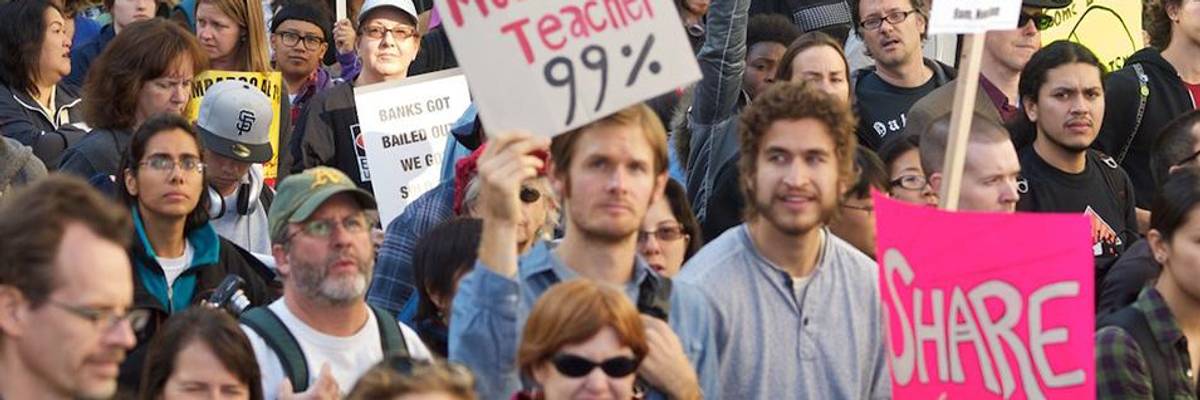
Occupy Oakland General Strike on October 2, 2011. (photo/cc/Brian Sims)
More than two-thirds of the world's entire wealth will be owned by the richest 1% of people by 2030, new research warns.
The shocking findings of the new report produced by the UK's House of Commons Library claims that if trends which began after the 2008 financial crisis continue, the 1% will control 64% of world's money in just 12 years' time.
The widening gap between the 1% and everyone else was first highlighted by the Occupy Wall Street movement, which started in 2011 and famously used the slogan: "We are the 99%."
The study claims that the wealth of the richest one percent grows at six percent annually, outstripping the three percent annual growth of everyone else, causing a continual movement of money to the top.
Polling that accompanies the study indicated that the majority of people are unhappy about wealth inequality. Thirty-four percent said that the super-rich would have the most power in 2030, more even than governments (28 percent).
More than four in ten of those polled also said they worried that rising income inequality would lead to corruption or the "super-rich enjoying unfair influence on government policy".
Since 2008, the assets of the top 1% have been growing at twice the rate of the other 99%.
If that rate carries on, the 1% will own about $305 trillion by 2030, up from $139 trillion today.
The Guardian reports:
The research was commissioned by Liam Byrne, the former Labour cabinet minister, as part of a gathering of MPs, academics, business leaders, trade unions and civil society leaders focused on addressing the problem...
The hope is to create pressure for global action when leaders of the G20 group of nations gather for a summit in Buenos Aires in November. Byrne, who organised the first OECD global parliamentary conference on inclusive growth, said he believed global inequality was "now at a tipping point".
"If we don't take steps to rewrite the rules of how our economies work, then we condemn ourselves to a future that remains unequal for good," he said. "That's morally bad, and economically disastrous, risking a new explosion in instability, corruption and poverty."
Dear Common Dreams reader, It’s been nearly 30 years since I co-founded Common Dreams with my late wife, Lina Newhouser. We had the radical notion that journalism should serve the public good, not corporate profits. It was clear to us from the outset what it would take to build such a project. No paid advertisements. No corporate sponsors. No millionaire publisher telling us what to think or do. Many people said we wouldn't last a year, but we proved those doubters wrong. Together with a tremendous team of journalists and dedicated staff, we built an independent media outlet free from the constraints of profits and corporate control. Our mission has always been simple: To inform. To inspire. To ignite change for the common good. Building Common Dreams was not easy. Our survival was never guaranteed. When you take on the most powerful forces—Wall Street greed, fossil fuel industry destruction, Big Tech lobbyists, and uber-rich oligarchs who have spent billions upon billions rigging the economy and democracy in their favor—the only bulwark you have is supporters who believe in your work. But here’s the urgent message from me today. It's never been this bad out there. And it's never been this hard to keep us going. At the very moment Common Dreams is most needed, the threats we face are intensifying. We need your support now more than ever. We don't accept corporate advertising and never will. We don't have a paywall because we don't think people should be blocked from critical news based on their ability to pay. Everything we do is funded by the donations of readers like you. When everyone does the little they can afford, we are strong. But if that support retreats or dries up, so do we. Will you donate now to make sure Common Dreams not only survives but thrives? —Craig Brown, Co-founder |
More than two-thirds of the world's entire wealth will be owned by the richest 1% of people by 2030, new research warns.
The shocking findings of the new report produced by the UK's House of Commons Library claims that if trends which began after the 2008 financial crisis continue, the 1% will control 64% of world's money in just 12 years' time.
The widening gap between the 1% and everyone else was first highlighted by the Occupy Wall Street movement, which started in 2011 and famously used the slogan: "We are the 99%."
The study claims that the wealth of the richest one percent grows at six percent annually, outstripping the three percent annual growth of everyone else, causing a continual movement of money to the top.
Polling that accompanies the study indicated that the majority of people are unhappy about wealth inequality. Thirty-four percent said that the super-rich would have the most power in 2030, more even than governments (28 percent).
More than four in ten of those polled also said they worried that rising income inequality would lead to corruption or the "super-rich enjoying unfair influence on government policy".
Since 2008, the assets of the top 1% have been growing at twice the rate of the other 99%.
If that rate carries on, the 1% will own about $305 trillion by 2030, up from $139 trillion today.
The Guardian reports:
The research was commissioned by Liam Byrne, the former Labour cabinet minister, as part of a gathering of MPs, academics, business leaders, trade unions and civil society leaders focused on addressing the problem...
The hope is to create pressure for global action when leaders of the G20 group of nations gather for a summit in Buenos Aires in November. Byrne, who organised the first OECD global parliamentary conference on inclusive growth, said he believed global inequality was "now at a tipping point".
"If we don't take steps to rewrite the rules of how our economies work, then we condemn ourselves to a future that remains unequal for good," he said. "That's morally bad, and economically disastrous, risking a new explosion in instability, corruption and poverty."
More than two-thirds of the world's entire wealth will be owned by the richest 1% of people by 2030, new research warns.
The shocking findings of the new report produced by the UK's House of Commons Library claims that if trends which began after the 2008 financial crisis continue, the 1% will control 64% of world's money in just 12 years' time.
The widening gap between the 1% and everyone else was first highlighted by the Occupy Wall Street movement, which started in 2011 and famously used the slogan: "We are the 99%."
The study claims that the wealth of the richest one percent grows at six percent annually, outstripping the three percent annual growth of everyone else, causing a continual movement of money to the top.
Polling that accompanies the study indicated that the majority of people are unhappy about wealth inequality. Thirty-four percent said that the super-rich would have the most power in 2030, more even than governments (28 percent).
More than four in ten of those polled also said they worried that rising income inequality would lead to corruption or the "super-rich enjoying unfair influence on government policy".
Since 2008, the assets of the top 1% have been growing at twice the rate of the other 99%.
If that rate carries on, the 1% will own about $305 trillion by 2030, up from $139 trillion today.
The Guardian reports:
The research was commissioned by Liam Byrne, the former Labour cabinet minister, as part of a gathering of MPs, academics, business leaders, trade unions and civil society leaders focused on addressing the problem...
The hope is to create pressure for global action when leaders of the G20 group of nations gather for a summit in Buenos Aires in November. Byrne, who organised the first OECD global parliamentary conference on inclusive growth, said he believed global inequality was "now at a tipping point".
"If we don't take steps to rewrite the rules of how our economies work, then we condemn ourselves to a future that remains unequal for good," he said. "That's morally bad, and economically disastrous, risking a new explosion in instability, corruption and poverty."