

SUBSCRIBE TO OUR FREE NEWSLETTER
Daily news & progressive opinion—funded by the people, not the corporations—delivered straight to your inbox.
5
#000000
#FFFFFF
To donate by check, phone, or other method, see our More Ways to Give page.
Daily news & progressive opinion—funded by the people, not the corporations—delivered straight to your inbox.
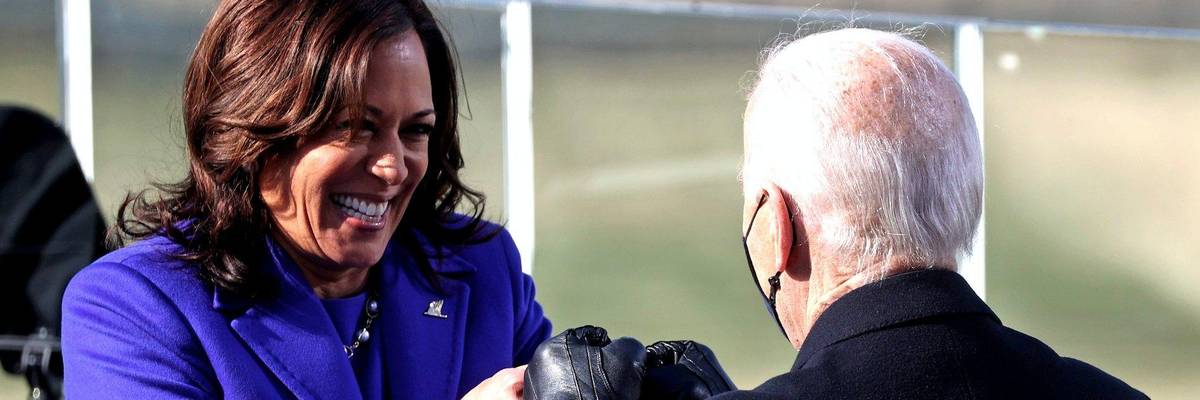
President Joe Biden and Vice President Kamala Harris at their Inauguration on January 20, 2021. (Photo via Shutterstock)
President Joe Biden hit just the right notes in his splendid Inaugural Address.
You could almost hear the sigh of a relief coming from the vast majority of Americans when he said, "Let's start afresh."
This was a warm and healing speech, so necessary after what the country has been through over the last four years.
He acknowledged what needed to be acknowledged, and he affirmed what needed to be affirmed. And in his down-to-earth manner, he set a new and positive tone for moving this country forward.
He acknowledged the "riotous mob" that tried to "use violence to silence the will of the people" on January 6.
He acknowledged that "democracy is fragile."
He acknowledged that "we face an attack on our democracy and on truth," and he decried a "culture in which facts themselves are manipulated, even manufactured," and in which lies are "told for power and for profit."
And so he affirmed "democracy," a word that he used eleven times, including five times in the first minute.
And so he affirmed "truth," a word he used five times.
He also acknowledged the virulent racism that is afoot in the land, citing "a rise of political extremism, white supremacy, domestic terrorism that we must confront and we will defeat."
He nodded to the Black Lives Matter movement, saying that "a cry for racial justice some 400 years in the making moves us."
And he affirmed that "the dream of justice for all will be deferred no longer."
He acknowledged the "once in a century virus that silently stalks the country," and he movingly observed a moment of silence for the 400,000 Americans who have died from COVID-19.
And then he affirmed we "will overcome this deadly virus."
He acknowledged the "climate crisis," and affirmed that he would address it.
And he acknowledged the division in the country, and affirmed "unity" and "an end to this uncivil war."
As he put it, "We can see each other, not as adversaries, but as neighbors. We can treat each other with dignity and respect. We can join forces, stop the shouting, and lower the temperature."
He offered wise advice on this front: "Let's begin to listen to one another again. Hear one another. See one another. Show respect to one another. Politics doesn't have to be a raging fire, destroying everything in its path. Every disagreement doesn't have to be a cause for total war."
And he continued, in one of his most poignant passages: "If we show a little tolerance and humility, and if we are willing to stand in the other person's shoes--as my mom would say--just for a moment, stand in their shoes. Because here's the thing about life: There's no accounting for what fate will deal you. Some days, when you need a hand. There are other days when we're called to lend a hand. That's how it has to be. That's what we do for one another."
This was a warm and healing speech, so necessary after what the country has been through over the last four years.
But it wasn't a vacuous speech. By saluting democracy, truth, and racial justice, and by calling out white supremacy, he offered a much-needed course correction in substance as well as in style.
On his longed-for Inauguration Day, Joe Biden rose to the occasion.
This article first appeared in the Wisconsin Examiner.
Dear Common Dreams reader, It’s been nearly 30 years since I co-founded Common Dreams with my late wife, Lina Newhouser. We had the radical notion that journalism should serve the public good, not corporate profits. It was clear to us from the outset what it would take to build such a project. No paid advertisements. No corporate sponsors. No millionaire publisher telling us what to think or do. Many people said we wouldn't last a year, but we proved those doubters wrong. Together with a tremendous team of journalists and dedicated staff, we built an independent media outlet free from the constraints of profits and corporate control. Our mission has always been simple: To inform. To inspire. To ignite change for the common good. Building Common Dreams was not easy. Our survival was never guaranteed. When you take on the most powerful forces—Wall Street greed, fossil fuel industry destruction, Big Tech lobbyists, and uber-rich oligarchs who have spent billions upon billions rigging the economy and democracy in their favor—the only bulwark you have is supporters who believe in your work. But here’s the urgent message from me today. It's never been this bad out there. And it's never been this hard to keep us going. At the very moment Common Dreams is most needed, the threats we face are intensifying. We need your support now more than ever. We don't accept corporate advertising and never will. We don't have a paywall because we don't think people should be blocked from critical news based on their ability to pay. Everything we do is funded by the donations of readers like you. When everyone does the little they can afford, we are strong. But if that support retreats or dries up, so do we. Will you donate now to make sure Common Dreams not only survives but thrives? —Craig Brown, Co-founder |
President Joe Biden hit just the right notes in his splendid Inaugural Address.
You could almost hear the sigh of a relief coming from the vast majority of Americans when he said, "Let's start afresh."
This was a warm and healing speech, so necessary after what the country has been through over the last four years.
He acknowledged what needed to be acknowledged, and he affirmed what needed to be affirmed. And in his down-to-earth manner, he set a new and positive tone for moving this country forward.
He acknowledged the "riotous mob" that tried to "use violence to silence the will of the people" on January 6.
He acknowledged that "democracy is fragile."
He acknowledged that "we face an attack on our democracy and on truth," and he decried a "culture in which facts themselves are manipulated, even manufactured," and in which lies are "told for power and for profit."
And so he affirmed "democracy," a word that he used eleven times, including five times in the first minute.
And so he affirmed "truth," a word he used five times.
He also acknowledged the virulent racism that is afoot in the land, citing "a rise of political extremism, white supremacy, domestic terrorism that we must confront and we will defeat."
He nodded to the Black Lives Matter movement, saying that "a cry for racial justice some 400 years in the making moves us."
And he affirmed that "the dream of justice for all will be deferred no longer."
He acknowledged the "once in a century virus that silently stalks the country," and he movingly observed a moment of silence for the 400,000 Americans who have died from COVID-19.
And then he affirmed we "will overcome this deadly virus."
He acknowledged the "climate crisis," and affirmed that he would address it.
And he acknowledged the division in the country, and affirmed "unity" and "an end to this uncivil war."
As he put it, "We can see each other, not as adversaries, but as neighbors. We can treat each other with dignity and respect. We can join forces, stop the shouting, and lower the temperature."
He offered wise advice on this front: "Let's begin to listen to one another again. Hear one another. See one another. Show respect to one another. Politics doesn't have to be a raging fire, destroying everything in its path. Every disagreement doesn't have to be a cause for total war."
And he continued, in one of his most poignant passages: "If we show a little tolerance and humility, and if we are willing to stand in the other person's shoes--as my mom would say--just for a moment, stand in their shoes. Because here's the thing about life: There's no accounting for what fate will deal you. Some days, when you need a hand. There are other days when we're called to lend a hand. That's how it has to be. That's what we do for one another."
This was a warm and healing speech, so necessary after what the country has been through over the last four years.
But it wasn't a vacuous speech. By saluting democracy, truth, and racial justice, and by calling out white supremacy, he offered a much-needed course correction in substance as well as in style.
On his longed-for Inauguration Day, Joe Biden rose to the occasion.
This article first appeared in the Wisconsin Examiner.
President Joe Biden hit just the right notes in his splendid Inaugural Address.
You could almost hear the sigh of a relief coming from the vast majority of Americans when he said, "Let's start afresh."
This was a warm and healing speech, so necessary after what the country has been through over the last four years.
He acknowledged what needed to be acknowledged, and he affirmed what needed to be affirmed. And in his down-to-earth manner, he set a new and positive tone for moving this country forward.
He acknowledged the "riotous mob" that tried to "use violence to silence the will of the people" on January 6.
He acknowledged that "democracy is fragile."
He acknowledged that "we face an attack on our democracy and on truth," and he decried a "culture in which facts themselves are manipulated, even manufactured," and in which lies are "told for power and for profit."
And so he affirmed "democracy," a word that he used eleven times, including five times in the first minute.
And so he affirmed "truth," a word he used five times.
He also acknowledged the virulent racism that is afoot in the land, citing "a rise of political extremism, white supremacy, domestic terrorism that we must confront and we will defeat."
He nodded to the Black Lives Matter movement, saying that "a cry for racial justice some 400 years in the making moves us."
And he affirmed that "the dream of justice for all will be deferred no longer."
He acknowledged the "once in a century virus that silently stalks the country," and he movingly observed a moment of silence for the 400,000 Americans who have died from COVID-19.
And then he affirmed we "will overcome this deadly virus."
He acknowledged the "climate crisis," and affirmed that he would address it.
And he acknowledged the division in the country, and affirmed "unity" and "an end to this uncivil war."
As he put it, "We can see each other, not as adversaries, but as neighbors. We can treat each other with dignity and respect. We can join forces, stop the shouting, and lower the temperature."
He offered wise advice on this front: "Let's begin to listen to one another again. Hear one another. See one another. Show respect to one another. Politics doesn't have to be a raging fire, destroying everything in its path. Every disagreement doesn't have to be a cause for total war."
And he continued, in one of his most poignant passages: "If we show a little tolerance and humility, and if we are willing to stand in the other person's shoes--as my mom would say--just for a moment, stand in their shoes. Because here's the thing about life: There's no accounting for what fate will deal you. Some days, when you need a hand. There are other days when we're called to lend a hand. That's how it has to be. That's what we do for one another."
This was a warm and healing speech, so necessary after what the country has been through over the last four years.
But it wasn't a vacuous speech. By saluting democracy, truth, and racial justice, and by calling out white supremacy, he offered a much-needed course correction in substance as well as in style.
On his longed-for Inauguration Day, Joe Biden rose to the occasion.
This article first appeared in the Wisconsin Examiner.

