SUBSCRIBE TO OUR FREE NEWSLETTER
Daily news & progressive opinion—funded by the people, not the corporations—delivered straight to your inbox.
5
#000000
#FFFFFF
To donate by check, phone, or other method, see our More Ways to Give page.
Daily news & progressive opinion—funded by the people, not the corporations—delivered straight to your inbox.
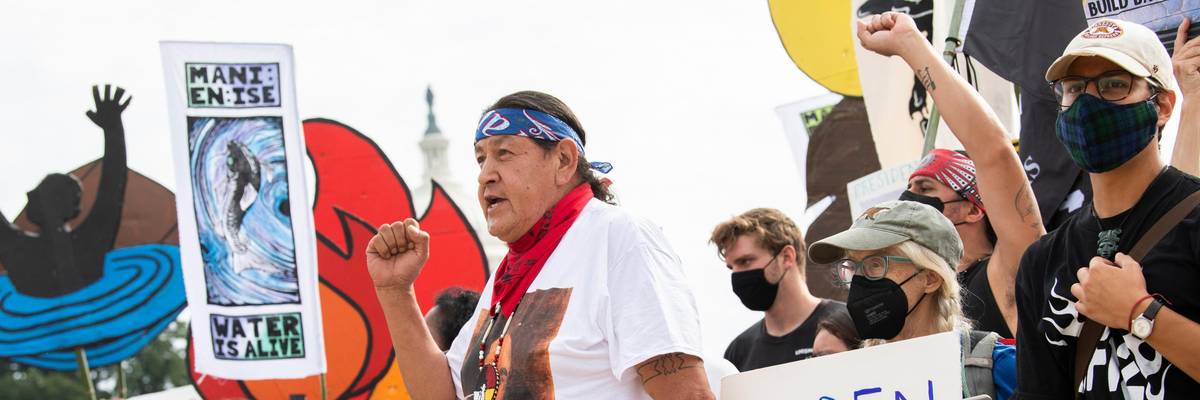
Activists rally with the People vs. Fossil Fuels demonstration to call for President Biden to stop approving fossil fuel projects at the Capitol Reflecting Pool on Friday, October 15, 2021. (Photo: Tom Williams/CQ-Roll Call, Inc via Getty Images)
When you work on climate, the news can often feel like one step forward, two steps back. But lately, ordinary people have been winning big victories to protect their communities--and our planet.
Last November, for example, President Biden announced at the UN climate talks in Scotland that the U.S. will lead "by the power of our example" when it comes to transitioning off fossil fuels and cutting emissions.
We need to celebrate these recent victories, to give us hope and inspiration for the struggles ahead.
Then, just two weeks later, his administration announced the largest sale of offshore drilling leases in U.S. history. They've sold some 1.7 million acres in the Gulf of Mexico out of a staggering 81 million acres on offer.
The hypocrisy was galling, but there's a lot more at stake than the bad symbolism. Burning this oil would be like putting 130 coal power plants online.
And offshore drilling is dangerous, as Gulf communities know well. The BP Deepwater Horizon disaster in 2010 was the largest oil spill in the history of offshore drilling. It killed 11 workers, damaged ecosystems, and devastated fishing communities, including the United Houma Nation.
But this time, Gulf communities are refusing to be a sacrifice zone--and they may be winning.
This January, they won a major victory against this egregious injustice. A federal district court found the analysis the government used to justify the lease sale seriously underestimated greenhouse gas emissions and other risks. Movements are now pressuring the Interior Department to let the ruling stand and end this disastrous lease sale.
People are winning victories over fossil fuel giants in other places, too.
On February 3, a federal appeals court ordered the government to reconsider its analysis of the Mountain Valley Pipeline's impact on endangered species. Just days before, the same court found that the government's reviews allowing the pipeline to cut through the Jefferson National Forest were also flawed.
Together, these decisions could cause significant delays for the Virginia-West Virginia pipeline, and maybe even kill the project.
If that happens, communities near and far could breathe easier. The Mountain Valley Pipeline poses serious threats to water quality and ecosystems and increases landslide risks--with potentially catastrophic consequences for a pipeline carrying explosive gas. And if completed, the gas it would transport would produce as much carbon dioxide as 26 coal plants.
My colleague Gabrielle Colchete and I found in a 2020 report that the pipeline was putting vulnerable communities at particular risk. Its route snakes through West Virginia communities where poverty rates run 25 percent higher than average, while over half the Census tracts along the pipeline path there have below average life expectancy.
Not every win comes from the courts. To cap things off, the Los Angeles City Council voted to ban new oil drilling within city limits--and to start a process to phase out existing drilling.
Oil extraction is highly polluting, emitting cancer-causing chemicals like benzene and chemicals that contribute to smog, which aggravates asthma and other respiratory concerns. In a familiar pattern, working class communities of color have borne the brunt of urban oil drilling in Los Angeles, with oil rigs operating next to homes, schools, and daycare centers.
Not to mention the carbon emitted by burning the oil extracted--and the methane emitted from the oil drilling operations--make a mockery of California's lofty climate goals.
There's still a hard fight ahead to end the toxic fossil fuel industry once and for all. Movements led by impacted frontline communities, working together through nationwide formations such as the Climate Justice Alliance, Indigenous Environmental Network, and the Build Back Fossil Free coalition, are working towards this goal.
But in the meantime, we need to celebrate these recent victories, to give us hope and inspiration for the struggles ahead.
Dear Common Dreams reader, It’s been nearly 30 years since I co-founded Common Dreams with my late wife, Lina Newhouser. We had the radical notion that journalism should serve the public good, not corporate profits. It was clear to us from the outset what it would take to build such a project. No paid advertisements. No corporate sponsors. No millionaire publisher telling us what to think or do. Many people said we wouldn't last a year, but we proved those doubters wrong. Together with a tremendous team of journalists and dedicated staff, we built an independent media outlet free from the constraints of profits and corporate control. Our mission has always been simple: To inform. To inspire. To ignite change for the common good. Building Common Dreams was not easy. Our survival was never guaranteed. When you take on the most powerful forces—Wall Street greed, fossil fuel industry destruction, Big Tech lobbyists, and uber-rich oligarchs who have spent billions upon billions rigging the economy and democracy in their favor—the only bulwark you have is supporters who believe in your work. But here’s the urgent message from me today. It's never been this bad out there. And it's never been this hard to keep us going. At the very moment Common Dreams is most needed, the threats we face are intensifying. We need your support now more than ever. We don't accept corporate advertising and never will. We don't have a paywall because we don't think people should be blocked from critical news based on their ability to pay. Everything we do is funded by the donations of readers like you. When everyone does the little they can afford, we are strong. But if that support retreats or dries up, so do we. Will you donate now to make sure Common Dreams not only survives but thrives? —Craig Brown, Co-founder |
When you work on climate, the news can often feel like one step forward, two steps back. But lately, ordinary people have been winning big victories to protect their communities--and our planet.
Last November, for example, President Biden announced at the UN climate talks in Scotland that the U.S. will lead "by the power of our example" when it comes to transitioning off fossil fuels and cutting emissions.
We need to celebrate these recent victories, to give us hope and inspiration for the struggles ahead.
Then, just two weeks later, his administration announced the largest sale of offshore drilling leases in U.S. history. They've sold some 1.7 million acres in the Gulf of Mexico out of a staggering 81 million acres on offer.
The hypocrisy was galling, but there's a lot more at stake than the bad symbolism. Burning this oil would be like putting 130 coal power plants online.
And offshore drilling is dangerous, as Gulf communities know well. The BP Deepwater Horizon disaster in 2010 was the largest oil spill in the history of offshore drilling. It killed 11 workers, damaged ecosystems, and devastated fishing communities, including the United Houma Nation.
But this time, Gulf communities are refusing to be a sacrifice zone--and they may be winning.
This January, they won a major victory against this egregious injustice. A federal district court found the analysis the government used to justify the lease sale seriously underestimated greenhouse gas emissions and other risks. Movements are now pressuring the Interior Department to let the ruling stand and end this disastrous lease sale.
People are winning victories over fossil fuel giants in other places, too.
On February 3, a federal appeals court ordered the government to reconsider its analysis of the Mountain Valley Pipeline's impact on endangered species. Just days before, the same court found that the government's reviews allowing the pipeline to cut through the Jefferson National Forest were also flawed.
Together, these decisions could cause significant delays for the Virginia-West Virginia pipeline, and maybe even kill the project.
If that happens, communities near and far could breathe easier. The Mountain Valley Pipeline poses serious threats to water quality and ecosystems and increases landslide risks--with potentially catastrophic consequences for a pipeline carrying explosive gas. And if completed, the gas it would transport would produce as much carbon dioxide as 26 coal plants.
My colleague Gabrielle Colchete and I found in a 2020 report that the pipeline was putting vulnerable communities at particular risk. Its route snakes through West Virginia communities where poverty rates run 25 percent higher than average, while over half the Census tracts along the pipeline path there have below average life expectancy.
Not every win comes from the courts. To cap things off, the Los Angeles City Council voted to ban new oil drilling within city limits--and to start a process to phase out existing drilling.
Oil extraction is highly polluting, emitting cancer-causing chemicals like benzene and chemicals that contribute to smog, which aggravates asthma and other respiratory concerns. In a familiar pattern, working class communities of color have borne the brunt of urban oil drilling in Los Angeles, with oil rigs operating next to homes, schools, and daycare centers.
Not to mention the carbon emitted by burning the oil extracted--and the methane emitted from the oil drilling operations--make a mockery of California's lofty climate goals.
There's still a hard fight ahead to end the toxic fossil fuel industry once and for all. Movements led by impacted frontline communities, working together through nationwide formations such as the Climate Justice Alliance, Indigenous Environmental Network, and the Build Back Fossil Free coalition, are working towards this goal.
But in the meantime, we need to celebrate these recent victories, to give us hope and inspiration for the struggles ahead.
When you work on climate, the news can often feel like one step forward, two steps back. But lately, ordinary people have been winning big victories to protect their communities--and our planet.
Last November, for example, President Biden announced at the UN climate talks in Scotland that the U.S. will lead "by the power of our example" when it comes to transitioning off fossil fuels and cutting emissions.
We need to celebrate these recent victories, to give us hope and inspiration for the struggles ahead.
Then, just two weeks later, his administration announced the largest sale of offshore drilling leases in U.S. history. They've sold some 1.7 million acres in the Gulf of Mexico out of a staggering 81 million acres on offer.
The hypocrisy was galling, but there's a lot more at stake than the bad symbolism. Burning this oil would be like putting 130 coal power plants online.
And offshore drilling is dangerous, as Gulf communities know well. The BP Deepwater Horizon disaster in 2010 was the largest oil spill in the history of offshore drilling. It killed 11 workers, damaged ecosystems, and devastated fishing communities, including the United Houma Nation.
But this time, Gulf communities are refusing to be a sacrifice zone--and they may be winning.
This January, they won a major victory against this egregious injustice. A federal district court found the analysis the government used to justify the lease sale seriously underestimated greenhouse gas emissions and other risks. Movements are now pressuring the Interior Department to let the ruling stand and end this disastrous lease sale.
People are winning victories over fossil fuel giants in other places, too.
On February 3, a federal appeals court ordered the government to reconsider its analysis of the Mountain Valley Pipeline's impact on endangered species. Just days before, the same court found that the government's reviews allowing the pipeline to cut through the Jefferson National Forest were also flawed.
Together, these decisions could cause significant delays for the Virginia-West Virginia pipeline, and maybe even kill the project.
If that happens, communities near and far could breathe easier. The Mountain Valley Pipeline poses serious threats to water quality and ecosystems and increases landslide risks--with potentially catastrophic consequences for a pipeline carrying explosive gas. And if completed, the gas it would transport would produce as much carbon dioxide as 26 coal plants.
My colleague Gabrielle Colchete and I found in a 2020 report that the pipeline was putting vulnerable communities at particular risk. Its route snakes through West Virginia communities where poverty rates run 25 percent higher than average, while over half the Census tracts along the pipeline path there have below average life expectancy.
Not every win comes from the courts. To cap things off, the Los Angeles City Council voted to ban new oil drilling within city limits--and to start a process to phase out existing drilling.
Oil extraction is highly polluting, emitting cancer-causing chemicals like benzene and chemicals that contribute to smog, which aggravates asthma and other respiratory concerns. In a familiar pattern, working class communities of color have borne the brunt of urban oil drilling in Los Angeles, with oil rigs operating next to homes, schools, and daycare centers.
Not to mention the carbon emitted by burning the oil extracted--and the methane emitted from the oil drilling operations--make a mockery of California's lofty climate goals.
There's still a hard fight ahead to end the toxic fossil fuel industry once and for all. Movements led by impacted frontline communities, working together through nationwide formations such as the Climate Justice Alliance, Indigenous Environmental Network, and the Build Back Fossil Free coalition, are working towards this goal.
But in the meantime, we need to celebrate these recent victories, to give us hope and inspiration for the struggles ahead.