SUBSCRIBE TO OUR FREE NEWSLETTER
Daily news & progressive opinion—funded by the people, not the corporations—delivered straight to your inbox.
5
#000000
#FFFFFF
To donate by check, phone, or other method, see our More Ways to Give page.
Daily news & progressive opinion—funded by the people, not the corporations—delivered straight to your inbox.
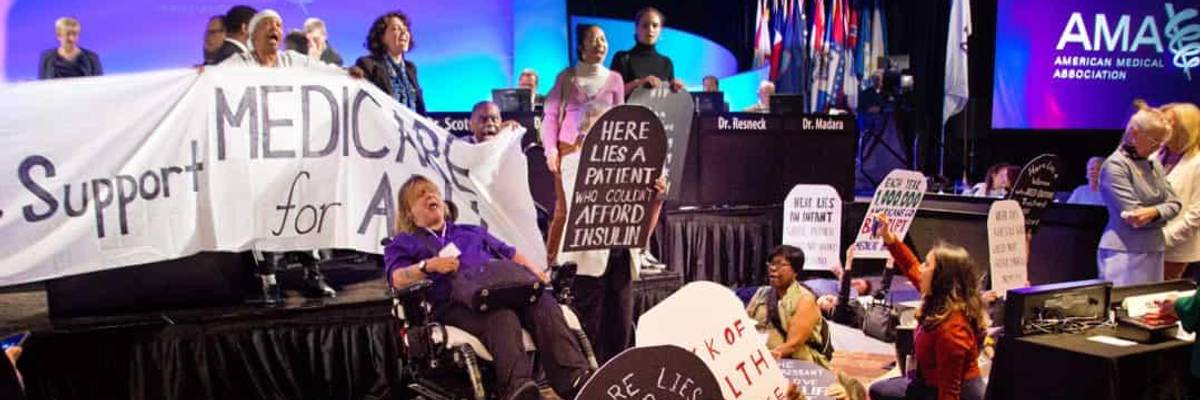
Seventy percent of Americans support universal health care as presented in the Medicare for All Act of 2019. (Photo: People's Action Blog)
Seniors chanting "Get out of the way!" as they hold cardboard tombstones might not seem like a challenge to the largest physicians' group in the United States. But in 78-year-old Reggie Griffin, the American Medical Association met their match.
"The time is up for us to sit on the sidelines and complain about things," says Reggie, a retired graphic designer who helped take over the floor of the AMA's annual convention this June in Chicago. "I have two grown daughters, five grown grandkids, and five young great-grandkids. We've got to fight for them now, to preserve and improve what we have for the future."
Reggie helped lead this "die-in" that pressured the AMA to drop out of the Partnership for America's Health Care Future, a lobby founded last year by private insurers, hospitals and pharmaceutical makers. The Partnership has spent hundreds of millions so far to stop the expansion of health care coverage.
Reggie and other members of Jane Addams Senior Caucus, a senior-led member-driven organizing and advocacy affiliate of People's Action, joined over a dozen groups and about 400 people at the AMA's annual convention to demand they leave the Partnership. And it worked.
Decades of education and direct action brought these activists to rally inside and outside the Hyatt Regency to make sure the AMA heard how the current system puts profits over patients' well-being. Caregivers and the chronically ill gave testimony to how insurers and ballooning health care costs kept them and their loved ones from accessing needed care.
"In our group there were doctors and medical students, but most were seniors like me - some in wheelchairs - each of whom has their own painful experiences to share of being denied care when we needed it most," says Reggie.
The importance of this win cannot be overstated. The AMA has a long history of opposing health care reforms, including Medicare and Medicaid, which they decried as "socialized medicine." The AMA lobbied with private insurers to undermine President Obama's efforts to include a public insurance option in the Affordable Care Act which could have shrunk the number of uninsured, now at thirty million.
Seventy percent of Americans support universal health care as presented in the Medicare for All Act of 2019, a bill in Congress to improve and expand the Medicare system, which the AMA actively opposed with the Partnership until this month.
To be clear, the physicians' group has not officially dropped its opposition to Medicare for All, but its recent 53%-47% delegate vote was the closest they have come to changing their position since the AMA first opposed single-payer health care in the 1940s.
More importantly, the AMA will no longer contribute to the millions spent by the Partnership to kill the bill. Last year alone, the group collectively spent $143 million on lobbying Congress, according to the Center for Responsive Politics.
In 2018, the AMA had over $550 million in reserves alone, so it does not lack the resources to put money behind its priorities. Most would not believe that a bunch of grassroots activists could stop a 172-year-old professional organization in its tracks. Such a feat would be nothing short of David felling Goliath.
But that's exactly what we did.
Dear Common Dreams reader, It’s been nearly 30 years since I co-founded Common Dreams with my late wife, Lina Newhouser. We had the radical notion that journalism should serve the public good, not corporate profits. It was clear to us from the outset what it would take to build such a project. No paid advertisements. No corporate sponsors. No millionaire publisher telling us what to think or do. Many people said we wouldn't last a year, but we proved those doubters wrong. Together with a tremendous team of journalists and dedicated staff, we built an independent media outlet free from the constraints of profits and corporate control. Our mission has always been simple: To inform. To inspire. To ignite change for the common good. Building Common Dreams was not easy. Our survival was never guaranteed. When you take on the most powerful forces—Wall Street greed, fossil fuel industry destruction, Big Tech lobbyists, and uber-rich oligarchs who have spent billions upon billions rigging the economy and democracy in their favor—the only bulwark you have is supporters who believe in your work. But here’s the urgent message from me today. It's never been this bad out there. And it's never been this hard to keep us going. At the very moment Common Dreams is most needed, the threats we face are intensifying. We need your support now more than ever. We don't accept corporate advertising and never will. We don't have a paywall because we don't think people should be blocked from critical news based on their ability to pay. Everything we do is funded by the donations of readers like you. When everyone does the little they can afford, we are strong. But if that support retreats or dries up, so do we. Will you donate now to make sure Common Dreams not only survives but thrives? —Craig Brown, Co-founder |
Seniors chanting "Get out of the way!" as they hold cardboard tombstones might not seem like a challenge to the largest physicians' group in the United States. But in 78-year-old Reggie Griffin, the American Medical Association met their match.
"The time is up for us to sit on the sidelines and complain about things," says Reggie, a retired graphic designer who helped take over the floor of the AMA's annual convention this June in Chicago. "I have two grown daughters, five grown grandkids, and five young great-grandkids. We've got to fight for them now, to preserve and improve what we have for the future."
Reggie helped lead this "die-in" that pressured the AMA to drop out of the Partnership for America's Health Care Future, a lobby founded last year by private insurers, hospitals and pharmaceutical makers. The Partnership has spent hundreds of millions so far to stop the expansion of health care coverage.
Reggie and other members of Jane Addams Senior Caucus, a senior-led member-driven organizing and advocacy affiliate of People's Action, joined over a dozen groups and about 400 people at the AMA's annual convention to demand they leave the Partnership. And it worked.
Decades of education and direct action brought these activists to rally inside and outside the Hyatt Regency to make sure the AMA heard how the current system puts profits over patients' well-being. Caregivers and the chronically ill gave testimony to how insurers and ballooning health care costs kept them and their loved ones from accessing needed care.
"In our group there were doctors and medical students, but most were seniors like me - some in wheelchairs - each of whom has their own painful experiences to share of being denied care when we needed it most," says Reggie.
The importance of this win cannot be overstated. The AMA has a long history of opposing health care reforms, including Medicare and Medicaid, which they decried as "socialized medicine." The AMA lobbied with private insurers to undermine President Obama's efforts to include a public insurance option in the Affordable Care Act which could have shrunk the number of uninsured, now at thirty million.
Seventy percent of Americans support universal health care as presented in the Medicare for All Act of 2019, a bill in Congress to improve and expand the Medicare system, which the AMA actively opposed with the Partnership until this month.
To be clear, the physicians' group has not officially dropped its opposition to Medicare for All, but its recent 53%-47% delegate vote was the closest they have come to changing their position since the AMA first opposed single-payer health care in the 1940s.
More importantly, the AMA will no longer contribute to the millions spent by the Partnership to kill the bill. Last year alone, the group collectively spent $143 million on lobbying Congress, according to the Center for Responsive Politics.
In 2018, the AMA had over $550 million in reserves alone, so it does not lack the resources to put money behind its priorities. Most would not believe that a bunch of grassroots activists could stop a 172-year-old professional organization in its tracks. Such a feat would be nothing short of David felling Goliath.
But that's exactly what we did.
Seniors chanting "Get out of the way!" as they hold cardboard tombstones might not seem like a challenge to the largest physicians' group in the United States. But in 78-year-old Reggie Griffin, the American Medical Association met their match.
"The time is up for us to sit on the sidelines and complain about things," says Reggie, a retired graphic designer who helped take over the floor of the AMA's annual convention this June in Chicago. "I have two grown daughters, five grown grandkids, and five young great-grandkids. We've got to fight for them now, to preserve and improve what we have for the future."
Reggie helped lead this "die-in" that pressured the AMA to drop out of the Partnership for America's Health Care Future, a lobby founded last year by private insurers, hospitals and pharmaceutical makers. The Partnership has spent hundreds of millions so far to stop the expansion of health care coverage.
Reggie and other members of Jane Addams Senior Caucus, a senior-led member-driven organizing and advocacy affiliate of People's Action, joined over a dozen groups and about 400 people at the AMA's annual convention to demand they leave the Partnership. And it worked.
Decades of education and direct action brought these activists to rally inside and outside the Hyatt Regency to make sure the AMA heard how the current system puts profits over patients' well-being. Caregivers and the chronically ill gave testimony to how insurers and ballooning health care costs kept them and their loved ones from accessing needed care.
"In our group there were doctors and medical students, but most were seniors like me - some in wheelchairs - each of whom has their own painful experiences to share of being denied care when we needed it most," says Reggie.
The importance of this win cannot be overstated. The AMA has a long history of opposing health care reforms, including Medicare and Medicaid, which they decried as "socialized medicine." The AMA lobbied with private insurers to undermine President Obama's efforts to include a public insurance option in the Affordable Care Act which could have shrunk the number of uninsured, now at thirty million.
Seventy percent of Americans support universal health care as presented in the Medicare for All Act of 2019, a bill in Congress to improve and expand the Medicare system, which the AMA actively opposed with the Partnership until this month.
To be clear, the physicians' group has not officially dropped its opposition to Medicare for All, but its recent 53%-47% delegate vote was the closest they have come to changing their position since the AMA first opposed single-payer health care in the 1940s.
More importantly, the AMA will no longer contribute to the millions spent by the Partnership to kill the bill. Last year alone, the group collectively spent $143 million on lobbying Congress, according to the Center for Responsive Politics.
In 2018, the AMA had over $550 million in reserves alone, so it does not lack the resources to put money behind its priorities. Most would not believe that a bunch of grassroots activists could stop a 172-year-old professional organization in its tracks. Such a feat would be nothing short of David felling Goliath.
But that's exactly what we did.