SUBSCRIBE TO OUR FREE NEWSLETTER
Daily news & progressive opinion—funded by the people, not the corporations—delivered straight to your inbox.
5
#000000
#FFFFFF
To donate by check, phone, or other method, see our More Ways to Give page.

A new analysis released Thursday by the environmental group Friends of the Earth shows that Facebook is continuing to allow thoroughly debunked climate lies to run rampant on its platform, despite the tech giant's frequent public pledges to combat disinformation.
"Facebook is becoming the last bastion of climate denial."
--Michael Khoo, Friends of the Earth
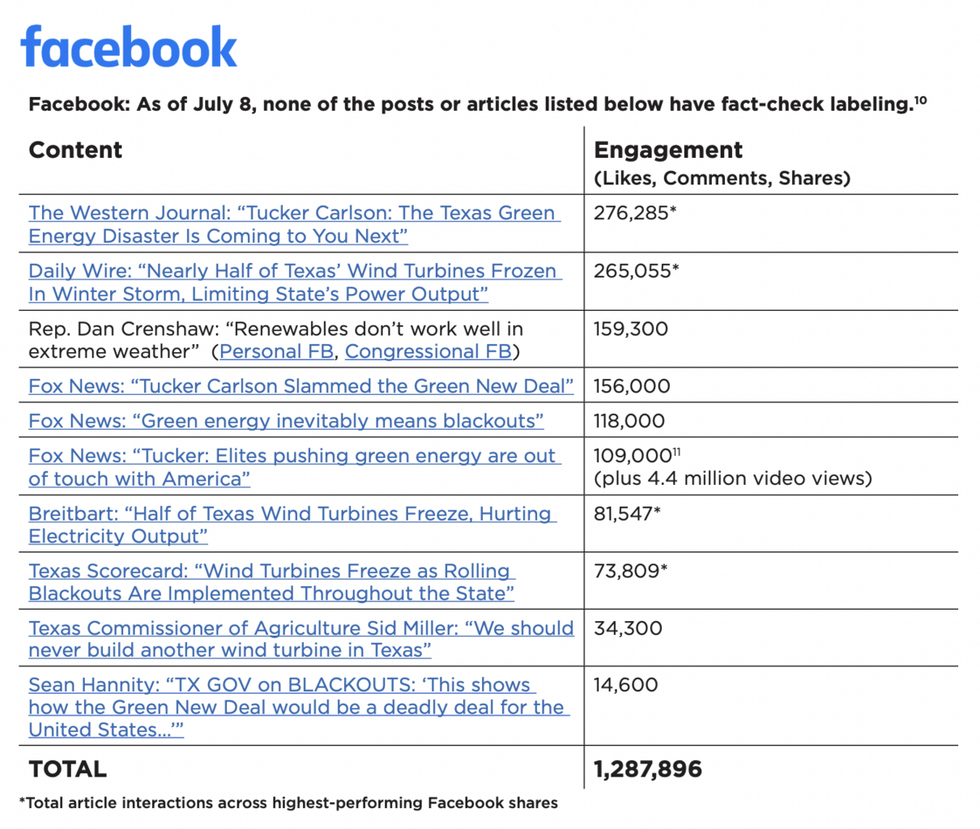
To demonstrate the extent of Facebook's failure, Friends of the Earth conducted a case study (pdf) of posts related to the widespread power outages in Texas that followed a devastating winter storm in February.
The group found that Facebook appended fact-check labels to just 0.9% of interactions with high-performing posts spreading the false narrative that wind energy--not the state's overwhelming reliance on fossil fuels--was to blame for the Texas power outages. That claim was quickly seized upon by Texas Republicans and right-wing media outlets, which used their Facebook pages to perpetuate the lie.
"The incident illustrates how right-wing extremists and fossil fuel interests weaponized social media to deride climate solutions," Friends of the Earth says in its new report. "The campaign rapidly expanded into mainstream media and subsequently the political arena, providing false talking points for politicians to blame renewable power and climate solutions at large for the failures of fossil fuels in Texas."
Facebook and other social media platforms, the group argues, "have given the fossil fuel industry's public relations campaigns a new lease on life, as they offer a safe space for the worst climate disinformation."
Michael Khoo, Friends of the Earth co-chair of the Climate Disinformation Coalition, said in a statement that the data shows "Facebook and other tech platforms must take far stronger action to limit the super-spreaders, and not put the burden on ordinary users."
"As mainstream news outlets strengthen their approach to disinformation, Facebook is becoming the last bastion of climate denial," Khoo added. "This doesn't need to be the case. Solving climate change is difficult but solving climate disinformation is simple: turn it off."
Friends of the Earth argued that Facebook should implement a number of policies to stop the dissemination of climate lies and other misinformation on its platform:
The group published its analysis and policy recommendations to coincide with Facebook's announcement Thursday that it is rolling out several new measures purportedly aimed at helping users "engage with climate topics and ensure people have access to reliable information while reducing misinformation."
"Worse still, they don't even propose to stop profiting from fossil fuel advertising."
--Imran Ahmed, Center for Countering Digital Hate
In an effort to increase "reliable information about climate change" on its platform, Facebook said it is investing $1 million in a "climate grant program, in partnership with the International Fact Checking Network, to support organizations working to combat climate misinformation."
Facebook also announced plans to expand its Climate Science Center, which was launched last year with the stated goal of exposing users to "factual and up-to-date climate information."
Friends of the Earth and other civil society organizations responded to Facebook's new initiative with deep skepticism. Khoo argued that "for a company that makes $85 billion a year, a $1 million program that outsources the problem they've created shows that Facebook is not serious about solving climate disinformation."
Imran Ahmed, CEO of the Center for Countering Digital Hate, echoed that critique, arguing in a statement that "this is too little, too late from Facebook."
"Facebook is, once again, proposing nothing to tackle the spread of rampant climate misinformation, or the known misinformation superspreaders using their service to lie to people," said Ahmed. "Worse still, they don't even propose to stop profiting from fossil fuel advertising."
A new analysis released Thursday by the environmental group Friends of the Earth shows that Facebook is continuing to allow thoroughly debunked climate lies to run rampant on its platform, despite the tech giant's frequent public pledges to combat disinformation.
"Facebook is becoming the last bastion of climate denial."
--Michael Khoo, Friends of the Earth
To demonstrate the extent of Facebook's failure, Friends of the Earth conducted a case study (pdf) of posts related to the widespread power outages in Texas that followed a devastating winter storm in February.
The group found that Facebook appended fact-check labels to just 0.9% of interactions with high-performing posts spreading the false narrative that wind energy--not the state's overwhelming reliance on fossil fuels--was to blame for the Texas power outages. That claim was quickly seized upon by Texas Republicans and right-wing media outlets, which used their Facebook pages to perpetuate the lie.
"The incident illustrates how right-wing extremists and fossil fuel interests weaponized social media to deride climate solutions," Friends of the Earth says in its new report. "The campaign rapidly expanded into mainstream media and subsequently the political arena, providing false talking points for politicians to blame renewable power and climate solutions at large for the failures of fossil fuels in Texas."
Facebook and other social media platforms, the group argues, "have given the fossil fuel industry's public relations campaigns a new lease on life, as they offer a safe space for the worst climate disinformation."
Michael Khoo, Friends of the Earth co-chair of the Climate Disinformation Coalition, said in a statement that the data shows "Facebook and other tech platforms must take far stronger action to limit the super-spreaders, and not put the burden on ordinary users."
"As mainstream news outlets strengthen their approach to disinformation, Facebook is becoming the last bastion of climate denial," Khoo added. "This doesn't need to be the case. Solving climate change is difficult but solving climate disinformation is simple: turn it off."
Friends of the Earth argued that Facebook should implement a number of policies to stop the dissemination of climate lies and other misinformation on its platform:
The group published its analysis and policy recommendations to coincide with Facebook's announcement Thursday that it is rolling out several new measures purportedly aimed at helping users "engage with climate topics and ensure people have access to reliable information while reducing misinformation."
"Worse still, they don't even propose to stop profiting from fossil fuel advertising."
--Imran Ahmed, Center for Countering Digital Hate
In an effort to increase "reliable information about climate change" on its platform, Facebook said it is investing $1 million in a "climate grant program, in partnership with the International Fact Checking Network, to support organizations working to combat climate misinformation."
Facebook also announced plans to expand its Climate Science Center, which was launched last year with the stated goal of exposing users to "factual and up-to-date climate information."
Friends of the Earth and other civil society organizations responded to Facebook's new initiative with deep skepticism. Khoo argued that "for a company that makes $85 billion a year, a $1 million program that outsources the problem they've created shows that Facebook is not serious about solving climate disinformation."
Imran Ahmed, CEO of the Center for Countering Digital Hate, echoed that critique, arguing in a statement that "this is too little, too late from Facebook."
"Facebook is, once again, proposing nothing to tackle the spread of rampant climate misinformation, or the known misinformation superspreaders using their service to lie to people," said Ahmed. "Worse still, they don't even propose to stop profiting from fossil fuel advertising."
A new analysis released Thursday by the environmental group Friends of the Earth shows that Facebook is continuing to allow thoroughly debunked climate lies to run rampant on its platform, despite the tech giant's frequent public pledges to combat disinformation.
"Facebook is becoming the last bastion of climate denial."
--Michael Khoo, Friends of the Earth
To demonstrate the extent of Facebook's failure, Friends of the Earth conducted a case study (pdf) of posts related to the widespread power outages in Texas that followed a devastating winter storm in February.
The group found that Facebook appended fact-check labels to just 0.9% of interactions with high-performing posts spreading the false narrative that wind energy--not the state's overwhelming reliance on fossil fuels--was to blame for the Texas power outages. That claim was quickly seized upon by Texas Republicans and right-wing media outlets, which used their Facebook pages to perpetuate the lie.
"The incident illustrates how right-wing extremists and fossil fuel interests weaponized social media to deride climate solutions," Friends of the Earth says in its new report. "The campaign rapidly expanded into mainstream media and subsequently the political arena, providing false talking points for politicians to blame renewable power and climate solutions at large for the failures of fossil fuels in Texas."
Facebook and other social media platforms, the group argues, "have given the fossil fuel industry's public relations campaigns a new lease on life, as they offer a safe space for the worst climate disinformation."
Michael Khoo, Friends of the Earth co-chair of the Climate Disinformation Coalition, said in a statement that the data shows "Facebook and other tech platforms must take far stronger action to limit the super-spreaders, and not put the burden on ordinary users."
"As mainstream news outlets strengthen their approach to disinformation, Facebook is becoming the last bastion of climate denial," Khoo added. "This doesn't need to be the case. Solving climate change is difficult but solving climate disinformation is simple: turn it off."
Friends of the Earth argued that Facebook should implement a number of policies to stop the dissemination of climate lies and other misinformation on its platform:
The group published its analysis and policy recommendations to coincide with Facebook's announcement Thursday that it is rolling out several new measures purportedly aimed at helping users "engage with climate topics and ensure people have access to reliable information while reducing misinformation."
"Worse still, they don't even propose to stop profiting from fossil fuel advertising."
--Imran Ahmed, Center for Countering Digital Hate
In an effort to increase "reliable information about climate change" on its platform, Facebook said it is investing $1 million in a "climate grant program, in partnership with the International Fact Checking Network, to support organizations working to combat climate misinformation."
Facebook also announced plans to expand its Climate Science Center, which was launched last year with the stated goal of exposing users to "factual and up-to-date climate information."
Friends of the Earth and other civil society organizations responded to Facebook's new initiative with deep skepticism. Khoo argued that "for a company that makes $85 billion a year, a $1 million program that outsources the problem they've created shows that Facebook is not serious about solving climate disinformation."
Imran Ahmed, CEO of the Center for Countering Digital Hate, echoed that critique, arguing in a statement that "this is too little, too late from Facebook."
"Facebook is, once again, proposing nothing to tackle the spread of rampant climate misinformation, or the known misinformation superspreaders using their service to lie to people," said Ahmed. "Worse still, they don't even propose to stop profiting from fossil fuel advertising."