SUBSCRIBE TO OUR FREE NEWSLETTER
Daily news & progressive opinion—funded by the people, not the corporations—delivered straight to your inbox.
5
#000000
#FFFFFF
To donate by check, phone, or other method, see our More Ways to Give page.
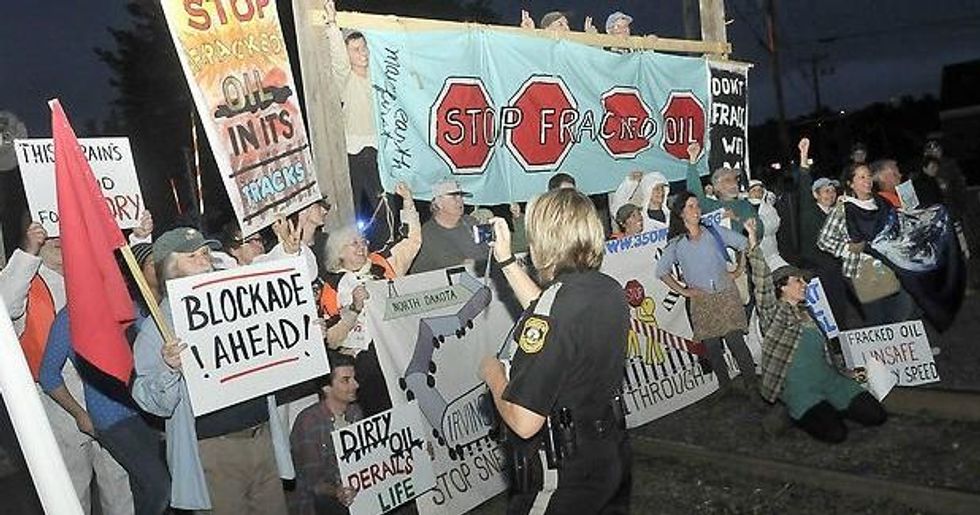
Associating themselves with a growing national campaign of direct action against the fossil fuel industry called "Fearless Summer," the protesters at the scene erected a large scaffold over the tracks and held signs reading "Trains for people, not for oil" and "This train's bound for Gory" (pun intended).
Police arrived, and after several warnings for the protesters to disperse, the six who refused were arrested as the scaffolding was destroyed with a chain saw.
Local media reported a surprisingly large law enforcement response with police from numerous towns showing up at the scene, including troopers from the State Police.
350 Maine*, the statewide group associated but independent from international organization 350.org that led the action, said the goal was to draw attention to the "fracked oil" that is quietly passing through the state on a regular basis. Local members of Earth First also participated in the action.
The groups say that the trains running through Maine carry crude from the Bakken oil fields of North Dakota and are especially toxic because "fracked oil" is extracted by blasting a high pressure toxic cocktail deep into the ground to release the oil from shale rock, polluting air and water in surrounding communities.
"People say that this new oil boom in the US will make us energy secure," said Meaghan LaSala, student at University of Southern Maine and an organzier with 350 Maine. "But there is nothing secure about runaway climate change. This is our moment to change our trajectory before it's too late."
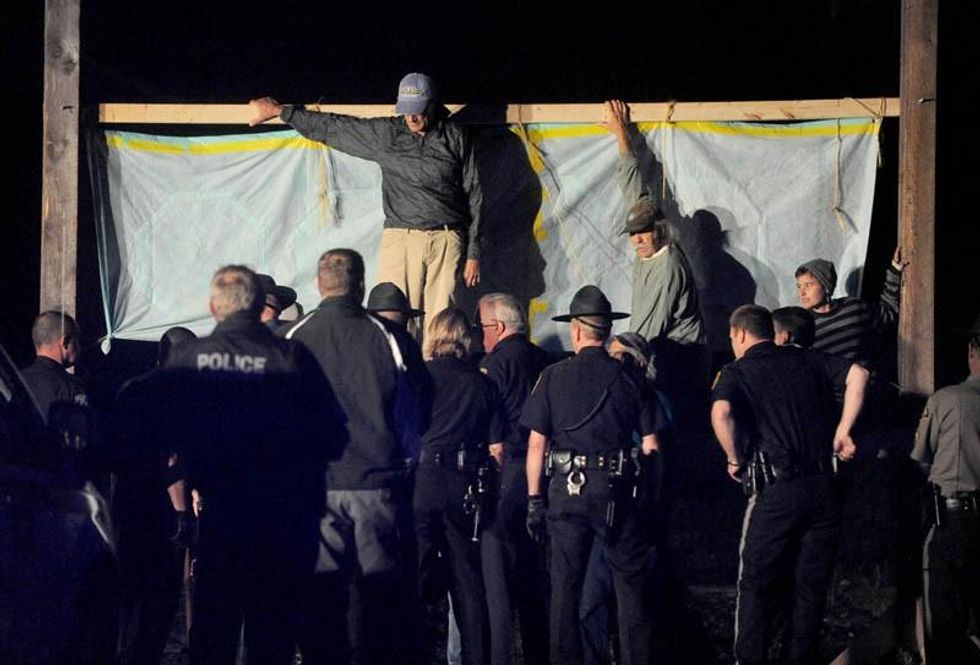
One of those arrested, 63-year old Read Brugger from the town of Freedom, was clear about his motivations.
"We feel there has not been enough awareness about the millions of gallons of crude shell oil that shipped across Maine each month," Brugger told the local Bangor Daily News. "We feel need to move beyond fossil fuels and get away from the poisonous ways oil is being extracted."
The BDN, which reported that many at the scene "said they did not know that fracked oil was being transported through Maine," made it seem like the action, at least on local level, may have had the desired result.
But the campaigners acknowledged their concerns go beyond even the dire threats faced by Maine communities if one of these trains rerails or a spill occurs.
"We believe the moment we're in, in terms of climate change, is a dramatic one and it calls for dramatic action," said LaSala in an interview with the Morning Sentinel.

"We oppose the continued extraction of fossil fuels, but we also oppose its transportation over thousands of miles of environmentally sensitive areas," added Sarah Linnekin, a student at Maine's Unity College. "Since my number one job is to protect my children, I feel an obligation to take action."
[*Full disclosure: This writer is a sometimes volunteer for 350 Maine, though had no involvement with this action.]
______________________________________________
Associating themselves with a growing national campaign of direct action against the fossil fuel industry called "Fearless Summer," the protesters at the scene erected a large scaffold over the tracks and held signs reading "Trains for people, not for oil" and "This train's bound for Gory" (pun intended).
Police arrived, and after several warnings for the protesters to disperse, the six who refused were arrested as the scaffolding was destroyed with a chain saw.
Local media reported a surprisingly large law enforcement response with police from numerous towns showing up at the scene, including troopers from the State Police.
350 Maine*, the statewide group associated but independent from international organization 350.org that led the action, said the goal was to draw attention to the "fracked oil" that is quietly passing through the state on a regular basis. Local members of Earth First also participated in the action.
The groups say that the trains running through Maine carry crude from the Bakken oil fields of North Dakota and are especially toxic because "fracked oil" is extracted by blasting a high pressure toxic cocktail deep into the ground to release the oil from shale rock, polluting air and water in surrounding communities.
"People say that this new oil boom in the US will make us energy secure," said Meaghan LaSala, student at University of Southern Maine and an organzier with 350 Maine. "But there is nothing secure about runaway climate change. This is our moment to change our trajectory before it's too late."
One of those arrested, 63-year old Read Brugger from the town of Freedom, was clear about his motivations.
"We feel there has not been enough awareness about the millions of gallons of crude shell oil that shipped across Maine each month," Brugger told the local Bangor Daily News. "We feel need to move beyond fossil fuels and get away from the poisonous ways oil is being extracted."
The BDN, which reported that many at the scene "said they did not know that fracked oil was being transported through Maine," made it seem like the action, at least on local level, may have had the desired result.
But the campaigners acknowledged their concerns go beyond even the dire threats faced by Maine communities if one of these trains rerails or a spill occurs.
"We believe the moment we're in, in terms of climate change, is a dramatic one and it calls for dramatic action," said LaSala in an interview with the Morning Sentinel.
"We oppose the continued extraction of fossil fuels, but we also oppose its transportation over thousands of miles of environmentally sensitive areas," added Sarah Linnekin, a student at Maine's Unity College. "Since my number one job is to protect my children, I feel an obligation to take action."
[*Full disclosure: This writer is a sometimes volunteer for 350 Maine, though had no involvement with this action.]
______________________________________________
Associating themselves with a growing national campaign of direct action against the fossil fuel industry called "Fearless Summer," the protesters at the scene erected a large scaffold over the tracks and held signs reading "Trains for people, not for oil" and "This train's bound for Gory" (pun intended).
Police arrived, and after several warnings for the protesters to disperse, the six who refused were arrested as the scaffolding was destroyed with a chain saw.
Local media reported a surprisingly large law enforcement response with police from numerous towns showing up at the scene, including troopers from the State Police.
350 Maine*, the statewide group associated but independent from international organization 350.org that led the action, said the goal was to draw attention to the "fracked oil" that is quietly passing through the state on a regular basis. Local members of Earth First also participated in the action.
The groups say that the trains running through Maine carry crude from the Bakken oil fields of North Dakota and are especially toxic because "fracked oil" is extracted by blasting a high pressure toxic cocktail deep into the ground to release the oil from shale rock, polluting air and water in surrounding communities.
"People say that this new oil boom in the US will make us energy secure," said Meaghan LaSala, student at University of Southern Maine and an organzier with 350 Maine. "But there is nothing secure about runaway climate change. This is our moment to change our trajectory before it's too late."
One of those arrested, 63-year old Read Brugger from the town of Freedom, was clear about his motivations.
"We feel there has not been enough awareness about the millions of gallons of crude shell oil that shipped across Maine each month," Brugger told the local Bangor Daily News. "We feel need to move beyond fossil fuels and get away from the poisonous ways oil is being extracted."
The BDN, which reported that many at the scene "said they did not know that fracked oil was being transported through Maine," made it seem like the action, at least on local level, may have had the desired result.
But the campaigners acknowledged their concerns go beyond even the dire threats faced by Maine communities if one of these trains rerails or a spill occurs.
"We believe the moment we're in, in terms of climate change, is a dramatic one and it calls for dramatic action," said LaSala in an interview with the Morning Sentinel.
"We oppose the continued extraction of fossil fuels, but we also oppose its transportation over thousands of miles of environmentally sensitive areas," added Sarah Linnekin, a student at Maine's Unity College. "Since my number one job is to protect my children, I feel an obligation to take action."
[*Full disclosure: This writer is a sometimes volunteer for 350 Maine, though had no involvement with this action.]
______________________________________________