

SUBSCRIBE TO OUR FREE NEWSLETTER
Daily news & progressive opinion—funded by the people, not the corporations—delivered straight to your inbox.
5
#000000
#FFFFFF
To donate by check, phone, or other method, see our More Ways to Give page.
Daily news & progressive opinion—funded by the people, not the corporations—delivered straight to your inbox.
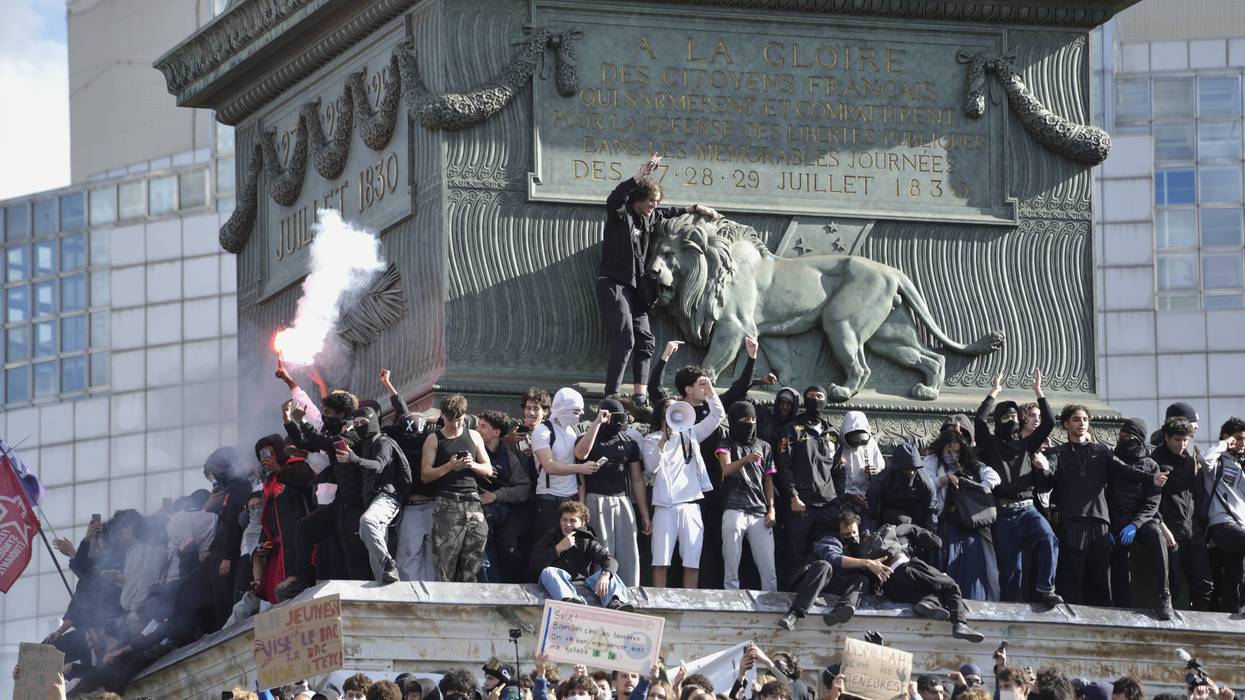
"There's rats in the schools. There's holes in the windows... it's not suitable conditions to study," said one French student.
High school students across France on Thursday once again took to the streets to protest against against the state of the country's schools.
Euronews, citing information from France's Interior Ministry, reported that 71,500 people took part in Thursday's protests.
Students taking part in the nationwide protests have been joined by teachers and parents, as well as members of labor unions who earlier this week marched in solidarity.
The demonstrations began in the suburbs of Paris last month, where students blockaded their schools to protest staffing shortages, dilapidated buildings, and a university application system that has been criticized for keeping students in the dark for months about their acceptance into programs.
In an interview with NPR published Thursday, 19-year-old French student Clara Houssain described the conditions of schools that were leading to the demonstrations.
"There's rats in the schools," said Houssain. "There's holes in the windows... it's not suitable conditions to study. They don't have a French teacher for six months. And then we're asked to pass an exam, and that exam is supposed to be fair. But it's not fair if you haven't had a teacher for six months."
Jean-Luc Mélenchon, leader the left-wing France Unbowed party, took to social media on Thursday to celebrate the success of the student demonstrations.
"The Bastille has been retaken," he wrote, while posting a video of demonstrators at the July Column in Paris, built to commemorate the Revolution of 1830. "Powerful demonstration by the youth who carry their demands in the most beautiful way possible! Immense pride."
La Bastille est reprise. Démonstration puissante de la jeunesse qui porte ses revendications de la plus belle façon qui soit ! Fierté immense. Rendez-vous mardi 13 octobre à l'appel des syndicats de jeunes et des salariés. https://t.co/5SYLDREZam
— Jean-Luc Mélenchon (@JLMelenchon) October 8, 2026
The Guardian reported on Thursday that Édouard Geffray, the French education minister, met with students and teachers in the city of Reims and pledged to implement "an emergency plan to ensure absent teachers can be replaced on a long-term basis," and to initiate a review of the university application system.
However, high school student union leaders who spoke with The Guardian said they were underwhelmed by the government's promises so far.
Student leader Ryad Rani told the newspaper that the demonstrations "will continue," accusing the government of offering "no concrete measures whatsoever, no response to our demands."
Sabrine Kharbach similarly said that the protests would not stop "for as long as €10 billion hasn’t been put on the table," a reference to the amount of money organizers say is needed for education investment.
A Paris secondary school teacher identified as Cathy said in an interview with Euronews that the student revolt had been brewing for a long time.
"The students have demands that are very close to the ones teachers have been putting forward years," she explained. "The system is degraded and it's because there has been no response for so long, that this is happening."
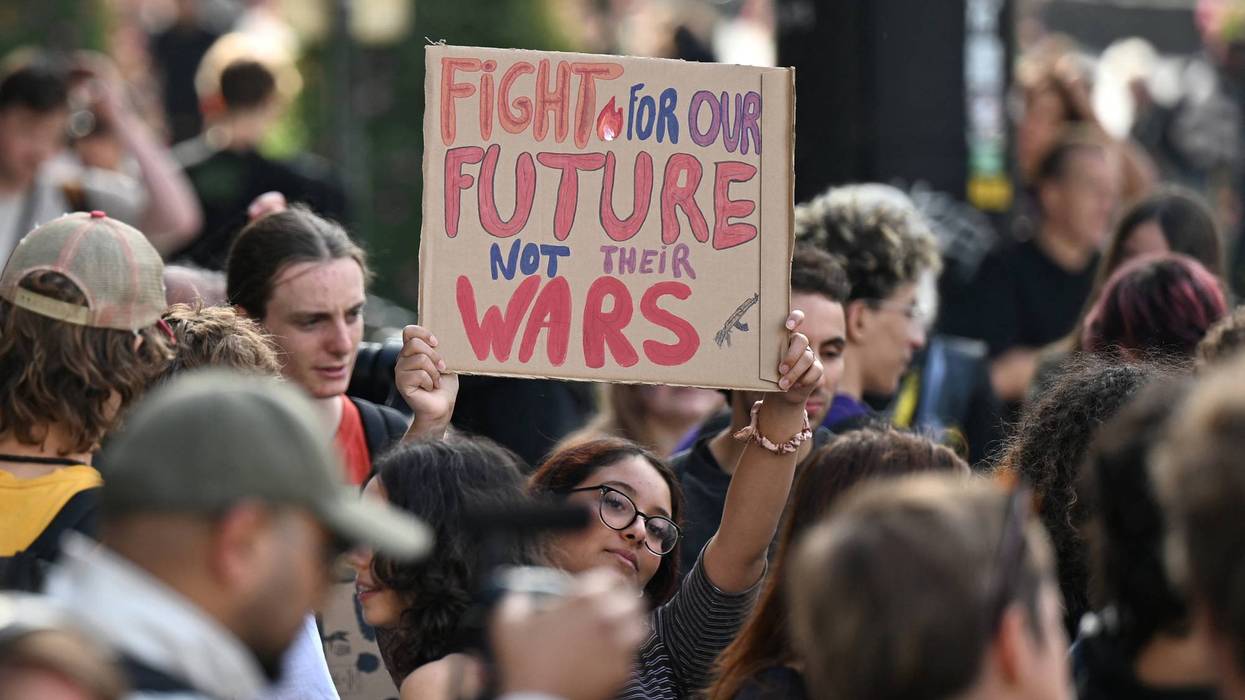
Protests across Europe have focused on education cuts, while a Gen Z-led movement has spearheaded demonstrations over voting rights in India.
"We are going to sweep away the old world," said the deputy of the French National Assembly on Thursday, highlighting a rapidly growing global protest movement, largely led by students and young people, against austerity measures.
Clémence Guetté, a member of the left-wing French party La France Insoumise, or France Unbowed, added that "the youth wants to change everything," posting on social media a video of a massive demonstration in Paris—just one of several cities across France where students have led more than 250,000 people in protests demanding education funding and decrying cuts in the proposed 2027 national budget.
But Guetté noted that while France's growing protests—and the violent response of the police—have captured international attention, with thousands of people demanding the resignation of President Emmanuel Macron in Place de la Bastille, Paris on Thursday, the movement against austerity and corrupt governance has spread across Europe and is also gaining traction across Latin America and South Asia.
"The youth of the world are rising up," said Guetté.
The protests against education cuts, dilapidated school buildings, and crowded classrooms in France began in mid-September in lower-income Parisian suburbs before spreading nationwide.
As they have shown no sign of slowing down, thousands of miles away in India, the Generation Z-led Cockroach Janta Party (CJP)—so named because the chief justice of the Supreme Court derided unemployed young people as "cockroaches" this year—has spearheaded calls for the resignation of the country's top Election Commission official.
The Election Commission has been accused of an illegal purge of voters over its “special intensive revision” of voter rolls, which has included removing more than 130 million names.
The CJP initially took to the streets over the summer to demand the resignation of the Indian education minister, due to leaks of the country's medical school entrance exam, which had delayed university admissions for millions of students and forced them to retake the intense exams. CJP organizers said the scandal has led to the suicides of more than 20 students.
Those protests were ultimately successful in forcing Education Minister Dharmendra Pradhan out of office.
Thousands of supporters joined a demonstration in Bengaluru on Thursday as the CJP condemned the detention on Wednesday of politician Rahul Gandhi, a leader of the opposition against Prime Minister Narendra Modi, as well as other protesters.
Leaders of the mass protest movement on Thursday rejected allegations that the protests, which have also been met with violence from police, are "destabilizing the country."
"When you declare living people as dead [on voter rolls] for your political gains, that is destabilizing the country," said one organizer.
When you declare living people as “Dead” for your political gains, that is destabilising the country. https://t.co/FZTPkKgBJk
— Cockroach Janta Party - CJP (@Cockroachisback) October 8, 2026
As Common Dreams reported Wednesday, Spain residents have also been inspired in recent days to take to the streets by the tens of thousands following the eviction of María del Carmen Abascal Martín, an 87-year-old woman who died this week before she was able to return home, as the demonstrations over housing justice were underway.
After Maricarmen's eviction on September 23, the Spanish Socialist Workers’ Party, led by Prime Minister Pedro Sánchez, announced new rental regulations and protections for vulnerable tenants, but lawmakers rejected the package. Sánchez responded by dissolving the legislature and calling for snap elections in November.
Meanwhile, tens of thousands of people have marched in Madrid, Valencia, and other cities to demand a general strike and affordable housing across Spain, where the average rent has doubled over the last 10 years.
More than 1,000 people have set up encampments at Puerta del Sol in Madrid and Plaza Catalunya in Barcelona, saying they will not leave until the government takes concrete steps to protect tenants.
🇪🇸 Maricarmen Abascal, the 87-year-old woman whose eviction sparked housing protests in #Spain, has died, Madrid's tenants' union said on Wednesday.Abascal became a symbol of Spain's housing market on September 23 when she was evicted from her life-long Madrid home on a stretcher after the real estate firm that owned the apartment drastically hiked the rent.
— FRANCE 24 English (@France24_en) October 8, 2026
In Chile, student unions led protests last week against proposed education cuts in the country's 2027 budget, put forward by conservative President Jose Antonio Kast. Chilean national police blocked people from marching through Santiago last Thursday toward La Moneda presidential palace, with officers firing water cannons and tear gas at the crowd.
According to the undersecretary of the interior, at least 17 people were arrested, and Kast condemned the protests.
One commentator on the social media platform X called on the public to connect "the dots on these Gen Z protests."
Across the globe, they said, "young people can't get hired. Can't afford rent. Can't afford a house. Can't see a future."
"The streets are the only place left," they added. "This is going global."
Another recent entry into the international protest movement came last week in Belgium, where students in Liège were reportedly directly inspired by the France protests to speak out against rising education costs and overcrowding in schools.
The city's main train station was temporarily closed on Thursday and traffic was disrupted, and more than 100 protesters were arrested.
“We support each other because we’re facing pretty much the same issues,” Alfred, a 19-year-old student, told Reuters of the connection between the Belgian and French unrest.
Students in Italy, Ireland, and Germany have also called for protests over soaring university costs and government disinvestment in education, particularly as worldwide energy costs have gone up due to the US-Israeli war on Iran.
In Rome and Turin, high school students began occupying their schools on Monday under the slogan, "Let's do as in France."
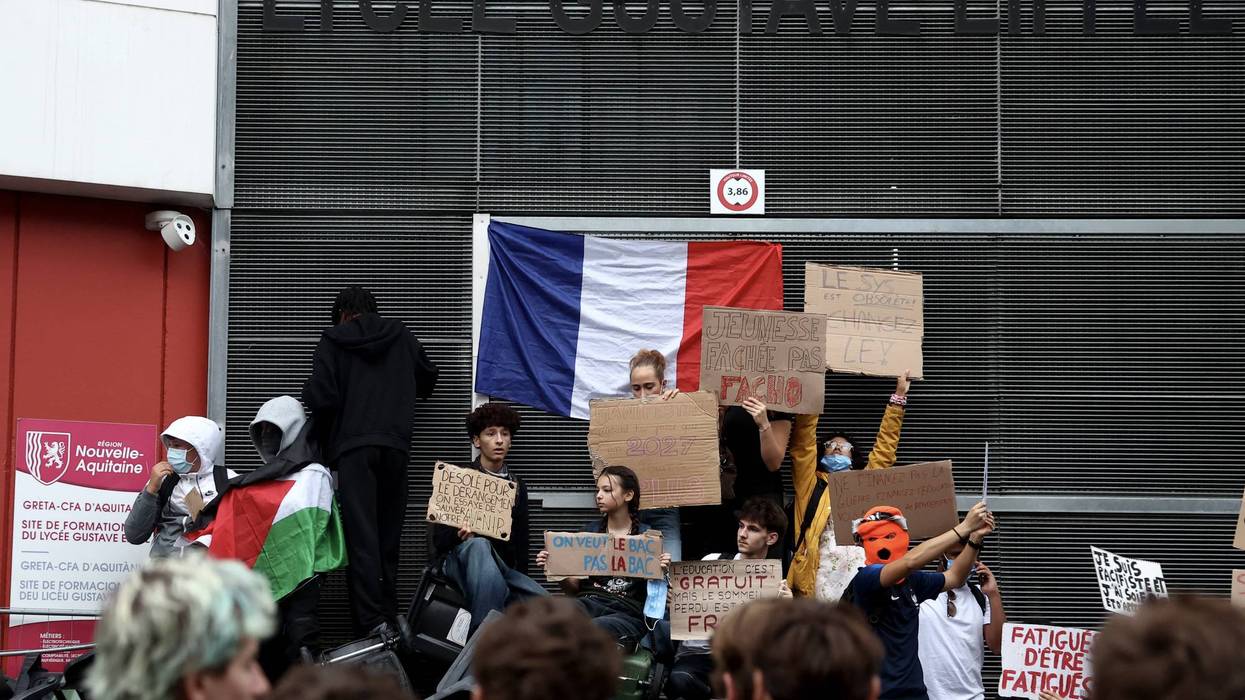
The American Revolution helped inspire France’s struggle for liberty. Now, France’s students are offering Americans an example we ought to consider: A generation can defend its future together instead of being told, one person at a time, to adjust its expectations.
France’s October 6 mobilization challenges Americans to defend their future through peaceful collective action.
Call me a Jacobin. Call me whatever you want.
On October 6, students, teachers, and parents took to the streets across France in a national day of action over missing teachers, overcrowded classrooms, and deteriorating schools. Americans should pay attention to what they are demanding—and what their pressure has already helped put on the political agenda.
Our circumstances differ from France’s, but the gap between a promised future and a delivered one is familiar.
When I watch young people in France insist that their futures deserve more than another promise, I feel something like the hope Thomas Jefferson felt watching the beginnings of the French Revolution: the possibility that ordinary people might demand a greater say in the society they inhabit.
History does not offer a clean comparison. Jefferson’s enthusiasm led him to excuse terrible bloodshed, and I will not follow him there. What moves me today is the courage of students organizing peacefully, walking out, and refusing to treat deteriorating conditions as the natural order of things.
The American Revolution helped inspire France’s struggle for liberty. Now, France’s students are offering Americans an example we ought to consider: A generation can defend its future together instead of being told, one person at a time, to adjust its expectations.
The immediate grievances are concrete. Reuters has reported on French high school students protesting overcrowded classrooms, deteriorating buildings, and teacher shortages. One 17-year-old aspiring teacher described taking her French examination without having had a French teacher. A younger student carried a sign declaring, “Our address should not decide our future.” [Source]
That is a demand for the promise of education to mean something.
We tell young people to attend class, work hard, and prepare for a career. We tell them that education is their route to stability. Then, when the institutions responsible for providing that education fail them, we act surprised that they refuse to keep participating quietly.
Their sacrifice deserves acknowledgment. Walking out can mean missed instruction, disciplinary consequences, and added pressure around examinations. These students have futures to build. Their willingness to interrupt that work should make us ask why continuing as usual feels like the greater risk.
And with teachers missing, some students were already losing instruction. A government cannot count every hour lost to protest while overlooking the hours its own failures have taken.
The violence must be named plainly. By October 2, Education Minister Édouard Geffray reported at least 65 injured staff members, including 40 principals, about 170 wounded students, and more than 100 severely damaged high schools. By October 6, the prime minister reported 215 injured teenagers and 85 injured school staff. Schools have been set on fire. Reuters reported that two teachers in Marseille were inadvertently splashed with gasoline as a student tried to throw it into a trash bin. A regional education spokesperson separately reported a youth spraying gasoline at a teacher in La Ciotat; Reuters could not verify that incident’s circumstances.
Burning a school and endangering its staff betray the demand for a better education. Whoever commits those acts should be held accountable. Students, teachers, and principals deserve protection.
Officials also dispute the movement’s origins. Justice Minister Gérald Darmanin said outsiders had hijacked it; Interior Minister Laurent Nuñez described troublemakers moving between schools to incite violence. According to a government source cited by Reuters, intelligence agencies attributed its initiation to La France Insoumise and far-left allies. LFI denied the allegation. Those claims deserve scrutiny, rather than being treated as proof that every student’s complaint is manufactured.
Some Paris-area students told Reuters they were staying away because of the escalating violence. That is a loss of their voice, too. A peaceful movement needs to protect their ability to participate. Nonviolence must remain a commitment, especially when anger is justified. The society we want to build has to be visible in the way we fight for it.
If the police are more interested in silencing you than hearing your complaint, then that society deserves protesting, in my view. Police officers cannot resolve every political grievance, but they can respect the right to express one. When authorities answer peaceful dissent with intimidation or unjustified force, their response becomes another reason to protest.
A student should not have to fall silent to be treated as someone worth protecting.
But calls for order must come with an answer to the conditions that brought students into the streets. Returning everyone to the classroom will not resolve a teacher vacancy. Ending a blockade will not repair a neglected building.
If leaders want stability, they have to give young people a reason to believe the institutions around them can deliver it.
Promises alone cannot do that anymore.
There has already been a concrete retreat. On October 1, Education Minister Édouard Geffray announced that the government would withdraw proposed annual registration fees for students without scholarships in BTS technical programs and preparatory classes for the Grandes Écoles. The proposed charges were €178 and €270, respectively. He cited discussions with unions and the prime minister.
That reversal came amid the student mobilization. It does not prove that street protests alone caused the decision, and it does not repair a classroom. But it shows that a government proposal can be challenged and withdrawn. Pressure can produce something more tangible than another invitation to be patient.
Students deserve commitments they can evaluate: which positions will be filled, which buildings will be repaired, what resources will reach underserved schools, and when those changes will happen. A consultation can help identify a problem. It cannot become a permanent substitute for fixing it.
American Gen Z should take note.
Consider our fight over student debt. In June 2023, the Supreme Court struck down the Biden administration’s plan to cancel up to $10,000 in eligible federal student debt, or $20,000 for eligible Pell Grant recipients. The court held that the administration lacked authority under the law it had invoked. Borrowers who had been offered relief were left without that promised cancellation.
The legal question matters. So does the political responsibility to deliver a workable solution. Telling young Americans that education is the path to stability, then leaving them to navigate its financial consequences, is hardly an invitation to trust another announcement. Our circumstances differ from France’s, but the gap between a promised future and a delivered one is familiar.
Peaceful collective action gives that frustration somewhere to go. Student associations, unions, public meetings, demonstrations, and the ballot can turn private discouragement into demands people can act on together.
I do not expect every young American to take the same risk. Some cannot afford to miss a shift or a class. A serious movement makes room for them, too. Solidarity should widen participation and help people bear its costs.
What I admire in France is the refusal to surrender the idea that public institutions owe the next generation a fair chance.
God bless France. God bless the students peacefully standing up for the society they want to inherit.
And may America’s young people recognize that they deserve a voice in shaping theirs.
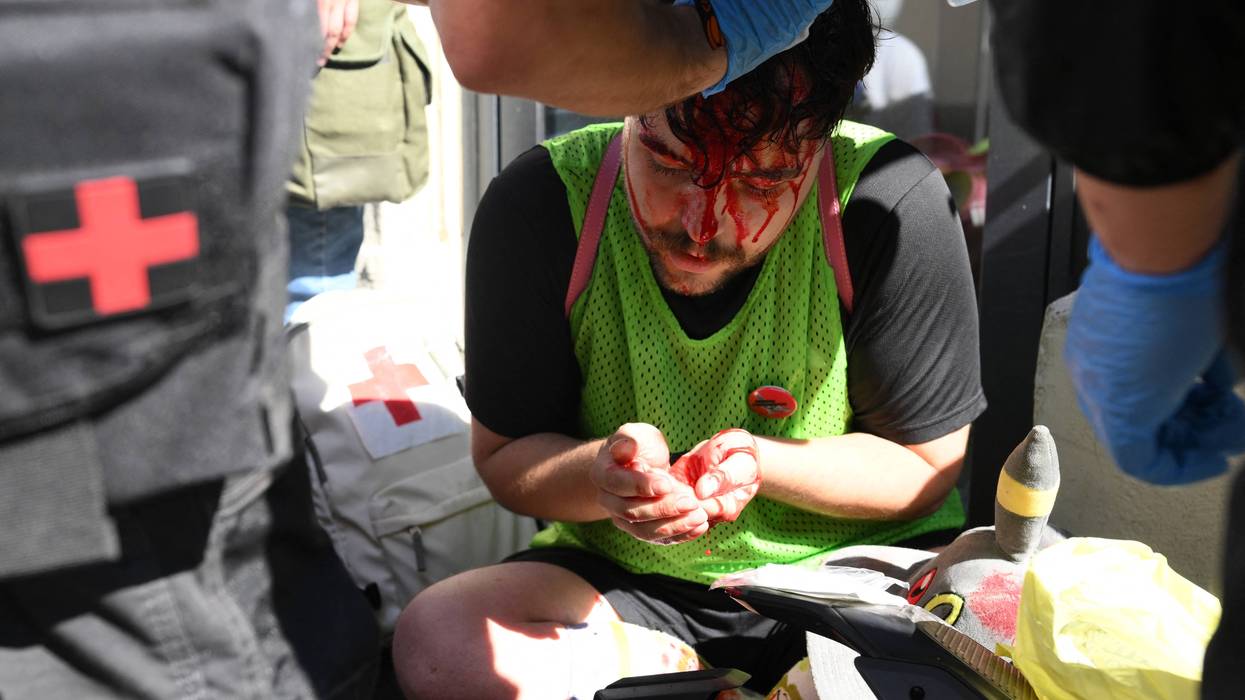
A 15-year-old's hand was blown off, a 16-year-old suffered a devastating eye injury, and a 14-year-old reportedly lost most of his teeth as Amnesty International accused French police of using disproportionate force.
Young people across France suffered horrifying injuries this week as riot police attacked high school and university students, faculty, and parents who were joined by striking workers in the latest nationwide mobilization over the country's underfunded education system.
Hundreds of thousands of students, workers, and their supporters rallied at more than 170 demonstrations across France Tuesday, with the arrest total topping 6,000 people—including roughly 4,400 minors—since the current wave of demonstrations began on September 28, according to the country's Interior Ministry.
The school blockades and other protests began in blue-collar Parisian suburbs and rapidly spread across the country as students and their supporters demanded more teachers and staff, smaller classes, improved school buildings, an end to socially discriminatory university admissions, and an education system that does not force working-class youth to bear the cost of government austerity.
The Confédération Générale du Travail (CGT), one of France's largest unions, urged its members to join Tuesday's mobilization alongside students and educators. The union said it would stand with high school and university students "including through strikes," while demanding major investment in public education.
"Beyond the issue of resources, students are demanding greater equality and social justice, aware that the policies of [President] Emmanuel Macron and his successive governments have deliberately damaged the principles of the French public education system," a coalition of unions including CGT said in a statement of solidarity.
Such solidarity was visible on the streets Tuesday as students from Épinay-sur-Seine marched alongside SUD-Rail railway employees, while education workers formed human chains to protect young protesters from police. Workers also joined students blockading a high school in Montpellier.
Protesters in some cities were met with police violence.
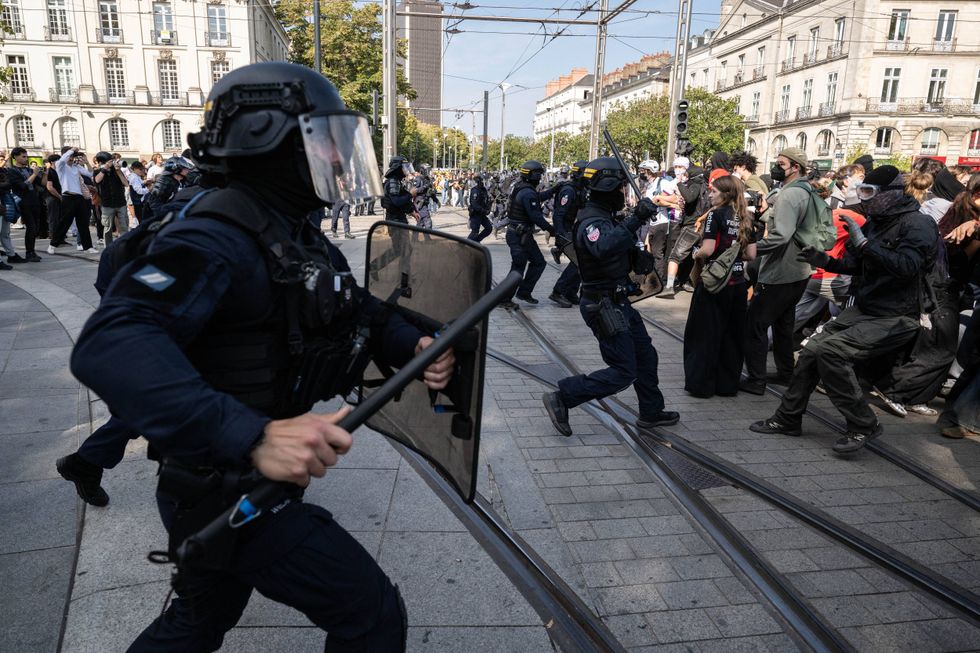 Police in riot gear charge student protesters in Nantes, France on October 6, 2026. (Photo by Sebastien Salom-Gomis/AFP via Getty Images)
"The repression is the same as that employed against the Yellow Vests except that now it's our kids who are in the streets," said Julien, a CGT Total refinery worker and union activist, referring to the 2018 economic protests that swept the nation. "The high school and university students have opened the way, and we have to follow them."
Coline, a high school student in Le Havre, said that workers physically placed themselves between young protesters and police.
"Union members formed a human chain between us and the CRS," she said. "All workers should do it because our demands are theirs. They portray us as rioters when we just want a future."
Alarming scenes of police terror shocked many observers.
In Lens, a 15-year-old student suffered a devastating hand injury during clashes near his high school Monday. According to La Voix du Nord, the teenager lost his hand after a police grenade exploded. The precise circumstances remain under investigation, chiefly by the Inspection Générale de la Police Nationale (IGPN).
A fellow student, Chloé, rejected the authorities' claims that the teenager was injured when he picked up the grenade.
"The police started coming toward us," she told La Voix du Nord. "So we all started running in the opposite direction. They threw smoke grenades at us... We were running. We couldn't see. And my high schoolmate got it in his hand."
She said the injured student began shouting, "My hand! My hand!"
"I turn around and see that he doesn't have a hand anymore," she recounted. "We all gathered around him."
"We're students, we're young," Chloé added. "There's no need to do that. It was useless; we were already leaving."
A 14-year-old in Saint-Ouen-l'Aumône reportedly suffered a double jaw fracture after being struck by a tear gas grenade fired at close range. Le Monde said the incident is among several cases being investigated by the IGPN.
Another 14-year-old reportedly lost most of his teeth after a police officer apparently fired a grenade at his face at close range during a protest northwest of Paris.
“His jaw is sealed shut, he can no longer speak, and he eats through a straw,” his mother told reporters.
In Tours, a 16-year-old reportedly suffered a severe eye injury when police fired "less-lethal" projectiles, including rubber-coated steel bullets, into a crowd of protesters during a high school blockade.
Another student, 16-year-old Isabella, connected the police crackdown to the class inequalities underlying the movement.
"Everybody told us that school was the great leveler, but today that is not the case at all," she told The Guardian. "A teenager in the suburbs of Paris is never going to have the same opportunities as a student from the city center."
The protests have also become a political flashpoint, with Jean-Luc Mélenchon and his left-wing La France Insoumise party openly backing the students while rejecting government accusations that they are responsible for the unrest. LFI lawmakers have appeared alongside protesters, while Mélenchon has condemned the police response and called on his supporters to nonviolently resist what he called police “savagery.”
On Tuesday, French Interior Minister Laurent Nuñez refused to apologize for the police violence, drawing calls from the left for his resignation.
Amnesty International accused French authorities of answering protests with "disproportionate" force.
“Footage and testimonies widely reported over the last week raise alarming concerns about the dangerous use of tear gas, batons, and restraint techniques by police," Amnesty International France president Anne Savinel-Barras said Monday. "Tear gas grenades have been discharged recklessly, and rubber bullets have been fired, causing serious injuries."
“Authorities must ensure that any response to demonstrations is necessary and proportionate, and that children and young people peacefully demanding their right to education are protected rather than being beaten, tear-gassed, or arbitrarily detained," she added. "The priority should be the de-escalation of tensions, and authorities must take all available precautionary measures to avoid the need to use force.”
At least dozens of protesting educators, parents, and labor unionists have also been injured by police during the demonstrations.
Some police also reportedly refused to attack protesters.
Workers interviewed during the protests appeared undaunted and focused on their own demands, as well as those of the students.
“We’re sick of wage freezes; 60% of low-wage public sector workers are paid less than the minimum wage for a full workweek,” CGT Poitiers official Vincent Bohan told World Socialist Web Site during a march in Paris last week. “More and more people rely on us, but there are not enough of us to meet the population’s needs.”
“When you hear Macron’s speeches, each one more provocative than the last, with billions of euros spent on killing, while people in France are starving, one feels like telling him: Stop... help people struggling here rather than killing people elsewhere," Bohan said, referring to rising tensions with Russia and France's testing of a new generation of nuclear missiles. "Frankly, we are very worried.”
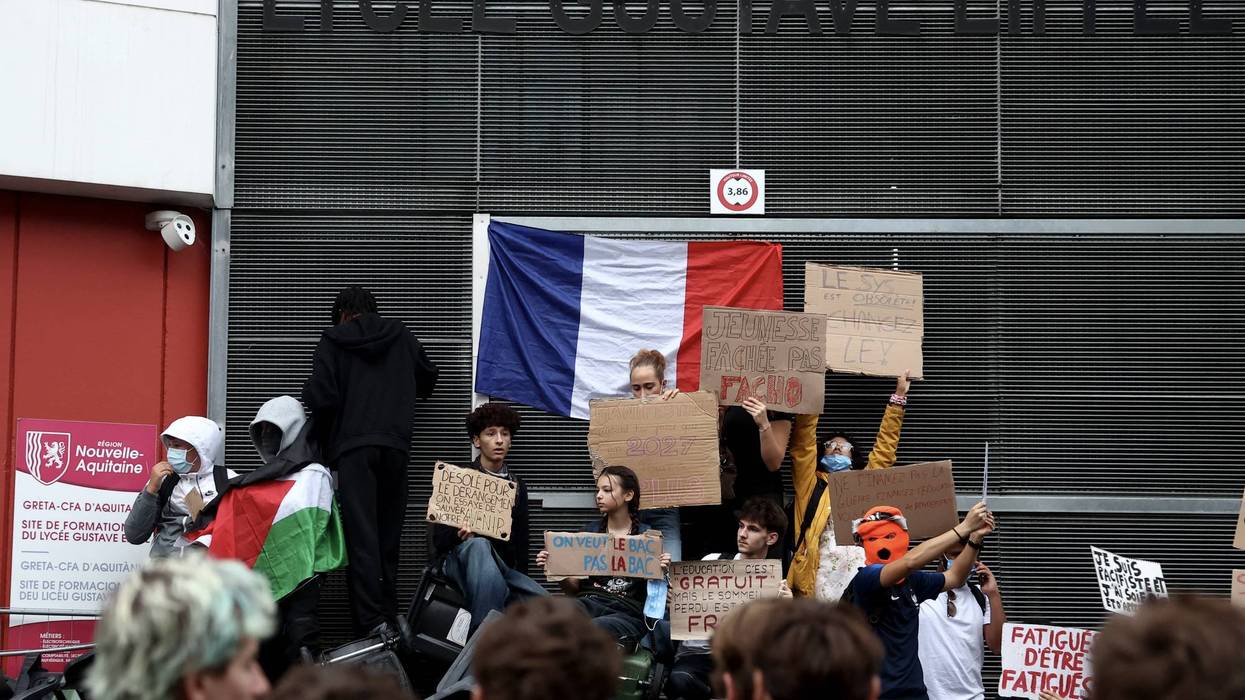
The French student movement has a long history of political activism based on organized protests and occupations not only for the improvement of their learning experience and school conditions but also against capitalism, consumerism, imperialism, and police repression.
France is presently in the throes of nationwide student protests that have turned increasingly violent as the police crack down on students, using tear gas and heavy-handed tactics as students blockade entrances to their schools and even set fire to several schools across France.
The students, aged between 15 and 18, are protesting over poor school conditions (overcrowded classrooms, crumbling infrastructure, heavy workloads, teacher shortages) and demand increased funding for schools. Thousands have been detained, mostly minors, and dozens injured, including some 50 law enforcement officers.
The high school protests begun in Aubervilliers, a low-income Paris suburb, but quickly spread nationwide, as usually happens with students protests in France. University students have now joined high school schools across France, thus creating an even more volatile situation for the French government. Incidentally, the student protests are unfolding alongside massive public-sector protests over pay and working conditions.
French students have also shown that they are always on the side of the workers’ fight for better working conditions and in their struggle for an alternative socioeconomic and political order.
France is indeed in crisis mode, economically, politically, and socially. Weak growth and deteriorating public finances have been the norm for several years now, while austerity is being advanced by the political establishment as the only available solution to the country’s economic problems and financial misery. French Prime Minister Sébastien Lecornu presented an austerity-driven government budget on October 1 that proposes 43 billion euros in new fiscal measures to reduce the deficit.
However, the budget bill is surely expected to face a rough ride as France has a deeply divided parliament that has repeatedly rejected austerity-driven budget proposals, forcing in fact several prime ministers since 2022 to step down. Lecornu’s government may very well be the next one to collapse as it is highly unlikely that either Marine Le Pen’s far-right National Rally (RN) party or Jean-Luc Mélenchon’s left-wing France Unbowed (LFI) party (which France’s Interior Ministry has actually classified as far left) will make compromises, especially in light of the fact that France’s next presidential election is scheduled for April 18 and May 2, 2027, and looks like the run-off election will be between Le Pen and Mélenchon.
In addition, France’s bond market is under growing pressure as its 10-year yield has reached the highest level since 2002. With the cost of borrowing money hitting a peak, France, which has faced sluggish growth for years, is likely to see even slower growth in 2027 than in 2026. This situation seems to be serving the far-right RN party particularly well, which has already scored a “historic victory” by securing enough seats in the recently held Senate election to establish its own caucus for the first time.
In the meantime, the student protests are being used both by Le Pen and government officials to target Jean-Luc Mélenchon’s party for allegedly deploying agitators and using rhetoric to stoke students’ anger.
There is little doubt that the concerns of French students are legitimate. Their grievances with the poor state of schools have been building since this summer’s heatwaves, which exposed “the poor state of schools, with poor insulation and no air conditioning,” according to Vincent Latour, a professor of British Studies at the University of Toulouse-II-Le Mirail. Moreover, the president of Union Syndicale Lycéenne (USL), 19-year old Ryad Rani, said that student grievances had elicited no response from the government and that the movement will continue with the protests until its demands are satisfied.
The French student movement has a long history of political activism based on organized protests and occupations not only for the improvement of their learning experience and school conditions but also against capitalism, consumerism, imperialism, and police repression. It doesn’t need outside agitators in order to mobilize and take action into its own hands and is definitely not controlled by any political party. French students have also shown that they are always on the side of the workers’ fight for better working conditions and in their struggle for an alternative socioeconomic and political order, which is precisely why the current student protests coincided with the public-sector workers strike against the government’s austerity policies. And poor school conditions are not the only reason behind the ongoing student protests. As Mael Breton, a high school student taking part in the protests said, “We want fewer police because we think there is a huge amount of police repression, both against high school student movements and social movements more generally.”
It is true that local MPs from the LFI party were quick to lend support to the protests and the blockades once they started. But those actions were not initiated by the LFI, and students outright rejected “claims that they are manipulated by radical-left politicians.” Once the protests and the blockades started, students utilized various social media platforms to articulate their grievances and make their slogans and the measures taken known to the rest of French society.
The year 1968 was one of great turmoil and unrest. We live in a different world today. But what was true for workers and students in May 68, remains true for today’s generation of French students: “The struggle continues.”
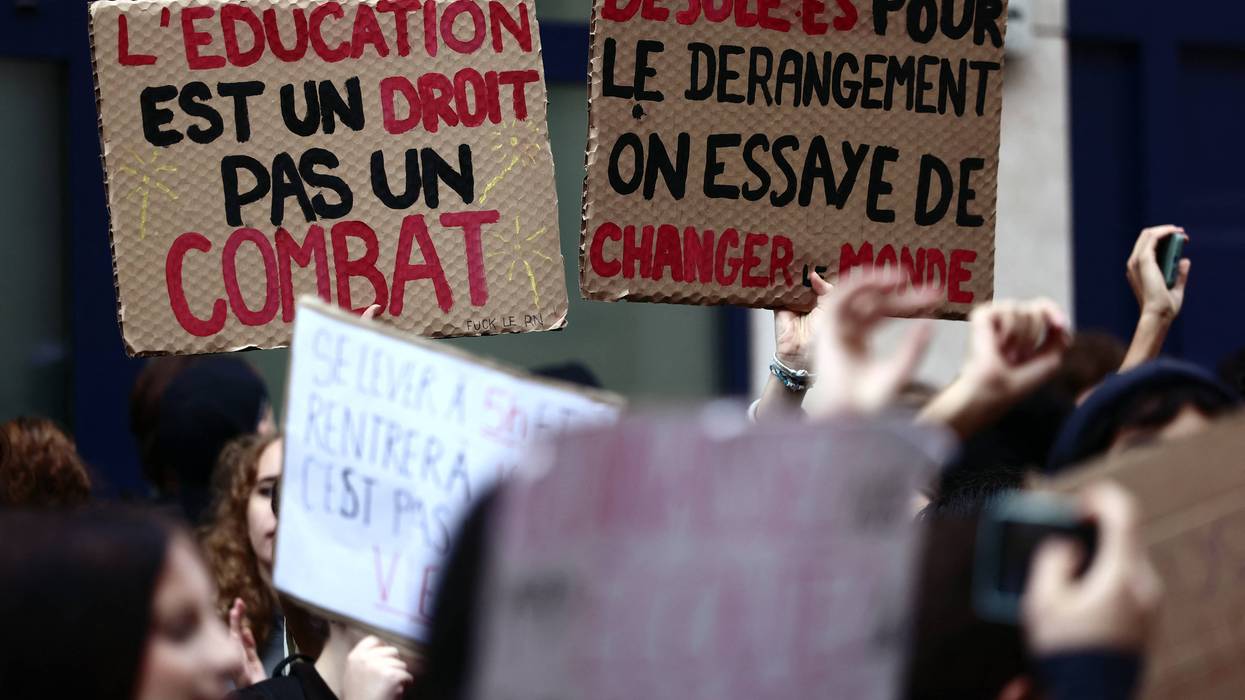
Some protests at schools have devolved into chaos in recent days, but students maintained they are peacefully demanding more support for schools.
Left-wing French political leader Jean-Luc Mélenchon said Friday that labor unions across the country were planning to strike next week alongside students who have been protesting poor school conditions and teacher shortages, as demonstrators reported unwarranted force by the police and the protests devolved into violence in parts of France.
The French justice minister said Friday that "an active and violent minority" of demonstrators has pushed widening protests against poor education funding into chaos, with fires being set at some schools, dozens of teachers an principals injured, and a police officer in northeastern France reportedly attacked by a mob.
Meanwhile, one student outside Lycée Voltaire in Paris held a sign that read, “School is a right, not a privilege," and a 17-year-old identified as Yves by The Guardian said he and his classmates were "totally pacifist" as they peacefully blocked the entrance to the school, joined by some of their teachers.
“The atmosphere on this barricade is generally very calm,” Yves said. “But there have been other people from outside school who have come past and tried to set fire to things, so we’ve tried to move the bins to stop that.”
The high school is one of many that students say have suffered from teacher shortages and neglect by the government, with students struggling to learn in classrooms packed with 40 children or more. Some protesters reported dilapidated school buildings in the European Union's second-largest economy, inequality in which a child's "social background" decides their success in school, excessively long school days that have done nothing to improve international rankings, and infrastructure that is ill-equipped for the soaring temperatures the climate emergency brought this summer.
“It was unbearable sitting exams in 35°C-40°C heat, even the teachers said those were impossible conditions," a 19-year-old student named Sofiane told The Guardian. Sofiane also expressed concerns that the government may end food assistance for low-income students.
On Thursday, the French government announced spending cuts in its 2027 budget.
“The education budget is being cut to shreds while so much extra funding is being put into the army,” a student named Sophia told The Guardian.
Justice Minister Gérald Darmanin told RTL Radio that officials are "not entirely sure" that protesters who have set fires to schools and perpetrated violence in the protests, which began last month in Paris before spreading across the country, "are even high school students themselves."
"We have gone from high school student demonstrations to a public order disturbance," said Darmanin.
Authorities said more than 560 schools were closed Friday due to the unrest, and Darmanin said police have made about 2,000 arrests of young people.
In Marseille, prosecutors said Thursday that two teachers had been assaulted by students who poured gasoline on them, but The Guardian reported Friday that the teachers had been inadvertently hit with the gasoline when a student was throwing it into a trash can.
At least two high schools in Paris were damaged by fire on Friday morning.
But Mélenchon, a presidential candidate and the leader of the left-wing party France Unbowed, suggested that demands for order from his opponent, the far-right National Rally leader Marine Le Pen, were disingenuous.
"Ms. Le Pen calls for the restoration of order," said Mélenchon. "What order is she talking about?! The daily disorder that our youth experience? Our adversaries live in a parallel reality."
Students on Friday accused police of using tear gas to disperse protests, and an investigation was being conducted into a police officer's alleged beating of a 14-year-old boy in Val d’Oise, outside Paris. The boy suffered severe injuries to his mouth and jaw. The officer also reportedly launched a rubber bullet, and the family's lawyer said the boy had thought he was "going to die."
"The government has opted for a crude and dangerous escalation," said Mélenchon on Friday.
On Thursday, one student in Saint-Denis held a sign that read, "Can we explain ourselves without being tear-gassed?"
Mélenchon said a strike in solidarity with the students by French labor unions was "taking shape for October 6, thanks to the decisive action of the trade union confederations."
"Everywhere, delegations of workers are forming to ensure the protection of young people," he said. "The government must stop playing at violence and festering. And completely revise its 'education' copy in the budget!"
"Join the October 6 demonstrations by wearing a white armband!" Mélenchon urged workers. "Step in to protect our youth!"
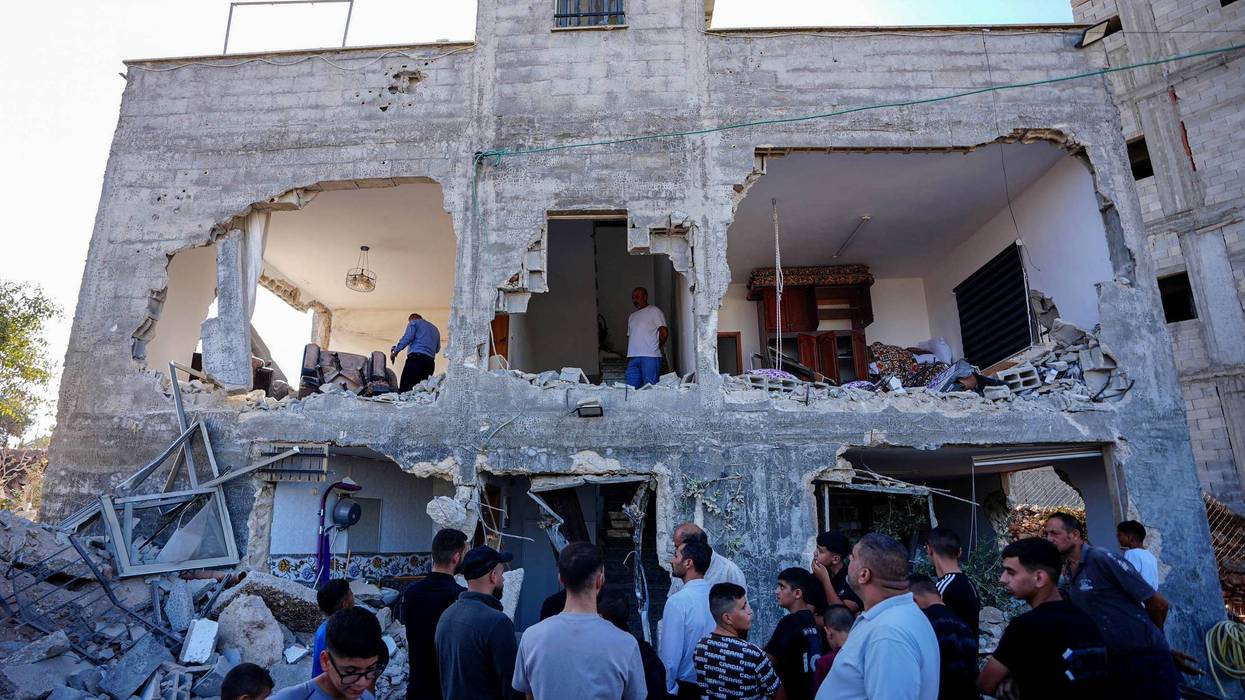
"Today, we refuse to be bystanders to further suffering and to the destruction of the two-state solution," said UK Foreign Secretary Ed Miliband.
The United Kingdom, France, and Canada joined forces on Tuesday to ban imports of goods and some services from illegal Israeli settlements in the occupied West Bank, where settlers and soldiers are assailing, displacing, and killing Palestinians at an unprecedented rate with the backing of Prime Minister Benjamin Netanyahu's government.
"Today, we refuse to be bystanders to further suffering and to the destruction of the two-state solution," Ed Miliband, the UK's foreign secretary, said in a speech to the House of Commons. Miliband pointed to the Israeli government's recent approval of construction projects that would evict Palestinian communities and "place settlements directly between East Jerusalem and the West Bank, cutting through the heart of Palestine."
"Let’s be clear what this means: the creation of a set of facts on the ground to make the two-state solution unviable," said Miliband, in what was described as the UK government's most forceful condemnation of Israeli conduct in the West Bank to date. "The British government agrees that there is ethnic cleansing of Palestinians in areas of the West Bank—perpetrated by settler terrorists. And all too often the Israeli government has turned a blind eye to this and worse, members of it have made statements and taken actions to support the forced displacement of Palestinians."
Miliband said the UK government would "take action against specific companies and individuals who provide services such as construction, infrastructure, financing, or real estate for settlement expansion" and penalize "those who finance or facilitate illegal settlements." He said the sanctions would be in place within six to nine months.
Miliband emphasized that in banning imports from Israel's West Bank settlements, the UK was not acting alone. The British foreign secretary noted that France and Canada will also "ban the import of goods from illegal settlements," joining "the Netherlands, Ireland, Belgium, Spain and Norway—which have either banned goods or are in the process of doing so."
Jean-Noël Barrot, France's foreign affairs minister, wrote on social media that France is cutting off imports from illegal Israeli settlements "because the West Bank is on the brink of explosion: unchecked expansion of colonization in violation of international law, surge in violence perpetrated by extremist settlers against Palestinians, acts of terror denounced by the Israeli authorities themselves."
"France cannot, through its trade, support a situation that threatens the security of Israelis and Palestinians alike, as well as peace and stability in the region," Barrot wrote. "Europe must uphold the same imperative."
In a joint statement on Tuesday, the foreign ministers of 12 nations—the UK, France, Canada, Denmark, Finland, Iceland, Ireland, Norway, Poland, Portugal, Spain, and Sweden—said that the situation in the West Bank is "rapidly deteriorating amid unprecedented levels of settler violence and settlement expansion, including the unacceptable decision to publish tenders for the E1 settlement project."
The foreign ministers confirmed their "intention to introduce national and/or support European restrictions on trade in goods with settlements which are illegal under international law, or that they are actively considering these and other measures, in accordance with their national procedures."
"In this regard, the UK, France, and Canada welcome the important action already taken by Ireland, Spain, the Netherlands, Norway, and Belgium, and will bring forward national measures to ban trade in settlement goods," the statement continued. "The government of Israel must immediately halt the expansion of settlements and civilian administrative powers, ensure accountability for settler violence, and investigate allegations against Israeli forces."
Advocates largely welcomed the governments' announcements while stressing that they should be the starting point for more sweeping action to confront the Israeli government's illegal annexation efforts in the West Bank and crimes against humanity across the Palestinian territories, including the decimated Gaza Strip.
"Today’s announcement is the result of many years of work by campaigners and Palestinians themselves fighting to end severe injustice," said Nick Dearden, director of the UK-based advocacy group Global Justice Now. "We know this move will be very popular in Britain. But it must be just the beginning. How can we cooperate with a military guilty of the most serious abuses of international law? How can we trade with a country that stands accused of genocide at the world’s highest court?"
Omar Barghouti, co-founder of the Boycott, Divestment, Sanctions (BDS) movement, dismissed the UK government's sanctions announcement as "largely performative," but said they also "reflect the impact of relentless public pressure on the current government."
"The UK is legally obliged to take serious measures to end its complicity with the State of Israel, not merely with the settlements, per the [International Court of Justice]," said Barghouti. "While Miliband says, 'We will not acquiesce in the destruction of the two-state solution,' he has not said how the UK will stop its active contribution to the Israeli-US led destruction of the international legal system and the drive towards a might-makes-right order."
US and Israeli officials responded furiously to the UK's sanctions announcement. Itamar Ben-Gvir, Israel's extremist national security minister, called for the closure of the British consulate in East Jerusalem, while Israel's finance minister demanded the expulsion of the British ambassador.
Mike Huckabee, the US ambassador to Israel, characterized the UK's trade ban as "discrimination against the Jewish people" and suggested that individual American states such as Florida could retaliate against the British government.
US Rep. Randy Fine (R-Fla.), a rabidly pro-Israel lawmaker and anti-Muslim bigot, wrote on social media that "Florida is one of Britain’s largest trading partners" and signaled that the state could move to boycott UK goods.
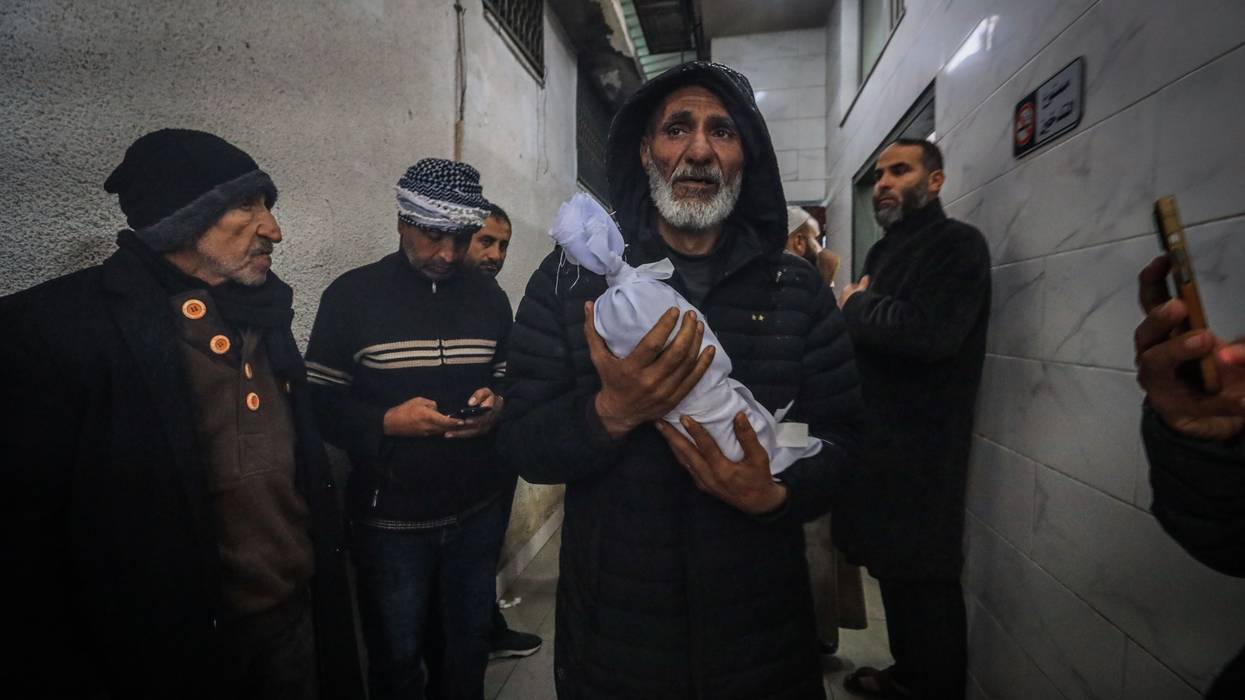
The abuses by the Israeli government and military are "a stain on the conscience of humanity, requiring the UK and France to act."
While critics of the French and British governments say they are doing too little to confront the crimes and human rights violations of Israel against the Palestinian people, about 100 former diplomats of the two nations penned an open letter published over the weekend agreeing that much stronger actions must be taken to end the atrocities taking place in both the Gaza Strip and the Occupied West Bank.
Published in Le Monde on Saturday, the joint op-ed by the former UK and French ambassadors and foreign diplomats argues that because their two nations "played a decisive role in the shaping of the Middle East," it is incumbent upon them to "make common cause over the region's fundamental faultline: equal rights for Israelis and Palestinians"—a dynamic grossly lacking as Palestinians are starved and bombed in Gaza, with their rights endlessly under assault in the West Bank.
According to the letter:
In Gaza, two million Palestinians are kettled into 30% of their devastated land, hungry, lacking medicine and housing. Over 1,200 Palestinians have been killed since the so-called "ceasefire" of October 2025. In East Jerusalem and the rest of the West Bank, Palestinian house demolitions and rampant settler violence—with the connivance of the Israeli army and police—amount to ethnic cleansing. Palestine is being erased before our eyes.
This policy of occupation and destruction extends to Lebanon—where many villages have been razed—and Syria. It is a stain on the conscience of humanity, requiring the UK and France to act.
While human rights groups have steadfastly demanded accountability for Israel—including tougher sanctions, suspension of trade agreements, a halt to weapons transfers, and enforcement of rulings by the International Court of Justice (ICJ) and proceedings at the International Criminal Court—for its ongoing criminal behavior against the Palestinians, European governments, the United States, and other Western allies have resisted such calls.
While noting that much can be done to help Palestine become "a fully functioning democratic nation," the letter from the former diplomats makes a call for seven specific actions designed to end Israeli impunity and bring the government back into compliance with international law. The policy recommendations directed at the UK and French governments are:
Nicholas Hopton, a former UK ambassador to Iran, Qatar and Yemen and one of the letter's signatories, said the language they used was not invented by the diplomats themselves.
“The words are not our own,” Hopton explained to Al Jazeera. “They are taken from the international legal bodies, the UN, those who have been observing from a neutral position and with expertise.”
What's key to understand, said Peter Millett, a former British ambassador to Libya who also signed the letter, is that what the signatories are asking for "is action, not words."
Foreign ministers of the France and Britia "over the last few months and years have issued statements of criticism, of condemnation and so forth," Millett told Al-Jazeera, "but as the letter makes clear, this is the time now where we need to see action on trade, action on settlements, more support for aid to go into Gaza, and the ending of the arms trade.”
At the heart of the letter is the idea that world leaders, whether in Europe or elsewhere, must now act aggressively to bring the suffering of the Palestinians to an end and bring Israel's violations and abuses to a halt.
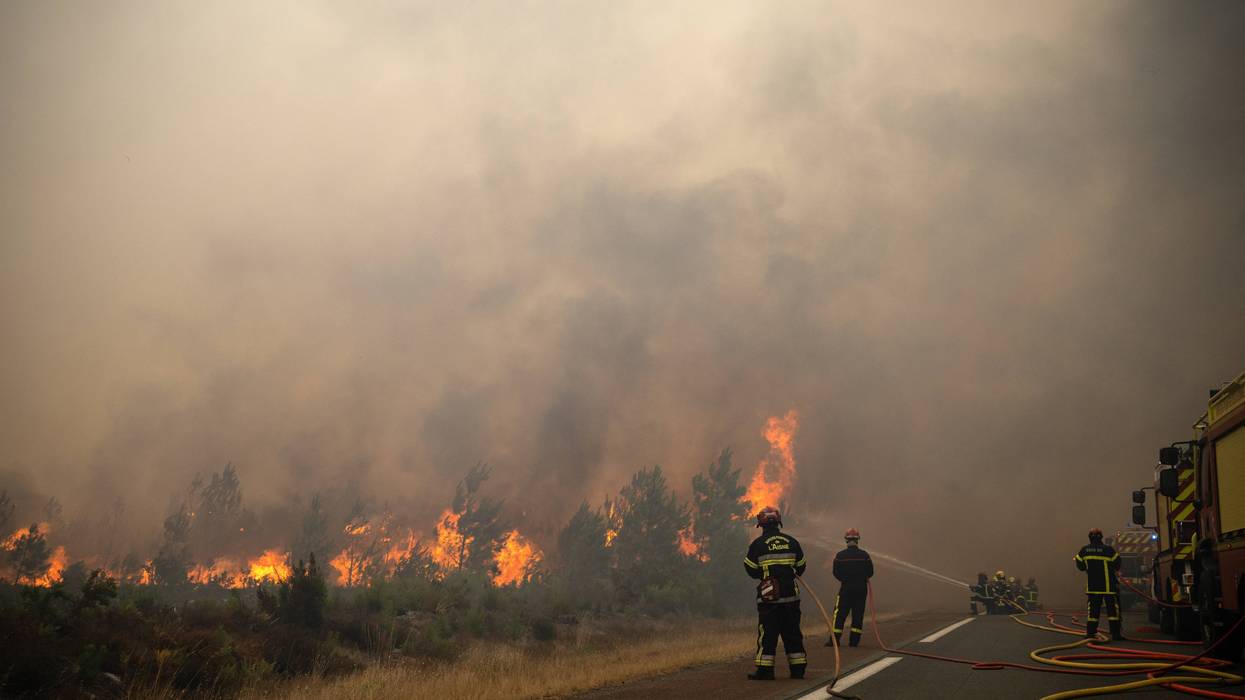
“It is the most painful manifestation of a climate emergency that is making… wildfires more voracious and heatwaves more frequent, and as a result our land more vulnerable," said Spanish Prime Minister Pedro Sánchez.
More than 300,000 people have been displaced as historic wildfires tear across France and Spain, presaging what some have called a climate-fueled "crisis of habitability" across Europe, which is heating faster than anywhere else on the globe.
Record heat and drought have fueled multiple record wildfires around the French wine-growing region of Bordeaux and in central Spain near Madrid. As the region expects to see temperatures above 95°F later this week, firefighters are racing to quell the blaze as it grows out of control.
Across the two countries, at least one person has been killed, and more than 100 have been sickened or injured. In France, 80 firefighters have been injured.
About 448 square miles of terrain have been scorched across France since the beginning of 2026, the highest annual total in modern history, even though it's only July.
The fires in France have grown so powerful and unwieldy that they've formed what the National Firefighters Federation of France described as a “pyrocumulonimbus”—an unprecedented fire-generated thunderstorm cloud that generates its own wind and lightning, which spreads the flames across the landscape.
In Spain, fires around Ávila burned about 193 square miles in five days—an area roughly five times the size of Barcelona—making it the largest wildfire in the nation's history. Civil protection chief Virginia Barcones said her country was facing a "monster."
Extreme wildfires are becoming more common around the world as global temperatures increase. Across Europe, where temperatures have soared twice as fast as the global average, the pattern has been even more intense.
Last year was the worst fire year on record in the European Union, with nearly 4,170 square miles of land burned—almost double the annual average from 2006-24.
Speaking at a climate conference, Spanish Prime Minister Pedro Sánchez emphasized that the fires should not be viewed as isolated incidents.
“It is the most painful manifestation of a climate emergency that is making… wildfires more voracious and heatwaves more frequent, and as a result our land more vulnerable,” Sánchez said. “It is no longer an exception. It is the rule.”
In an op-ed for Le Monde, philosopher Cynthia Fleury and the Socialist mayor of Saint-Médard-en-Jalles in southwestern France, Stéphane Delpeyrat-Vincent, wrote that where previous fires and heatwaves have posed threats to individuals, "the 2026 heatwave has been something else entirely."
"No longer are only individuals at risk, but entire regions," they wrote. "Extreme heat now goes hand in hand with megafires, the destruction of whole landscapes, the collapse of environments and the evacuation of entire towns. The health crisis has become a crisis of habitability."
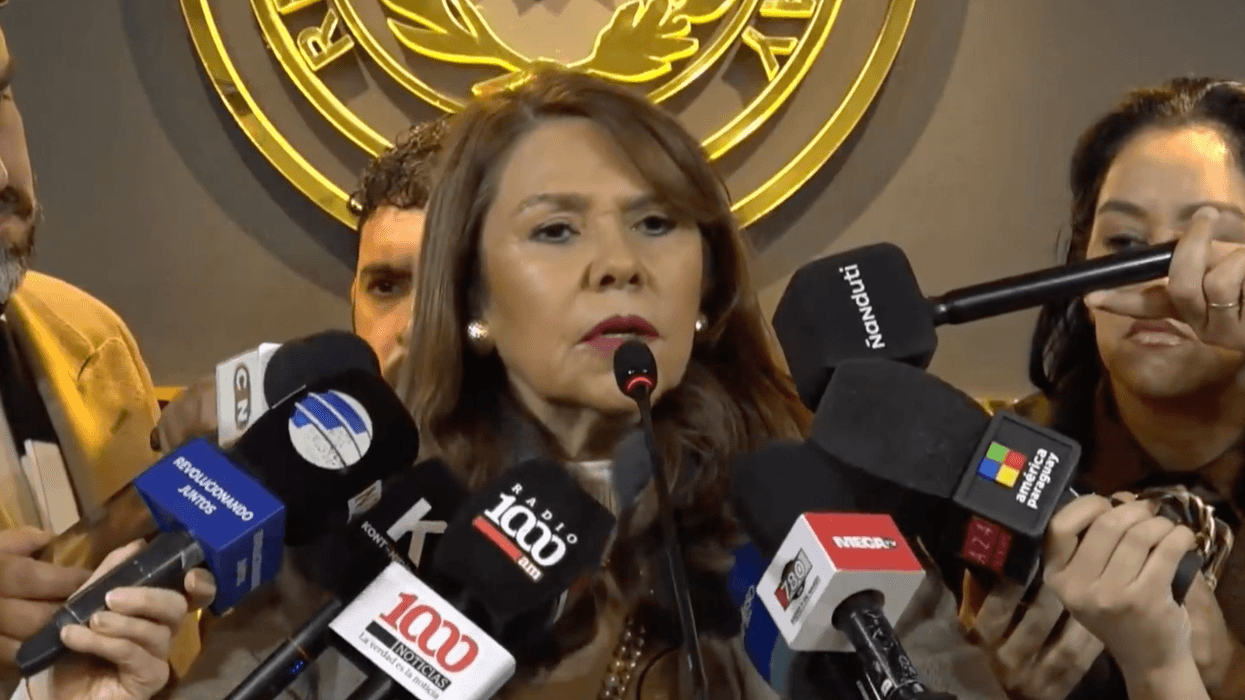
"I will not apologize," said 62-year-old Sen. Celeste Amarilla. "I come from a generation when gays were beaten up and calling someone a little Black shit was common."
A Paraguayan senator on Tuesday partially retracted her racist rant against French soccer superstar Kylian Mbappé but refused to apologize as French prosecutors weigh hate crime charges and officials in both countries condemned her remarks.
Prosecutors in Paris are considering charges of incitement to hatred or violence, or aggravated public insult, against right-wing Paraguayan opposition Sen. Celeste Amarilla, after the French Football Federation filed a complaint calling the "racist remarks" of the lawmaker "totally abject and unacceptable."
France eliminated Paraguay from the FIFA World Cup on Saturday, beating the South American side 1-0 in the Round of 16 match in Philadelphia, with Mbappé scoring a game-winning penalty kick in the 70th minute.
Following the unusually physical match—some observers accused Paraguay of being sore losers and playing dirty—Mbappé refused to shake Paraguayan goalkeeper Orlando Gill's hand.
An incensed Amarilla then took to X to call Mbappé a "colonized Cameroonian, pretending hard to be French, resentful, newly rich, arrogant, and ugly."
In a second post, the senator said Mbappé "didn't even learn to write; instead of mother's milk, he suckled on coconuts, and the most educated things he heard were the chimpanzees."
Mbappé was born in Paris and grew up just outside the French capital in Bondy.
Amarilla also cheered racist posts by other X users and asked "permission" to use one comment asking, "What kind of 'dark' thing can you ask someone who ran from lions so as not to be eaten?"
While many Paraguayans rushed to Amarilla's defense in the name of their national, sporting, and even racial honor, the country's Foreign Ministry released a statement saying the nation's government "deplores and rejects" her remarks, which it said are "contrary to the values and principles that inspire peaceful coexistence and respect for the human dignity that our country promotes."
Paraguayan Vice President Pedro Alliana also weighed in, asserting Monday that "football is an expression of fraternity" that "should unite people," and "there is no room for any type of discrimination" in the sport.
Mbappé responded directly to Amarilla on social media, saying, "You are a despicable woman and unworthy of your position."
"You do not represent Paraguay, that country which has sweated passion and honor throughout the competition," the French captain and Real Madrid superstar wrote. "Through your recklessness and your brazen racism, the entire world has already forgotten the journey and the historic effort that your players accomplished during this World Cup, making way for an incompetent woman who gives the worst possible image of her country."
French President Emmanuel Macron posted on social media: "Another goal for Kylian Mbappé. Against racism this time. All my support. When words defile, our values respond—dignity, respect, fraternity."
Amarilla subsequently posted a screed attacking what she called Mbappé's "arrogance" and "contempt."
"My posts were written in the heat of the moment," she claimed. "That mixed-race blood—a beautiful blend of Indigenous and Spanish blood flowing through my veins—was boiling while you mocked those great Paraguayan players who fought as equals until the very end of the match, and that's why I wrote those messages."
During Amarilla's youth, Paraguay committed genocide against the Aché, Ayoreo, Guaraní, and other Indigenous peoples under the US-backed dictatorship of Gen. Alfredo Stroessner.
"Soon afterward, however, I regretted responding with the same insults that I myself receive," Amarilla continued in a conciliatory twist. "I, too am looked down upon for being brown-skinned and Latina; they call us 'sudacas.' I regretted it and deleted the post. I realized I was repeating patterns that I hate. I understand that it may have hurt you, because it is humiliating."
"Now I demand that you also retract your words and apologize to me," she added.
Speaking at a Tuesday morning press conference, Amarilla again defended her actions, which she said were rooted in her Generation X upbringing, declaring, "I will not apologize."
🗣️ Celeste Amarilla: “I come from a generation where calling someone a “little Black sh*t” was common.
Watch out for Paraguayans. We put Dinho behind bars for corruption.
Don't underestimate me, I can file charges against you.”
She’s disgusting, bro. 🤮 pic.twitter.com/yAw55G0hSP
— 10 (@Kylian) July 7, 2026
"I'm nearly 62 years old and grew up in a society where gays were beaten and where calling someone a little Black shit was the most common thing," the senator said. "I come from that generation, so now I'm trying to build a different Celeste Amarilla, that's capable of co-existing with others."
"Have patience," she added. "I'm trying."