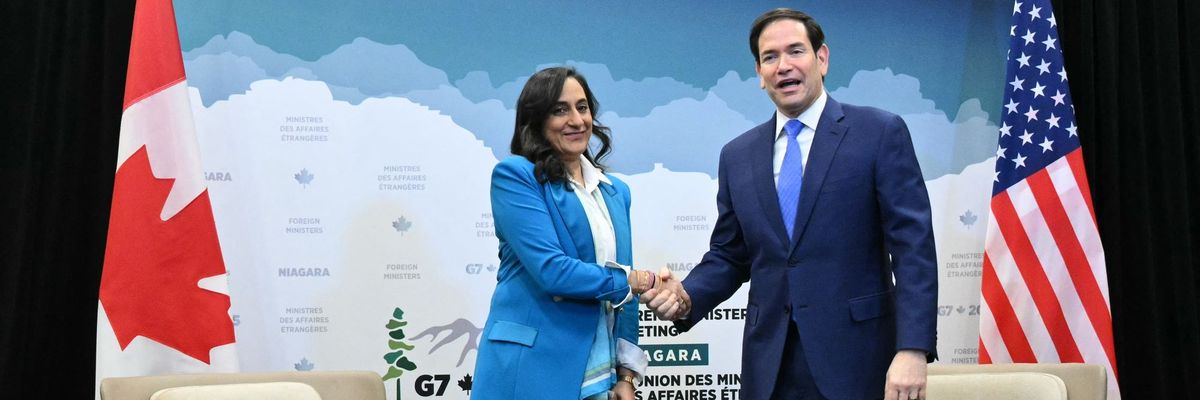
US Secretary of State Marco Rubio and Canadian Foreign Minister Anita Anand shake hands following talks at the G7 foreign ministers meeting on November 12, 2025.
(Photo by Mandel Ngan/Pool/AFP via Getty Images)
Rights Group Warns US Allies Against Complicity in 'Criminal' Trump Boat Bombings
"The UK, Canada, and other allied nations who partner with the United States on counternarcotics efforts have ample evidence that the US is unlawfully killing people at sea," said Human Rights Watch.
Dec 09, 2025
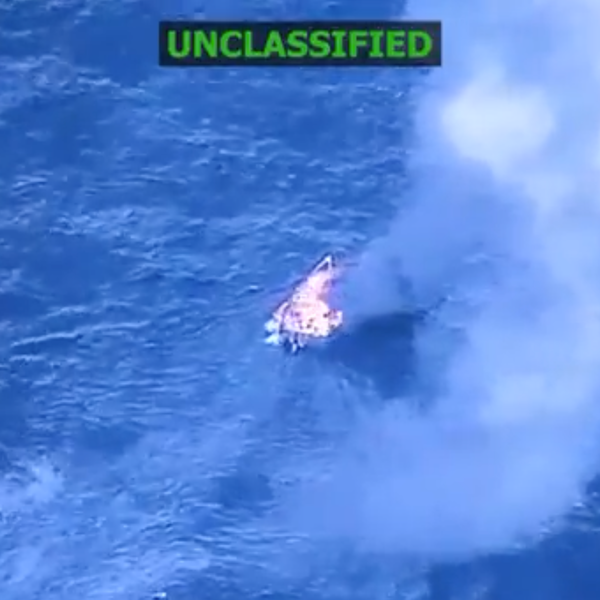
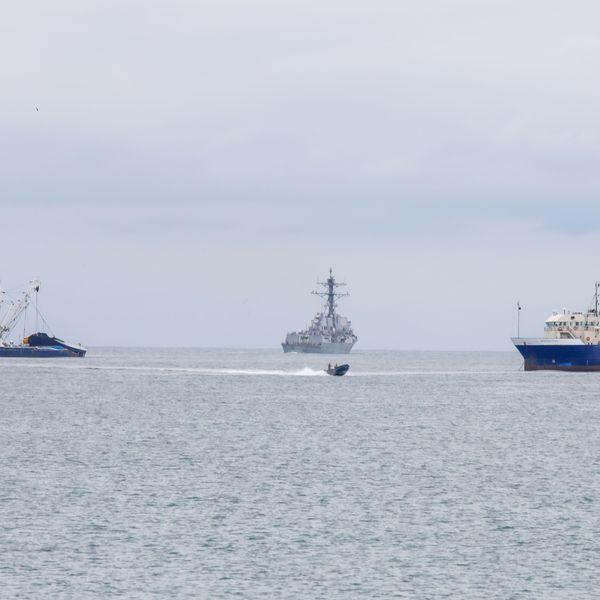
A leading human rights organization on Tuesday pushed allies of the United States to more forcefully condemn and take steps to stop President Donald Trump's deadly boat strikes in international waters, attacks that experts have characterized as extrajudicial killings.
"The UK, Canada, and other allied nations who partner with the United States on counternarcotics efforts have ample evidence that the US is unlawfully killing people at sea,” Sarah Yager, Washington director at Human Rights Watch (HRW), said in a statement. “The rules-based international order depends on countries speaking out against violations, even when they’re committed by powerful friends.”
HRW specifically urged countries at risk of complicity to closely examine their maritime cooperation and intelligence-sharing with the Trump administration, which claims—without evidence—that every vessel targeted was involved in drug smuggling operations that posed a threat to the US.
"The UK, France, and the Kingdom of the Netherlands have significant influence in the Caribbean due to their overseas territories in the region," the group said. "All three governments are also participants in Campaign Martillo, a multinational counternarcotics detection, monitoring, and interdiction operation that includes US Navy and Coast Guard vessels, along with military and law enforcement units from a dozen other nations, including Canada."
"Australia and New Zealand, which are part of the 'Five Eyes' intelligence sharing community with the United States, UK, and Canada where the governments share all signals and geospatial intelligence by default, may also find themselves implicated in the strikes and should take steps to evaluate their own risks," HRW added.
While officials from the nations named by HRW have criticized and distanced themselves from the Trump administration's strikes, their comments have largely been vague and tepid—especially when compared to the responses of some South American leaders. Australian Foreign Minister Penny Wong, for instance, said her country "is not involved in these US actions" and that "it is for the United States to articulate the legal basis of its actions."
HRW also pointed to Canadian Foreign Minister Anita Anand's statement that “the United States has made clear that it is using its own intelligence” to target the vessels in international waters.
"It is not sufficient to accept the US government’s assurances that it is not leveraging shared intelligence for its unlawful strikes," said HRW. "In contrast, when asked directly about the legality of the strikes, [Ahmed] declined to address the matter, saying instead that 'it is within the purview of US authorities to make that determination.'"
Last month, the UK reportedly suspended some intelligence sharing with the US due to the boat strikes. But US Secretary of State Marco Rubio called the CNN reporting a "fake story," and the UK's foreign secretary cited Rubio's comment when asked about the report.
HRW said major US allies "should make public any internal legal assessments as to whether the US strikes are violating international law, use their bilateral relationships to raise concerns directly with US officials, and push for individual criminal accountability for those responsible."
An Urgent Message From Our Co-Founder
Dear Common Dreams reader, The U.S. is on a fast track to authoritarianism like nothing I've ever seen. Meanwhile, corporate news outlets are utterly capitulating to Trump, twisting their coverage to avoid drawing his ire while lining up to stuff cash in his pockets. That's why I believe that Common Dreams is doing the best and most consequential reporting that we've ever done. Our small but mighty team is a progressive reporting powerhouse, covering the news every day that the corporate media never will. Our mission has always been simple: To inform. To inspire. And to ignite change for the common good. Now here's the key piece that I want all our readers to understand: None of this would be possible without your financial support. That's not just some fundraising cliche. It's the absolute and literal truth. We don't accept corporate advertising and never will. We don't have a paywall because we don't think people should be blocked from critical news based on their ability to pay. Everything we do is funded by the donations of readers like you. Will you donate now to help power the nonprofit, independent reporting of Common Dreams? Thank you for being a vital member of our community. Together, we can keep independent journalism alive when it’s needed most. - Craig Brown, Co-founder |
Our work is licensed under Creative Commons (CC BY-NC-ND 3.0). Feel free to republish and share widely.
A leading human rights organization on Tuesday pushed allies of the United States to more forcefully condemn and take steps to stop President Donald Trump's deadly boat strikes in international waters, attacks that experts have characterized as extrajudicial killings.
"The UK, Canada, and other allied nations who partner with the United States on counternarcotics efforts have ample evidence that the US is unlawfully killing people at sea,” Sarah Yager, Washington director at Human Rights Watch (HRW), said in a statement. “The rules-based international order depends on countries speaking out against violations, even when they’re committed by powerful friends.”
HRW specifically urged countries at risk of complicity to closely examine their maritime cooperation and intelligence-sharing with the Trump administration, which claims—without evidence—that every vessel targeted was involved in drug smuggling operations that posed a threat to the US.
"The UK, France, and the Kingdom of the Netherlands have significant influence in the Caribbean due to their overseas territories in the region," the group said. "All three governments are also participants in Campaign Martillo, a multinational counternarcotics detection, monitoring, and interdiction operation that includes US Navy and Coast Guard vessels, along with military and law enforcement units from a dozen other nations, including Canada."
"Australia and New Zealand, which are part of the 'Five Eyes' intelligence sharing community with the United States, UK, and Canada where the governments share all signals and geospatial intelligence by default, may also find themselves implicated in the strikes and should take steps to evaluate their own risks," HRW added.
While officials from the nations named by HRW have criticized and distanced themselves from the Trump administration's strikes, their comments have largely been vague and tepid—especially when compared to the responses of some South American leaders. Australian Foreign Minister Penny Wong, for instance, said her country "is not involved in these US actions" and that "it is for the United States to articulate the legal basis of its actions."
HRW also pointed to Canadian Foreign Minister Anita Anand's statement that “the United States has made clear that it is using its own intelligence” to target the vessels in international waters.
"It is not sufficient to accept the US government’s assurances that it is not leveraging shared intelligence for its unlawful strikes," said HRW. "In contrast, when asked directly about the legality of the strikes, [Ahmed] declined to address the matter, saying instead that 'it is within the purview of US authorities to make that determination.'"
Last month, the UK reportedly suspended some intelligence sharing with the US due to the boat strikes. But US Secretary of State Marco Rubio called the CNN reporting a "fake story," and the UK's foreign secretary cited Rubio's comment when asked about the report.
HRW said major US allies "should make public any internal legal assessments as to whether the US strikes are violating international law, use their bilateral relationships to raise concerns directly with US officials, and push for individual criminal accountability for those responsible."
A leading human rights organization on Tuesday pushed allies of the United States to more forcefully condemn and take steps to stop President Donald Trump's deadly boat strikes in international waters, attacks that experts have characterized as extrajudicial killings.
"The UK, Canada, and other allied nations who partner with the United States on counternarcotics efforts have ample evidence that the US is unlawfully killing people at sea,” Sarah Yager, Washington director at Human Rights Watch (HRW), said in a statement. “The rules-based international order depends on countries speaking out against violations, even when they’re committed by powerful friends.”
HRW specifically urged countries at risk of complicity to closely examine their maritime cooperation and intelligence-sharing with the Trump administration, which claims—without evidence—that every vessel targeted was involved in drug smuggling operations that posed a threat to the US.
"The UK, France, and the Kingdom of the Netherlands have significant influence in the Caribbean due to their overseas territories in the region," the group said. "All three governments are also participants in Campaign Martillo, a multinational counternarcotics detection, monitoring, and interdiction operation that includes US Navy and Coast Guard vessels, along with military and law enforcement units from a dozen other nations, including Canada."
"Australia and New Zealand, which are part of the 'Five Eyes' intelligence sharing community with the United States, UK, and Canada where the governments share all signals and geospatial intelligence by default, may also find themselves implicated in the strikes and should take steps to evaluate their own risks," HRW added.
While officials from the nations named by HRW have criticized and distanced themselves from the Trump administration's strikes, their comments have largely been vague and tepid—especially when compared to the responses of some South American leaders. Australian Foreign Minister Penny Wong, for instance, said her country "is not involved in these US actions" and that "it is for the United States to articulate the legal basis of its actions."
HRW also pointed to Canadian Foreign Minister Anita Anand's statement that “the United States has made clear that it is using its own intelligence” to target the vessels in international waters.
"It is not sufficient to accept the US government’s assurances that it is not leveraging shared intelligence for its unlawful strikes," said HRW. "In contrast, when asked directly about the legality of the strikes, [Ahmed] declined to address the matter, saying instead that 'it is within the purview of US authorities to make that determination.'"
Last month, the UK reportedly suspended some intelligence sharing with the US due to the boat strikes. But US Secretary of State Marco Rubio called the CNN reporting a "fake story," and the UK's foreign secretary cited Rubio's comment when asked about the report.
HRW said major US allies "should make public any internal legal assessments as to whether the US strikes are violating international law, use their bilateral relationships to raise concerns directly with US officials, and push for individual criminal accountability for those responsible."
We've had enough. The 1% own and operate the corporate media. They are doing everything they can to defend the status quo, squash dissent and protect the wealthy and the powerful. The Common Dreams media model is different. We cover the news that matters to the 99%. Our mission? To inform. To inspire. To ignite change for the common good. How? Nonprofit. Independent. Reader-supported. Free to read. Free to republish. Free to share. With no advertising. No paywalls. No selling of your data. Thousands of small donations fund our newsroom and allow us to continue publishing. Can you chip in? We can't do it without you. Thank you.