Breaking News & Views for the Progressive Community
We Can't Do It Without You!  
     
Home | About Us | Donate | Signup | Archives | Search
   
 
   Featured Views  
 

Printer Friendly Version E-Mail This Article
 
 
A Test of Moral Conscience
Published on Sunday, November 30, 2003 by the Long Island, NY Newsday
A Test of Moral Conscience
Does the Suffering Around the Globe Matter to the Top Dogs?
by Jeffrey Alexander and Ron Eyerman
 
When we turn on the evening news or glance at the front page of our daily newspaper, we are confronted with a seemingly endless outpouring of "bad news": words and pictures of defenseless people dying in civil war, communities torn apart in ethnic strife, massive poverty and ill health in nations and regions of the world we know little about. It is natural to ask, "Isn't there any good news?"

But that isn't the only question that might occur. In this thanksgiving season, we can think of these reports on the world's suffering as not simply "news," but tests of our moral conscience, posing moral dilemmas: Are these suffering people part of our world? Does their suffering matter to us?

While television has made it virtually impossible to remain ignorant of the suffering of distant others, it has not guaranteed a corresponding expansion of a sense of responsibility to alleviate it. Seeing is not enough. These problems require compassion and, even more, a sense of moral obligation to address the suffering of strangers.

We know that globalization - the spread of Western economic, political and social practices to all corners of the world - while vital for overcoming desperation and disease is, paradoxically, also a cause of much poverty and inequality, which means it is also an important factor in the spread of global terrorism. Ending the suffering will depend on massive structural economic changes and redistribution of wealth. The possibility for making such reforms, however, depends on another kind of change: Only when the privileged can put themselves in the place of others who are less fortunate, when they achieve moral empathy, can reforms be made.

How do we achieve this?

First, it helps to be aware of how we use language to code the qualities of character that qualify and disqualify individuals and groups for full inclusion in the civil community: rational/irrational, autonomous/dependent, honest/dishonest, open/secretive, cooperative/aggressive. We cannot have moral empathy for others we perceive as morally incompetent, irrational, dishonest, secretive, aggressive and dependent on authority. In such cases, their fate appears natural and morally justified.

But we know that, by representing themselves in terms of the positive attributes, excluded groups can gain empathy among better off people who might come to their aid. Over time the excluded can achieve enough legitimacy in the public sphere to stage social protests that will be taken seriously and lead eventually to reforms. Subordination and inclusion are not static structural conditions; they can be negotiated.

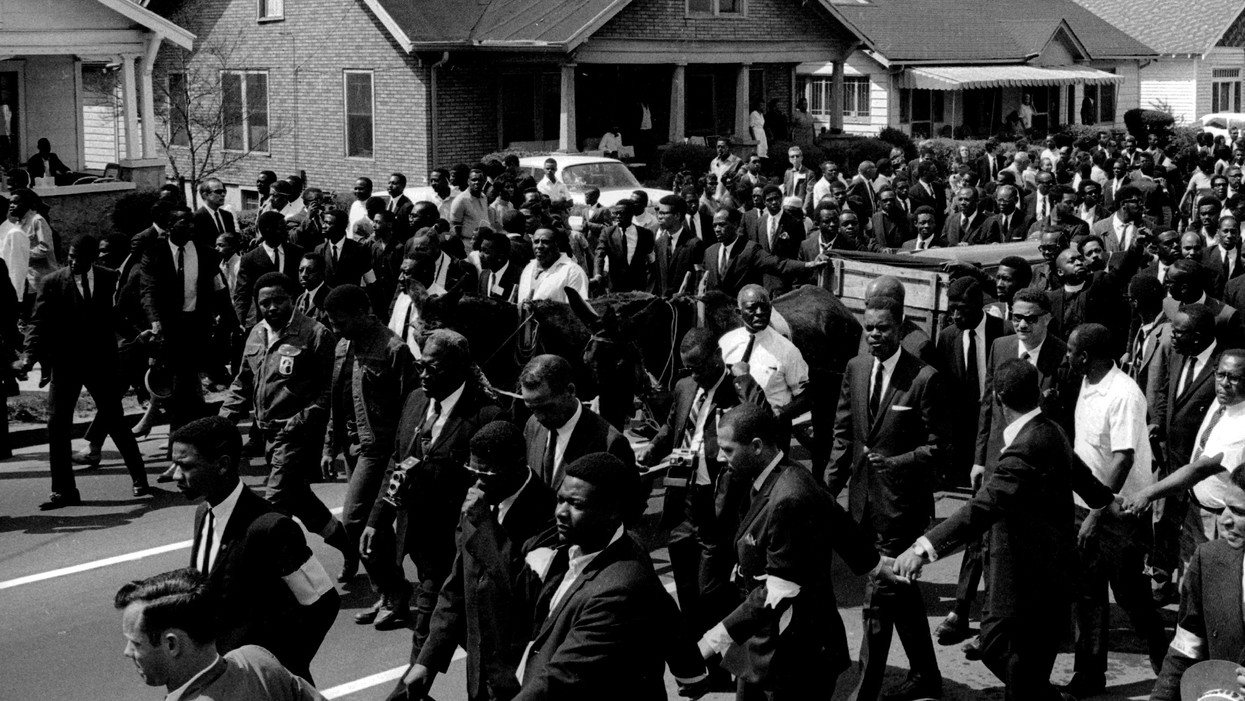
Social movements in the United States, such as environmentalism, the civil rights movement of the 1950s and '60s and the women's movements stretching back to the turn of the previous century, are central examples of this process.

One powerful image from the early days of the civil rights movement, for example, is that of a black American carrying a placard inscribed with the phrase "I AM A MAN." Convincing the rest of American society of this fact, changing the ascribed stereotype and thus opening the possibility of empathetic understanding was the first major accomplishment of that movement. It was central to helping the movement advance by encouraging sympathetic understanding and appealing to people's innate sense that social differences do not justify the different treatment of human beings.

On an evolving scale of recognition, ground zero is ignorance, antagonism or lack of interest in the excluded group. It is followed by moral awakening and learning, which can eventually become enthusiastic sympathy for the other. Objectification is displaced by broadening waves of humanization, which arrive with specific, remediable targets in mind.

Understanding this process allows us to refocus and reframe some of the central global dynamics of the last century. Anti-colonial movements and other global mobilizations of social protest can be viewed as communicative processes aimed at generating feelings of regret, empathy and humanization among Western audiences. Insofar as they succeeded, influential elites and the masses moved from ignorance, antagonism or lack of interest to compassion for the suffering of their non-Western "victims," supporting social struggles against their own governments, and demanding disengagement and even reparations.

Gandhi "performed" anti-colonialism not only to amass organizational power among Indians at home, but to persuade audiences in the British homeland. Algerians struggled against French colonialism not only militarily but by engaging the hearts and minds of Parisian intellectuals, artists and political leaders. The northern and southern Vietnamese pushed American forces out of Vietnam not simply by virtue of their military prowess but by projecting the trauma of Vietnam into American living rooms. The anti-apartheid struggle inside and outside South Africa can be viewed in a similar way.

The women's movement provides a contemporary example. Early struggles concerned equal rights for women internationally, something that involved changing perceptions of women from overly emotional, irrational creatures incapable of participating in civil society. Women had to be viewed as having the same capacity for rational decision-making as men. While this battle has for the most part been won in democratic countries, the struggle continues in other places, with the active support of women in those democratic countries, acting out of moral empathy.

Fortunately for those interested in solving suffering in the shorter rather than the longer run, the idea of global solidarity is not connected to a specific political theory, but rather to the ability and aspiration to view the world as one place and to see all humanity as linked. It is similar to the ideas of environmentalists, who view the human and natural environments as intimately united on a global scale.

In the 21st century, a renovation of sense and sensibility, a restructuring of the moral imagination along global lines is absolutely essential to ensuring a positive and progressive outcome to globalization.

We might take a cue from the social movements of the 1960s, '70s and '80s, which successfully constructed social and environmental problems as problems without borders. American environmentalists, for example, linked with distant aggrieved groups and populations in Vietnam, Biafra and other places, as they highlighted the global structural inequalities between the first and third worlds. They did this not only by confronting powerful opponents representing opposing interests, but by providing new ways of seeing and feeling that represented those distant aggrieved groups as "just like us," part of the same human community.

This will not be an easy task, but it is an essential one. It is not possible to wish progressive social movements and new ways of viewing the suffering of others into existence. It has become a political truism that all politics is local, that we must begin digging where we stand, and this is certainly correct. At the same time, strong political leadership that emphasizes empathy over confrontation and solidarity over self-righteousness is essential to setting things in motion at home and abroad. This is not the direction of the current administration in Washington, but change must start somewhere. Self-reflection at Thanksgiving may be just the necessary catalyst. If not now, when?

Jeffrey Alexander and Ron Eyerman are co-directors of the Center for Cultural Sociology at Yale University.

Copyright © 2003, Newsday, Inc.

###

Printer Friendly Version E-Mail This Article


CommonDreams.org is an Internet-based progressive news and grassroots activism organization, founded in 1997.
We are a nonprofit, progressive, independent and nonpartisan organization.

Home | About Us | Donate | Signup | Archives | Search

To inform. To inspire. To ignite change for the common good.

© Copyrighted 1997-2009